

With the onset of modern fish management that took place during the period
1960–2000, the most significant factors explaining trout distribution were related to
management practices (Miró and Ventura 2013). However, different factors were
important for the different species. For S. trutta, the probability of occurrence was
highest in areas where fish were stocked by helicopter, and in fish-managed areas.
The repeated use of helicopter stocking in recent decades has resulted in an extensive
occurrence of trout in these areas and, as a result, in more than half of the lakes with
fish. This result is similar to that found in other parts of the world where helicopters
and aeroplanes have been used for stocking trout, such as several mountain areas of
West USA, where trout is present in ca. 60% of lakes (Bahls 1992).
In contrast to S. trutta, S. fontinalis was preferentially found in lakes with forestry
road access, while O. mykiss was also found in lakes with road access but where
active fish management has been carried out. These two last species are present in a
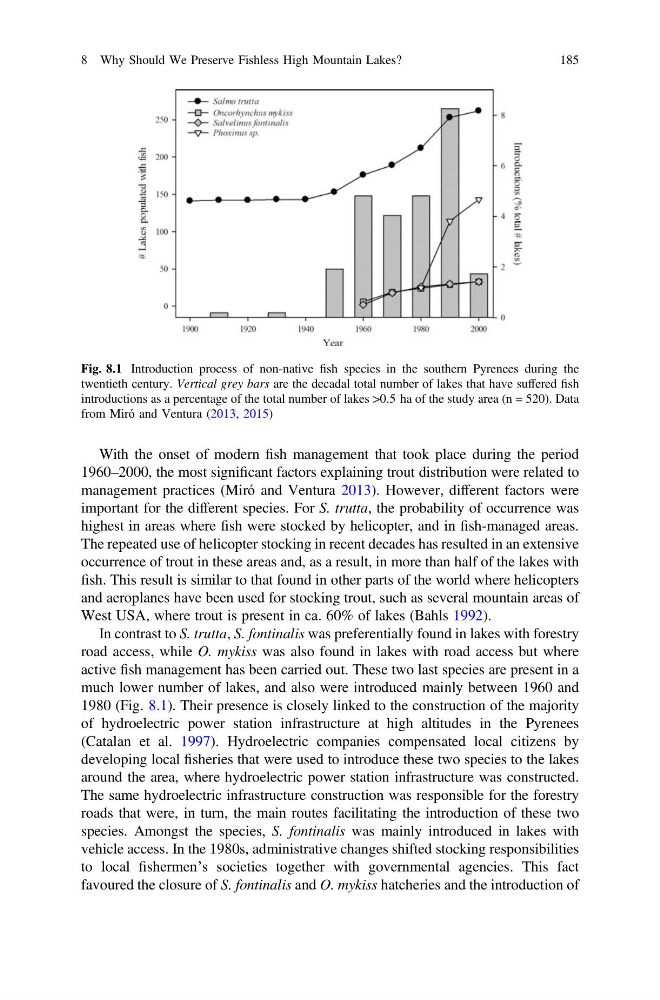
much lower number of lakes, and also were introduced mainly between 1960 and
1980 (Fig. 8.1). Their presence is closely linked to the construction of the majority
of hydroelectric power station infrastructure at high altitudes in the Pyrenees
(Catalan et al. 1997). Hydroelectric companies compensated local citizens by
developing local fisheries that were used to introduce these two species to the lakes
around the area, where hydroelectric power station infrastructure was constructed.
The same hydroelectric infrastructure construction was responsible for the forestry
roads that were, in turn, the main routes facilitating the introduction of these two
species. Amongst the species, S. fontinalis was mainly introduced in lakes with
vehicle access. In the 1980s, administrative changes shifted stocking responsibilities
to local fishermen’s societies together with governmental agencies. This fact
favoured the closure of S. fontinalis and O. mykiss hatcheries and the introduction of
Fig. 8.1 Introduction process of non-native fish species in the southern Pyrenees during the
twentieth century. Vertical grey bars are the decadal total number of lakes that have suffered fish
introductions as a percentage of the total number of lakes >0.5 ha of the study area (n = 520). Data
from Miró and Ventura (2013, 2015)
8 Why Should We Preserve Fishless High Mountain Lakes?
185
1960–2000, the most significant factors explaining trout distribution were related to
management practices (Miró and Ventura 2013). However, different factors were
important for the different species. For S. trutta, the probability of occurrence was
highest in areas where fish were stocked by helicopter, and in fish-managed areas.
The repeated use of helicopter stocking in recent decades has resulted in an extensive
occurrence of trout in these areas and, as a result, in more than half of the lakes with
fish. This result is similar to that found in other parts of the world where helicopters
and aeroplanes have been used for stocking trout, such as several mountain areas of
West USA, where trout is present in ca. 60% of lakes (Bahls 1992).
In contrast to S. trutta, S. fontinalis was preferentially found in lakes with forestry
road access, while O. mykiss was also found in lakes with road access but where
active fish management has been carried out. These two last species are present in a
much lower number of lakes, and also were introduced mainly between 1960 and
1980 (Fig. 8.1). Their presence is closely linked to the construction of the majority
of hydroelectric power station infrastructure at high altitudes in the Pyrenees
(Catalan et al. 1997). Hydroelectric companies compensated local citizens by
developing local fisheries that were used to introduce these two species to the lakes
around the area, where hydroelectric power station infrastructure was constructed.
The same hydroelectric infrastructure construction was responsible for the forestry
roads that were, in turn, the main routes facilitating the introduction of these two
species. Amongst the species, S. fontinalis was mainly introduced in lakes with
vehicle access. In the 1980s, administrative changes shifted stocking responsibilities
to local fishermen’s societies together with governmental agencies. This fact
favoured the closure of S. fontinalis and O. mykiss hatcheries and the introduction of
Fig. 8.1 Introduction process of non-native fish species in the southern Pyrenees during the
twentieth century. Vertical grey bars are the decadal total number of lakes that have suffered fish
introductions as a percentage of the total number of lakes >0.5 ha of the study area (n = 520). Data
from Miró and Ventura (2013, 2015)
8 Why Should We Preserve Fishless High Mountain Lakes?
185