

of what should be the most operative and predictive unit to measure biological
diversity in the microbial world is still under discussion (range 97–99% identity in
16S rRNA gene sequence, Kim et al. 2014). Luckily, diversity can be studied with any
coherent and well-defined standardised unit as far as it is defined in a simple, clear, and
unambiguous way. The ribosomal RNA genes are still the most successful proxy for a
combined view of systematics and taxonomy in microorganisms circumventing the
limitation that only a very small number of microbes can grow in culture media.
Although, two intrinsic limitations should be considered. First, the use of a proxy too
conservative for the “species level” that underestimates species diversity. Second, the
fact that it fails to detect fast speciation processes in natural communities by horizontal gene flow. These genetic processes can maintain adaptability and provide
ecological success to colonise particular environments (e.g. Llorens-Marés et al.
2017), leading to the emergence of a new “ecological species” nearly identical in the
16S rRNA gene sequence to a former population.
Altogether, microbial ecology is still in its infancy predicting species distributions across landscapes and identifying areas of high and low species richness, or
highlighting whether or not vulnerable groups of microbial species or microbial
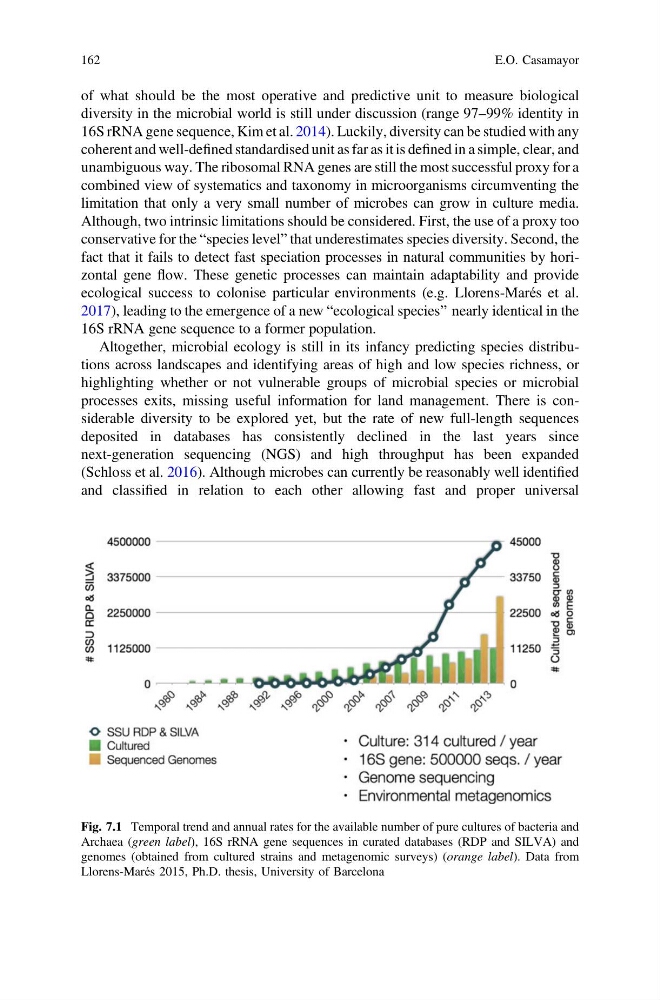
processes exits, missing useful information for land management. There is considerable diversity to be explored yet, but the rate of new full-length sequences
deposited in databases has consistently declined in the last years since
next-generation sequencing (NGS) and high throughput has been expanded
(Schloss et al. 2016). Although microbes can currently be reasonably well identified
and classified in relation to each other allowing fast and proper universal
Fig. 7.1 Temporal trend and annual rates for the available number of pure cultures of bacteria and
Archaea (green label), 16S rRNA gene sequences in curated databases (RDP and SILVA) and
genomes (obtained from cultured strains and metagenomic surveys) (orange label). Data from
Llorens-Marés 2015, Ph.D. thesis, University of Barcelona
162
E.O. Casamayor
diversity in the microbial world is still under discussion (range 97–99% identity in
16S rRNA gene sequence, Kim et al. 2014). Luckily, diversity can be studied with any
coherent and well-defined standardised unit as far as it is defined in a simple, clear, and
unambiguous way. The ribosomal RNA genes are still the most successful proxy for a
combined view of systematics and taxonomy in microorganisms circumventing the
limitation that only a very small number of microbes can grow in culture media.
Although, two intrinsic limitations should be considered. First, the use of a proxy too
conservative for the “species level” that underestimates species diversity. Second, the
fact that it fails to detect fast speciation processes in natural communities by horizontal gene flow. These genetic processes can maintain adaptability and provide
ecological success to colonise particular environments (e.g. Llorens-Marés et al.
2017), leading to the emergence of a new “ecological species” nearly identical in the
16S rRNA gene sequence to a former population.
Altogether, microbial ecology is still in its infancy predicting species distributions across landscapes and identifying areas of high and low species richness, or
highlighting whether or not vulnerable groups of microbial species or microbial
processes exits, missing useful information for land management. There is considerable diversity to be explored yet, but the rate of new full-length sequences
deposited in databases has consistently declined in the last years since
next-generation sequencing (NGS) and high throughput has been expanded
(Schloss et al. 2016). Although microbes can currently be reasonably well identified
and classified in relation to each other allowing fast and proper universal
Fig. 7.1 Temporal trend and annual rates for the available number of pure cultures of bacteria and
Archaea (green label), 16S rRNA gene sequences in curated databases (RDP and SILVA) and
genomes (obtained from cultured strains and metagenomic surveys) (orange label). Data from
Llorens-Marés 2015, Ph.D. thesis, University of Barcelona
162
E.O. Casamayor