

low-elevation forests showing intense dieback, there will be a replacement of silver
fir by beech and Scots pine in mesic and xeric sites, respectively. In fact, these
findings reveal that declining sites were characterised by a higher basal area of
beech and Scots pine than non-declining sites. We predict that the replacement of
silver fir by co-occurring species will proceed faster in the western declining sites
than eastwards. Finally, paleoecological evidence supports the contention that
similar past abrupt climatic changes may have caused analogous drought-induced
diebacks of tree species thus leading to rapid (ca. 500 years) changes in forest
composition (Foster et al. 2006).
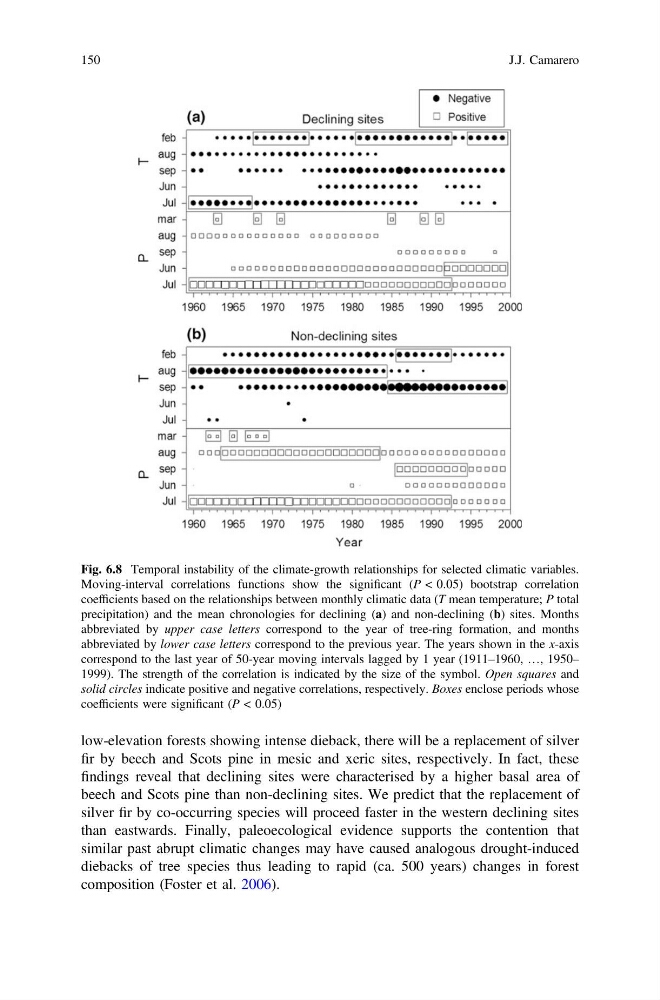
Fig. 6.8 Temporal instability of the climate-growth relationships for selected climatic variables.
Moving-interval correlations functions show the significant (P < 0.05) bootstrap correlation
coefficients based on the relationships between monthly climatic data (T mean temperature; P total
precipitation) and the mean chronologies for declining (a) and non-declining (b) sites. Months
abbreviated by upper case letters correspond to the year of tree-ring formation, and months
abbreviated by lower case letters correspond to the previous year. The years shown in the x-axis
correspond to the last year of 50-year moving intervals lagged by 1 year (1911–1960, …, 1950–
1999). The strength of the correlation is indicated by the size of the symbol. Open squares and
solid circles indicate positive and negative correlations, respectively. Boxes enclose periods whose
coefficients were significant (P < 0.05)
150
J.J. Camarero
fir by beech and Scots pine in mesic and xeric sites, respectively. In fact, these
findings reveal that declining sites were characterised by a higher basal area of
beech and Scots pine than non-declining sites. We predict that the replacement of
silver fir by co-occurring species will proceed faster in the western declining sites
than eastwards. Finally, paleoecological evidence supports the contention that
similar past abrupt climatic changes may have caused analogous drought-induced
diebacks of tree species thus leading to rapid (ca. 500 years) changes in forest
composition (Foster et al. 2006).
Fig. 6.8 Temporal instability of the climate-growth relationships for selected climatic variables.
Moving-interval correlations functions show the significant (P < 0.05) bootstrap correlation
coefficients based on the relationships between monthly climatic data (T mean temperature; P total
precipitation) and the mean chronologies for declining (a) and non-declining (b) sites. Months
abbreviated by upper case letters correspond to the year of tree-ring formation, and months
abbreviated by lower case letters correspond to the previous year. The years shown in the x-axis
correspond to the last year of 50-year moving intervals lagged by 1 year (1911–1960, …, 1950–
1999). The strength of the correlation is indicated by the size of the symbol. Open squares and
solid circles indicate positive and negative correlations, respectively. Boxes enclose periods whose
coefficients were significant (P < 0.05)
150
J.J. Camarero