

(decades or, in the best case, a few generations). There has been a highly accelerated
and profound transformation as a result of human action during the 20th century, due
to the exploitation of fossil fuels and technical and technological improvements.
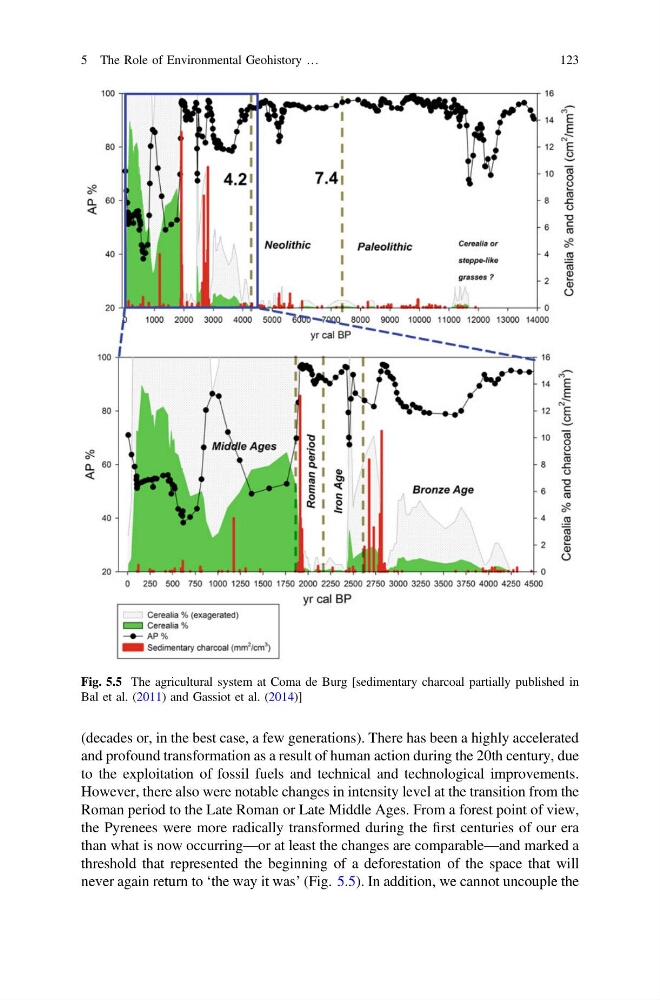
However, there also were notable changes in intensity level at the transition from the
Roman period to the Late Roman or Late Middle Ages. From a forest point of view,
the Pyrenees were more radically transformed during the first centuries of our era
than what is now occurring—or at least the changes are comparable—and marked a
threshold that represented the beginning of a deforestation of the space that will
never again return to ‘the way it was’ (Fig. 5.5). In addition, we cannot uncouple the
Fig. 5.5 The agricultural system at Coma de Burg [sedimentary charcoal partially published in
Bal et al. (2011) and Gassiot et al. (2014)]
5 The Role of Environmental Geohistory …
123
and profound transformation as a result of human action during the 20th century, due
to the exploitation of fossil fuels and technical and technological improvements.
However, there also were notable changes in intensity level at the transition from the
Roman period to the Late Roman or Late Middle Ages. From a forest point of view,
the Pyrenees were more radically transformed during the first centuries of our era
than what is now occurring—or at least the changes are comparable—and marked a
threshold that represented the beginning of a deforestation of the space that will
never again return to ‘the way it was’ (Fig. 5.5). In addition, we cannot uncouple the
Fig. 5.5 The agricultural system at Coma de Burg [sedimentary charcoal partially published in
Bal et al. (2011) and Gassiot et al. (2014)]
5 The Role of Environmental Geohistory …
123