

78
P. Krüger
for strong excitonic effects and features electron–hole multiplet coupling in L-edge
spectra [22]. Let us note that the latter effect is also well described with multichannel
multiple scattering theory [23, 24], where the electron–hole coupling is dealt by a CI
calculation of the scattering matrix. However, at present, none of these particle–hole
theories can fully account for the complex multiplet structure of L-edge spectra of
open-shell transition metal compounds. These spectra are still best described with
CI methods, either the semi-empirical ligand-field multiplet model (see Chap. 4) or
the ab initio complete active space approach on small clusters [25].
3.7.4 Static and Dynamical Mean-Field Theory
In strongly correlated electron systems, e.g. 3d transition metal oxides and 5 f elements, collective phenomena such as band magnetism, metal–insulator transition
and high-T c superconductivity are observed. These are genuine many-body effects
that cannot be explained in the independent particle picture. Itinerant magnetism
and the metal–insulator transition are due to the competition between the kinetic
energy, which leads to delocalized band states, and strong local Coulomb repulsion
which favours electron localization and formation of magnetic moments. The most
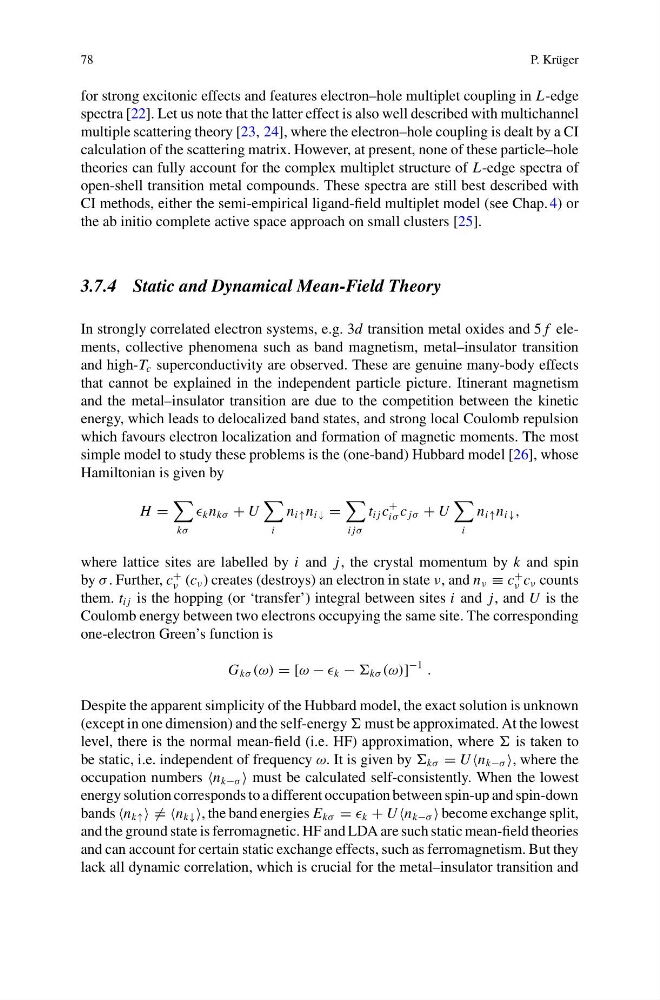
simple model to study these problems is the (one-band) Hubbard model [26], whose
Hamiltonian is given by
H =
kσ
k n kσ + U
i
n i↑ n i↓ =
i jσ
t i j c
+
iσ c jσ + U
i
n i↑ n i↓ ,
where lattice sites are labelled by i and j, the crystal momentum by k and spin
by σ . Further, c
+
ν (c ν ) creates (destroys) an electron in state ν, and n ν ≡ c
+
ν c ν counts
them. t i j is the hopping (or ‘transfer’) integral between sites i and j, and U is the
Coulomb energy between two electrons occupying the same site. The corresponding
one-electron Green’s function is
G kσ (ω) = [ω − k − kσ (ω)]
−1
.
Despite the apparent simplicity of the Hubbard model, the exact solution is unknown
(except in one dimension) and the self-energy must be approximated. At the lowest
level, there is the normal mean-field (i.e. HF) approximation, where is taken to
be static, i.e. independent of frequency ω. It is given by kσ = U n k−σ , where the
occupation numbers n k−σ must be calculated self-consistently. When the lowest
energy solution corresponds to a different occupation between spin-up and spin-down
bands n k↑ = =n k↓ , the band energies E kσ = k + U n k−σ become exchange split,
and the ground state is ferromagnetic. HF and LDA are such static mean-field theories
and can account for certain static exchange effects, such as ferromagnetism. But they
lack all dynamic correlation, which is crucial for the metal–insulator transition and
P. Krüger
for strong excitonic effects and features electron–hole multiplet coupling in L-edge
spectra [22]. Let us note that the latter effect is also well described with multichannel
multiple scattering theory [23, 24], where the electron–hole coupling is dealt by a CI
calculation of the scattering matrix. However, at present, none of these particle–hole
theories can fully account for the complex multiplet structure of L-edge spectra of
open-shell transition metal compounds. These spectra are still best described with
CI methods, either the semi-empirical ligand-field multiplet model (see Chap. 4) or
the ab initio complete active space approach on small clusters [25].
3.7.4 Static and Dynamical Mean-Field Theory
In strongly correlated electron systems, e.g. 3d transition metal oxides and 5 f elements, collective phenomena such as band magnetism, metal–insulator transition
and high-T c superconductivity are observed. These are genuine many-body effects
that cannot be explained in the independent particle picture. Itinerant magnetism
and the metal–insulator transition are due to the competition between the kinetic
energy, which leads to delocalized band states, and strong local Coulomb repulsion
which favours electron localization and formation of magnetic moments. The most
simple model to study these problems is the (one-band) Hubbard model [26], whose
Hamiltonian is given by
H =
kσ
k n kσ + U
i
n i↑ n i↓ =
i jσ
t i j c
+
iσ c jσ + U
i
n i↑ n i↓ ,
where lattice sites are labelled by i and j, the crystal momentum by k and spin
by σ . Further, c
+
ν (c ν ) creates (destroys) an electron in state ν, and n ν ≡ c
+
ν c ν counts
them. t i j is the hopping (or ‘transfer’) integral between sites i and j, and U is the
Coulomb energy between two electrons occupying the same site. The corresponding
one-electron Green’s function is
G kσ (ω) = [ω − k − kσ (ω)]
−1
.
Despite the apparent simplicity of the Hubbard model, the exact solution is unknown
(except in one dimension) and the self-energy must be approximated. At the lowest
level, there is the normal mean-field (i.e. HF) approximation, where is taken to
be static, i.e. independent of frequency ω. It is given by kσ = U n k−σ , where the
occupation numbers n k−σ must be calculated self-consistently. When the lowest
energy solution corresponds to a different occupation between spin-up and spin-down
bands n k↑ = =n k↓ , the band energies E kσ = k + U n k−σ become exchange split,
and the ground state is ferromagnetic. HF and LDA are such static mean-field theories
and can account for certain static exchange effects, such as ferromagnetism. But they
lack all dynamic correlation, which is crucial for the metal–insulator transition and