

56
S. J. Blundell
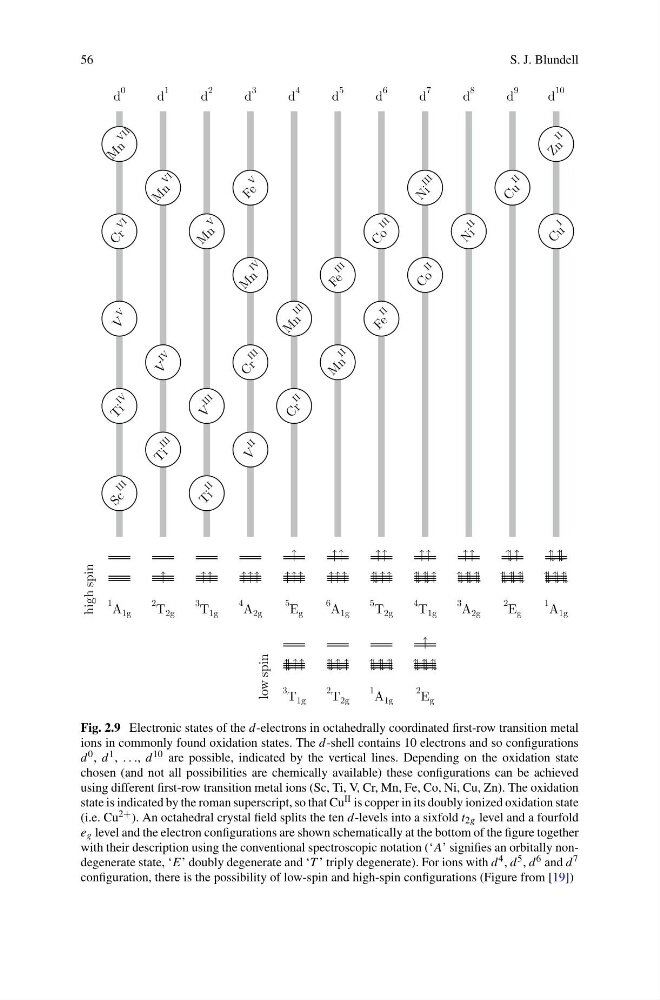
Fig. 2.9 Electronic states of the d-electrons in octahedrally coordinated first-row transition metal
ions in commonly found oxidation states. The d-shell contains 10 electrons and so configurations
d 0 , d 1 , . . ., d 10 are possible, indicated by the vertical lines. Depending on the oxidation state
chosen (and not all possibilities are chemically available) these configurations can be achieved
using different first-row transition metal ions (Sc, Ti, V, Cr, Mn, Fe, Co, Ni, Cu, Zn). The oxidation
state is indicated by the roman superscript, so that Cu II is copper in its doubly ionized oxidation state
(i.e. Cu 2+ ). An octahedral crystal field splits the ten d-levels into a sixfold t 2g level and a fourfold
e g level and the electron configurations are shown schematically at the bottom of the figure together
with their description using the conventional spectroscopic notation (‘A’ signifies an orbitally nondegenerate state, ‘E’ doubly degenerate and ‘T ’ triply degenerate). For ions with d 4 , d 5 , d 6 and d 7
configuration, there is the possibility of low-spin and high-spin configurations (Figure from [19])
S. J. Blundell
Fig. 2.9 Electronic states of the d-electrons in octahedrally coordinated first-row transition metal
ions in commonly found oxidation states. The d-shell contains 10 electrons and so configurations
d 0 , d 1 , . . ., d 10 are possible, indicated by the vertical lines. Depending on the oxidation state
chosen (and not all possibilities are chemically available) these configurations can be achieved
using different first-row transition metal ions (Sc, Ti, V, Cr, Mn, Fe, Co, Ni, Cu, Zn). The oxidation
state is indicated by the roman superscript, so that Cu II is copper in its doubly ionized oxidation state
(i.e. Cu 2+ ). An octahedral crystal field splits the ten d-levels into a sixfold t 2g level and a fourfold
e g level and the electron configurations are shown schematically at the bottom of the figure together
with their description using the conventional spectroscopic notation (‘A’ signifies an orbitally nondegenerate state, ‘E’ doubly degenerate and ‘T ’ triply degenerate). For ions with d 4 , d 5 , d 6 and d 7
configuration, there is the possibility of low-spin and high-spin configurations (Figure from [19])