

48
S. J. Blundell
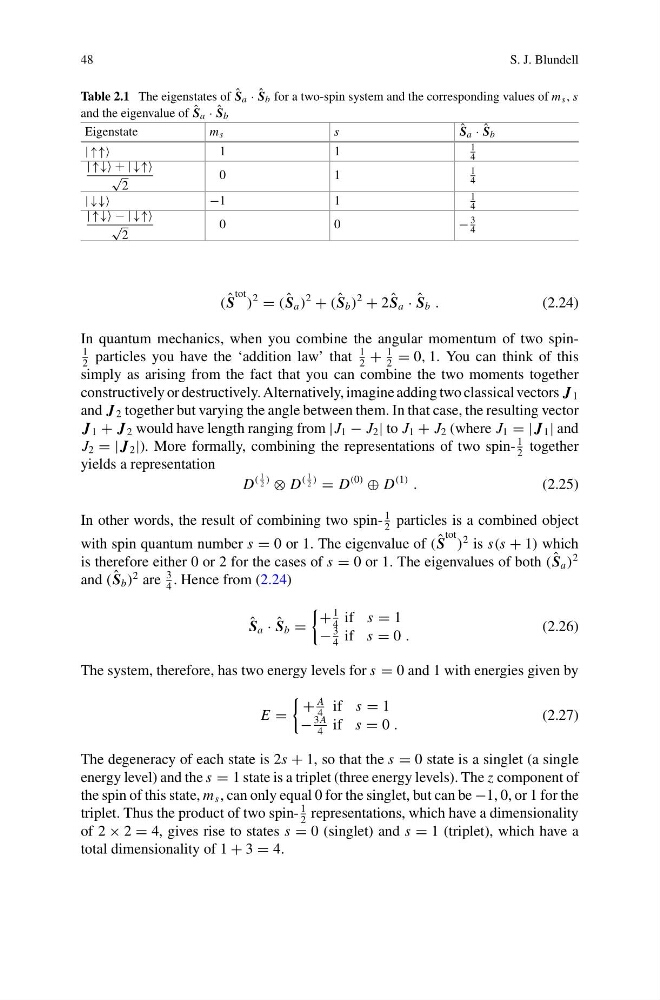
Table 2.1 The eigenstates of ˆ
S a · ˆ
S b for a two-spin system and the corresponding values of m s , s
and the eigenvalue of ˆ
S a · ˆ
S b
Eigenstate
m s
s
ˆ
S a · ˆ
S b
| ↑↑↑
1
1
1
4
| ↑↓↓ + | ↓↑↑
√
2
0
1
1
4
| ↓↓↓
−1
1
1
4
| ↑↓↓ − | ↓↑↑
√
2
0
0
−
3
4
( ˆ
S
tot )
2
= ( ˆ
S a )
2
+ ( ˆ
S b )
2
+ 2 ˆ
S a · ˆ
S b .
(2.24)
In quantum mechanics, when you combine the angular momentum of two spin1
2
particles you have the ‘addition law’ that
1
2
+
1
2
= 0, 1. You can think of this
simply as arising from the fact that you can combine the two moments together
constructively or destructively. Alternatively, imagine adding two classical vectors J 1
and J 2 together but varying the angle between them. In that case, the resulting vector
J 1 + J 2 would have length ranging from |J 1 − J 2 | to J 1 + J 2 (where J 1 = | J 1 | and
J 2 = | J 2 |). More formally, combining the representations of two spin1
2
together
yields a representation
D
(
1
2 )
⊗ D
(
1
2 )
= D
(0)
⊕ D
(1)
.
(2.25)
In other words, the result of combining two spin1
2
particles is a combined object
with spin quantum number s = 0 or 1. The eigenvalue of ( ˆ
S
tot )
2 is s(s + 1) which
is therefore either 0 or 2 for the cases of s = 0 or 1. The eigenvalues of both ( ˆ
S a )
2
and ( ˆ
S b )
2 are
3
4
. Hence from (2.24)
ˆ
S a · ˆ
S b =
+
1
4
if s = 1
−
3
4
if s = 0 .
(2.26)
The system, therefore, has two energy levels for s = 0 and 1 with energies given by
E =
+
A
4
if s = 1
−
3A
4
if s = 0 .
(2.27)
The degeneracy of each state is 2s + 1, so that the s = 0 state is a singlet (a single
energy level) and the s = 1 state is a triplet (three energy levels). The z component of
the spin of this state, m s , can only equal 0 for the singlet, but can be −1, 0, or 1 for the
triplet. Thus the product of two spin1
2
representations, which have a dimensionality
of 2 × 2 = 4, gives rise to states s = 0 (singlet) and s = 1 (triplet), which have a
total dimensionality of 1 + 3 = 4.
S. J. Blundell
Table 2.1 The eigenstates of ˆ
S a · ˆ
S b for a two-spin system and the corresponding values of m s , s
and the eigenvalue of ˆ
S a · ˆ
S b
Eigenstate
m s
s
ˆ
S a · ˆ
S b
| ↑↑↑
1
1
1
4
| ↑↓↓ + | ↓↑↑
√
2
0
1
1
4
| ↓↓↓
−1
1
1
4
| ↑↓↓ − | ↓↑↑
√
2
0
0
−
3
4
( ˆ
S
tot )
2
= ( ˆ
S a )
2
+ ( ˆ
S b )
2
+ 2 ˆ
S a · ˆ
S b .
(2.24)
In quantum mechanics, when you combine the angular momentum of two spin1
2
particles you have the ‘addition law’ that
1
2
+
1
2
= 0, 1. You can think of this
simply as arising from the fact that you can combine the two moments together
constructively or destructively. Alternatively, imagine adding two classical vectors J 1
and J 2 together but varying the angle between them. In that case, the resulting vector
J 1 + J 2 would have length ranging from |J 1 − J 2 | to J 1 + J 2 (where J 1 = | J 1 | and
J 2 = | J 2 |). More formally, combining the representations of two spin1
2
together
yields a representation
D
(
1
2 )
⊗ D
(
1
2 )
= D
(0)
⊕ D
(1)
.
(2.25)
In other words, the result of combining two spin1
2
particles is a combined object
with spin quantum number s = 0 or 1. The eigenvalue of ( ˆ
S
tot )
2 is s(s + 1) which
is therefore either 0 or 2 for the cases of s = 0 or 1. The eigenvalues of both ( ˆ
S a )
2
and ( ˆ
S b )
2 are
3
4
. Hence from (2.24)
ˆ
S a · ˆ
S b =
+
1
4
if s = 1
−
3
4
if s = 0 .
(2.26)
The system, therefore, has two energy levels for s = 0 and 1 with energies given by
E =
+
A
4
if s = 1
−
3A
4
if s = 0 .
(2.27)
The degeneracy of each state is 2s + 1, so that the s = 0 state is a singlet (a single
energy level) and the s = 1 state is a triplet (three energy levels). The z component of
the spin of this state, m s , can only equal 0 for the singlet, but can be −1, 0, or 1 for the
triplet. Thus the product of two spin1
2
representations, which have a dimensionality
of 2 × 2 = 4, gives rise to states s = 0 (singlet) and s = 1 (triplet), which have a
total dimensionality of 1 + 3 = 4.