

2 Concepts in Magnetism
45
10 3
× F (x)
x
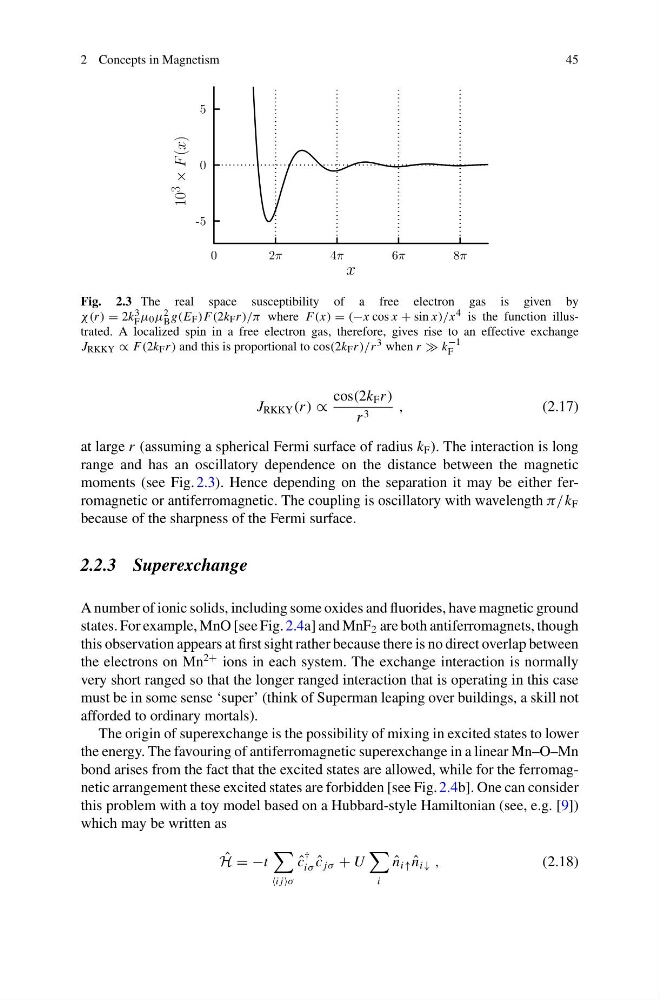
Fig. 2.3 The real space susceptibility of a free electron gas is given by
χ(r ) = 2k 3
F μ 0 μ 2
B g(E F )F(2k F r )/π where F(x) = (−x cos x + sin x)/x 4 is the function illustrated. A localized spin in a free electron gas, therefore, gives rise to an effective exchange
J RKKY ∝ F(2k F r ) and this is proportional to cos(2k F r )/r 3 when r k
−1
F
J RKKY (r ) ∝
cos(2k F r )
r 3
,
(2.17)
at large r (assuming a spherical Fermi surface of radius k F ). The interaction is long
range and has an oscillatory dependence on the distance between the magnetic
moments (see Fig. 2.3). Hence depending on the separation it may be either ferromagnetic or antiferromagnetic. The coupling is oscillatory with wavelength π/k F
because of the sharpness of the Fermi surface.
2.2.3 Superexchange
A number of ionic solids, including some oxides and fluorides, have magnetic ground
states. For example, MnO [see Fig. 2.4a] and MnF 2 are both antiferromagnets, though
this observation appears at first sight rather because there is no direct overlap between
the electrons on Mn
2+ ions in each system. The exchange interaction is normally
very short ranged so that the longer ranged interaction that is operating in this case
must be in some sense ‘super’ (think of Superman leaping over buildings, a skill not
afforded to ordinary mortals).
The origin of superexchange is the possibility of mixing in excited states to lower
the energy. The favouring of antiferromagnetic superexchange in a linear Mn–O–Mn
bond arises from the fact that the excited states are allowed, while for the ferromagnetic arrangement these excited states are forbidden [see Fig. 2.4b]. One can consider
this problem with a toy model based on a Hubbard-style Hamiltonian (see, e.g. [9])
which may be written as
ˆ
H = −t
i j
ˆ
c
†
iσ ˆ
c jσ + U
i
ˆ
n i↑ ˆ
n i↓ ,
(2.18)
45
10 3
× F (x)
x
Fig. 2.3 The real space susceptibility of a free electron gas is given by
χ(r ) = 2k 3
F μ 0 μ 2
B g(E F )F(2k F r )/π where F(x) = (−x cos x + sin x)/x 4 is the function illustrated. A localized spin in a free electron gas, therefore, gives rise to an effective exchange
J RKKY ∝ F(2k F r ) and this is proportional to cos(2k F r )/r 3 when r k
−1
F
J RKKY (r ) ∝
cos(2k F r )
r 3
,
(2.17)
at large r (assuming a spherical Fermi surface of radius k F ). The interaction is long
range and has an oscillatory dependence on the distance between the magnetic
moments (see Fig. 2.3). Hence depending on the separation it may be either ferromagnetic or antiferromagnetic. The coupling is oscillatory with wavelength π/k F
because of the sharpness of the Fermi surface.
2.2.3 Superexchange
A number of ionic solids, including some oxides and fluorides, have magnetic ground
states. For example, MnO [see Fig. 2.4a] and MnF 2 are both antiferromagnets, though
this observation appears at first sight rather because there is no direct overlap between
the electrons on Mn
2+ ions in each system. The exchange interaction is normally
very short ranged so that the longer ranged interaction that is operating in this case
must be in some sense ‘super’ (think of Superman leaping over buildings, a skill not
afforded to ordinary mortals).
The origin of superexchange is the possibility of mixing in excited states to lower
the energy. The favouring of antiferromagnetic superexchange in a linear Mn–O–Mn
bond arises from the fact that the excited states are allowed, while for the ferromagnetic arrangement these excited states are forbidden [see Fig. 2.4b]. One can consider
this problem with a toy model based on a Hubbard-style Hamiltonian (see, e.g. [9])
which may be written as
ˆ
H = −t
i j
ˆ
c
†
iσ ˆ
c jσ + U
i
ˆ
n i↑ ˆ
n i↓ ,
(2.18)