

1 X-Ray Sources at Large-Scale Facilities
31
forces of the electromagnetic field generated by undulator radiation on the electrons’
trajectory are negligible.
In the case of XFELs, however, the beam is tailored to have as low an emittance
and as high an electron density as possible, through the low-emittance gun and bunch
compression, respectively. The motivation for this is exactly to induce forces through
the generated radiation that are sufficiently large that they do indeed have an impact
on the energy and spatial distribution of the electron bunch. Although at the upstream
end of the XFEL undulator, this interaction is still very weak, it is sufficient to seed
the runaway process of SASE, which is now briefly described.
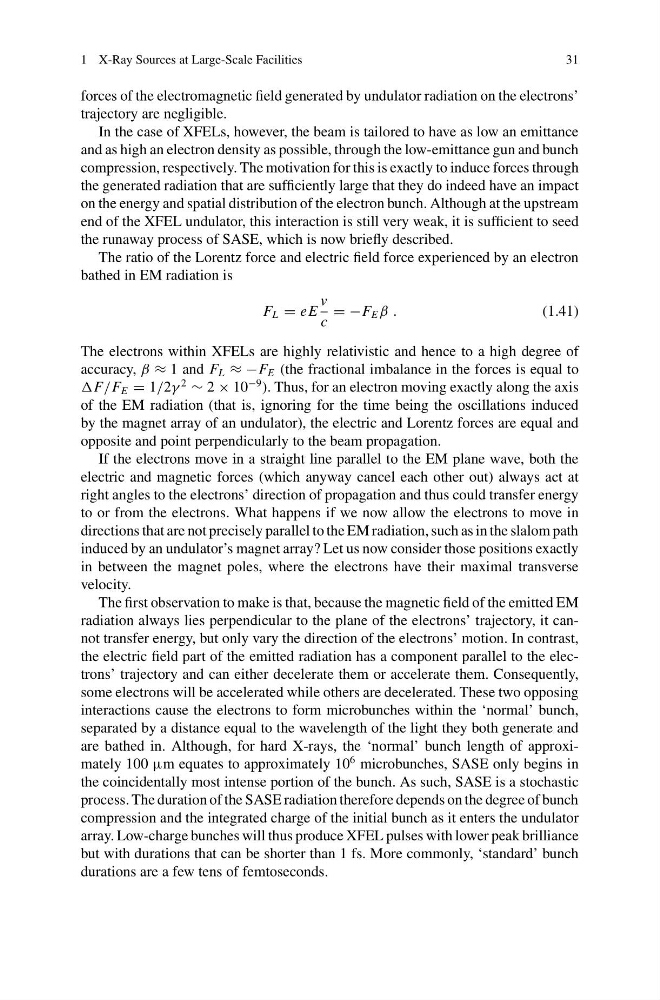
The ratio of the Lorentz force and electric field force experienced by an electron
bathed in EM radiation is
F L = eE
v
c
= −F E β .
(1.41)
The electrons within XFELs are highly relativistic and hence to a high degree of
accuracy, β ≈ 1 and F L ≈ −F E (the fractional imbalance in the forces is equal to
F/F E = 1/2γ
2
∼ 2 × 10
−9 ). Thus, for an electron moving exactly along the axis
of the EM radiation (that is, ignoring for the time being the oscillations induced
by the magnet array of an undulator), the electric and Lorentz forces are equal and
opposite and point perpendicularly to the beam propagation.
If the electrons move in a straight line parallel to the EM plane wave, both the
electric and magnetic forces (which anyway cancel each other out) always act at
right angles to the electrons’ direction of propagation and thus could transfer energy
to or from the electrons. What happens if we now allow the electrons to move in
directions that are not precisely parallel to the EM radiation, such as in the slalom path
induced by an undulator’s magnet array? Let us now consider those positions exactly
in between the magnet poles, where the electrons have their maximal transverse
velocity.
The first observation to make is that, because the magnetic field of the emitted EM
radiation always lies perpendicular to the plane of the electrons’ trajectory, it cannot transfer energy, but only vary the direction of the electrons’ motion. In contrast,
the electric field part of the emitted radiation has a component parallel to the electrons’ trajectory and can either decelerate them or accelerate them. Consequently,
some electrons will be accelerated while others are decelerated. These two opposing
interactions cause the electrons to form microbunches within the ‘normal’ bunch,
separated by a distance equal to the wavelength of the light they both generate and
are bathed in. Although, for hard X-rays, the ‘normal’ bunch length of approximately 100 µm equates to approximately 10
6 microbunches, SASE only begins in
the coincidentally most intense portion of the bunch. As such, SASE is a stochastic
process. The duration of the SASE radiation therefore depends on the degree of bunch
compression and the integrated charge of the initial bunch as it enters the undulator
array. Low-charge bunches will thus produce XFEL pulses with lower peak brilliance
but with durations that can be shorter than 1 fs. More commonly, ‘standard’ bunch
durations are a few tens of femtoseconds.
31
forces of the electromagnetic field generated by undulator radiation on the electrons’
trajectory are negligible.
In the case of XFELs, however, the beam is tailored to have as low an emittance
and as high an electron density as possible, through the low-emittance gun and bunch
compression, respectively. The motivation for this is exactly to induce forces through
the generated radiation that are sufficiently large that they do indeed have an impact
on the energy and spatial distribution of the electron bunch. Although at the upstream
end of the XFEL undulator, this interaction is still very weak, it is sufficient to seed
the runaway process of SASE, which is now briefly described.
The ratio of the Lorentz force and electric field force experienced by an electron
bathed in EM radiation is
F L = eE
v
c
= −F E β .
(1.41)
The electrons within XFELs are highly relativistic and hence to a high degree of
accuracy, β ≈ 1 and F L ≈ −F E (the fractional imbalance in the forces is equal to
F/F E = 1/2γ
2
∼ 2 × 10
−9 ). Thus, for an electron moving exactly along the axis
of the EM radiation (that is, ignoring for the time being the oscillations induced
by the magnet array of an undulator), the electric and Lorentz forces are equal and
opposite and point perpendicularly to the beam propagation.
If the electrons move in a straight line parallel to the EM plane wave, both the
electric and magnetic forces (which anyway cancel each other out) always act at
right angles to the electrons’ direction of propagation and thus could transfer energy
to or from the electrons. What happens if we now allow the electrons to move in
directions that are not precisely parallel to the EM radiation, such as in the slalom path
induced by an undulator’s magnet array? Let us now consider those positions exactly
in between the magnet poles, where the electrons have their maximal transverse
velocity.
The first observation to make is that, because the magnetic field of the emitted EM
radiation always lies perpendicular to the plane of the electrons’ trajectory, it cannot transfer energy, but only vary the direction of the electrons’ motion. In contrast,
the electric field part of the emitted radiation has a component parallel to the electrons’ trajectory and can either decelerate them or accelerate them. Consequently,
some electrons will be accelerated while others are decelerated. These two opposing
interactions cause the electrons to form microbunches within the ‘normal’ bunch,
separated by a distance equal to the wavelength of the light they both generate and
are bathed in. Although, for hard X-rays, the ‘normal’ bunch length of approximately 100 µm equates to approximately 10
6 microbunches, SASE only begins in
the coincidentally most intense portion of the bunch. As such, SASE is a stochastic
process. The duration of the SASE radiation therefore depends on the degree of bunch
compression and the integrated charge of the initial bunch as it enters the undulator
array. Low-charge bunches will thus produce XFEL pulses with lower peak brilliance
but with durations that can be shorter than 1 fs. More commonly, ‘standard’ bunch
durations are a few tens of femtoseconds.