

28
P. R. Willmott
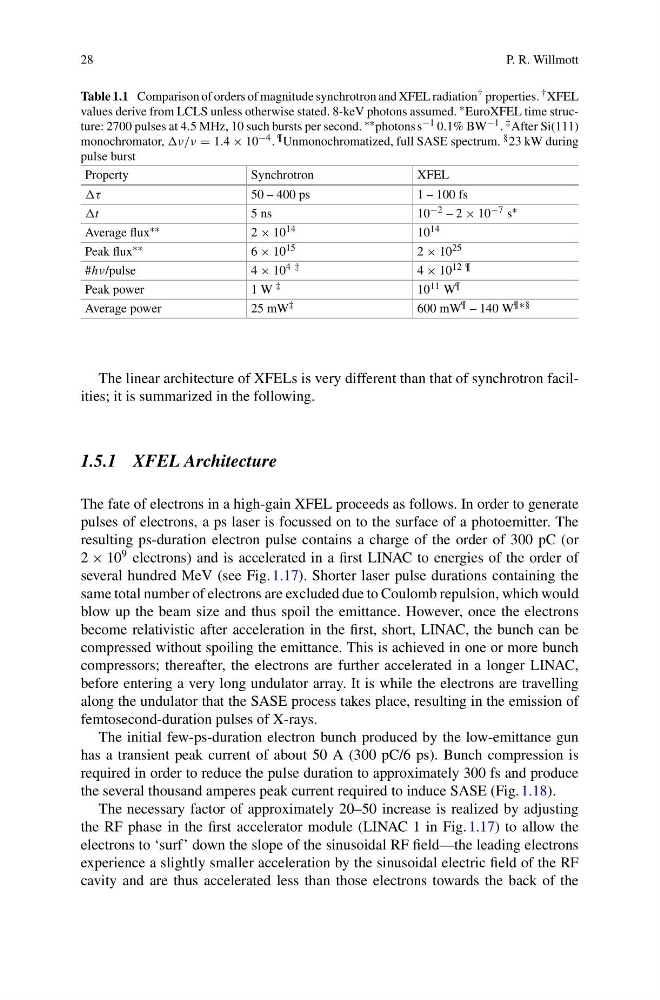
Table 1.1 Comparison of orders of magnitude synchrotron and XFEL radiation † properties. † XFEL
values derive from LCLS unless otherwise stated. 8-keV photons assumed. ∗ EuroXFEL time structure: 2700 pulses at 4.5 MHz, 10 such bursts per second. ∗∗ photons s −1 0.1% BW −1 . ‡ After Si(111)
monochromator, ν/ν = 1.4 × 10 −4 . ¶ Unmonochromatized, full SASE spectrum. § 23 kW during
pulse burst
Property
Synchrotron
XFEL
τ
50 – 400 ps
1 – 100 fs
t
5 ns
10 −2 – 2 × 10 −7 s ∗
Average flux ∗∗
2 × 10 14
10 14
Peak flux ∗∗
6 × 10 15
2 × 10 25
#hν/pulse
4 × 10 4 ‡
4 × 10 12 ¶
Peak power
1 W ‡
10 11 W ¶
Average power
25 mW ‡
600 mW ¶ – 140 W ¶ ∗§
The linear architecture of XFELs is very different than that of synchrotron facilities; it is summarized in the following.
1.5.1 XFEL Architecture
The fate of electrons in a high-gain XFEL proceeds as follows. In order to generate
pulses of electrons, a ps laser is focussed on to the surface of a photoemitter. The
resulting ps-duration electron pulse contains a charge of the order of 300 pC (or
2 × 10
9 electrons) and is accelerated in a first LINAC to energies of the order of
several hundred MeV (see Fig. 1.17). Shorter laser pulse durations containing the
same total number of electrons are excluded due to Coulomb repulsion, which would
blow up the beam size and thus spoil the emittance. However, once the electrons
become relativistic after acceleration in the first, short, LINAC, the bunch can be
compressed without spoiling the emittance. This is achieved in one or more bunch
compressors; thereafter, the electrons are further accelerated in a longer LINAC,
before entering a very long undulator array. It is while the electrons are travelling
along the undulator that the SASE process takes place, resulting in the emission of
femtosecond-duration pulses of X-rays.
The initial few-ps-duration electron bunch produced by the low-emittance gun
has a transient peak current of about 50 A (300 pC/6 ps). Bunch compression is
required in order to reduce the pulse duration to approximately 300 fs and produce
the several thousand amperes peak current required to induce SASE (Fig. 1.18).
The necessary factor of approximately 20–50 increase is realized by adjusting
the RF phase in the first accelerator module (LINAC 1 in Fig. 1.17) to allow the
electrons to ‘surf’ down the slope of the sinusoidal RF field—the leading electrons
experience a slightly smaller acceleration by the sinusoidal electric field of the RF
cavity and are thus accelerated less than those electrons towards the back of the
P. R. Willmott
Table 1.1 Comparison of orders of magnitude synchrotron and XFEL radiation † properties. † XFEL
values derive from LCLS unless otherwise stated. 8-keV photons assumed. ∗ EuroXFEL time structure: 2700 pulses at 4.5 MHz, 10 such bursts per second. ∗∗ photons s −1 0.1% BW −1 . ‡ After Si(111)
monochromator, ν/ν = 1.4 × 10 −4 . ¶ Unmonochromatized, full SASE spectrum. § 23 kW during
pulse burst
Property
Synchrotron
XFEL
τ
50 – 400 ps
1 – 100 fs
t
5 ns
10 −2 – 2 × 10 −7 s ∗
Average flux ∗∗
2 × 10 14
10 14
Peak flux ∗∗
6 × 10 15
2 × 10 25
#hν/pulse
4 × 10 4 ‡
4 × 10 12 ¶
Peak power
1 W ‡
10 11 W ¶
Average power
25 mW ‡
600 mW ¶ – 140 W ¶ ∗§
The linear architecture of XFELs is very different than that of synchrotron facilities; it is summarized in the following.
1.5.1 XFEL Architecture
The fate of electrons in a high-gain XFEL proceeds as follows. In order to generate
pulses of electrons, a ps laser is focussed on to the surface of a photoemitter. The
resulting ps-duration electron pulse contains a charge of the order of 300 pC (or
2 × 10
9 electrons) and is accelerated in a first LINAC to energies of the order of
several hundred MeV (see Fig. 1.17). Shorter laser pulse durations containing the
same total number of electrons are excluded due to Coulomb repulsion, which would
blow up the beam size and thus spoil the emittance. However, once the electrons
become relativistic after acceleration in the first, short, LINAC, the bunch can be
compressed without spoiling the emittance. This is achieved in one or more bunch
compressors; thereafter, the electrons are further accelerated in a longer LINAC,
before entering a very long undulator array. It is while the electrons are travelling
along the undulator that the SASE process takes place, resulting in the emission of
femtosecond-duration pulses of X-rays.
The initial few-ps-duration electron bunch produced by the low-emittance gun
has a transient peak current of about 50 A (300 pC/6 ps). Bunch compression is
required in order to reduce the pulse duration to approximately 300 fs and produce
the several thousand amperes peak current required to induce SASE (Fig. 1.18).
The necessary factor of approximately 20–50 increase is realized by adjusting
the RF phase in the first accelerator module (LINAC 1 in Fig. 1.17) to allow the
electrons to ‘surf’ down the slope of the sinusoidal RF field—the leading electrons
experience a slightly smaller acceleration by the sinusoidal electric field of the RF
cavity and are thus accelerated less than those electrons towards the back of the