

1 X-Ray Sources at Large-Scale Facilities
25
4th generation
3rd generation
0
1 0
2 0
3 0
4 0
Photon energy [keV]
10
16
10
17
10
18
10
19
10
20
10
21
10
22
Brilliance [ph/s/0.1% BW/mm
2
/mrad
2
]
3rd generation
4th generation
1
2
3
4
5
17
19
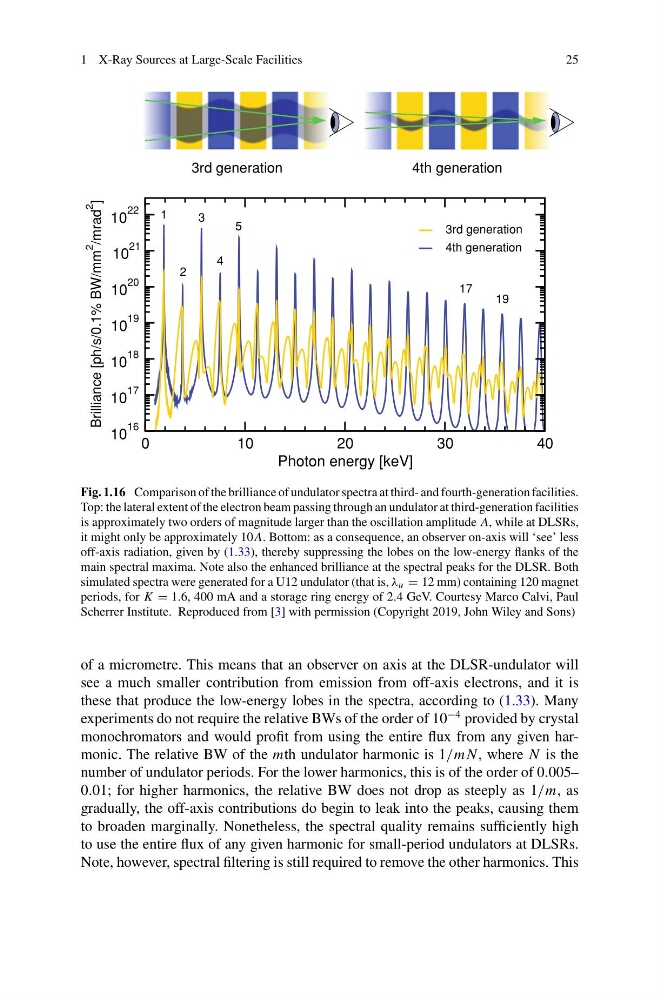
Fig. 1.16 Comparison of the brilliance of undulator spectra at third- and fourth-generation facilities.
Top: the lateral extent of the electron beam passing through an undulator at third-generation facilities
is approximately two orders of magnitude larger than the oscillation amplitude A, while at DLSRs,
it might only be approximately 10 A. Bottom: as a consequence, an observer on-axis will ‘see’ less
off-axis radiation, given by (1.33), thereby suppressing the lobes on the low-energy flanks of the
main spectral maxima. Note also the enhanced brilliance at the spectral peaks for the DLSR. Both
simulated spectra were generated for a U12 undulator (that is, λ u = 12 mm) containing 120 magnet
periods, for K = 1.6, 400 mA and a storage ring energy of 2.4 GeV. Courtesy Marco Calvi, Paul
Scherrer Institute. Reproduced from [3] with permission (Copyright 2019, John Wiley and Sons)
of a micrometre. This means that an observer on axis at the DLSR-undulator will
see a much smaller contribution from emission from off-axis electrons, and it is
these that produce the low-energy lobes in the spectra, according to (1.33). Many
experiments do not require the relative BWs of the order of 10
−4 provided by crystal
monochromators and would profit from using the entire flux from any given harmonic. The relative BW of the mth undulator harmonic is 1/m N , where N is the
number of undulator periods. For the lower harmonics, this is of the order of 0.005–
0.01; for higher harmonics, the relative BW does not drop as steeply as 1/m, as
gradually, the off-axis contributions do begin to leak into the peaks, causing them
to broaden marginally. Nonetheless, the spectral quality remains sufficiently high
to use the entire flux of any given harmonic for small-period undulators at DLSRs.
Note, however, spectral filtering is still required to remove the other harmonics. This
25
4th generation
3rd generation
0
1 0
2 0
3 0
4 0
Photon energy [keV]
10
16
10
17
10
18
10
19
10
20
10
21
10
22
Brilliance [ph/s/0.1% BW/mm
2
/mrad
2
]
3rd generation
4th generation
1
2
3
4
5
17
19
Fig. 1.16 Comparison of the brilliance of undulator spectra at third- and fourth-generation facilities.
Top: the lateral extent of the electron beam passing through an undulator at third-generation facilities
is approximately two orders of magnitude larger than the oscillation amplitude A, while at DLSRs,
it might only be approximately 10 A. Bottom: as a consequence, an observer on-axis will ‘see’ less
off-axis radiation, given by (1.33), thereby suppressing the lobes on the low-energy flanks of the
main spectral maxima. Note also the enhanced brilliance at the spectral peaks for the DLSR. Both
simulated spectra were generated for a U12 undulator (that is, λ u = 12 mm) containing 120 magnet
periods, for K = 1.6, 400 mA and a storage ring energy of 2.4 GeV. Courtesy Marco Calvi, Paul
Scherrer Institute. Reproduced from [3] with permission (Copyright 2019, John Wiley and Sons)
of a micrometre. This means that an observer on axis at the DLSR-undulator will
see a much smaller contribution from emission from off-axis electrons, and it is
these that produce the low-energy lobes in the spectra, according to (1.33). Many
experiments do not require the relative BWs of the order of 10
−4 provided by crystal
monochromators and would profit from using the entire flux from any given harmonic. The relative BW of the mth undulator harmonic is 1/m N , where N is the
number of undulator periods. For the lower harmonics, this is of the order of 0.005–
0.01; for higher harmonics, the relative BW does not drop as steeply as 1/m, as
gradually, the off-axis contributions do begin to leak into the peaks, causing them
to broaden marginally. Nonetheless, the spectral quality remains sufficiently high
to use the entire flux of any given harmonic for small-period undulators at DLSRs.
Note, however, spectral filtering is still required to remove the other harmonics. This