

1 X-Ray Sources at Large-Scale Facilities
15
BM
FQM
BM
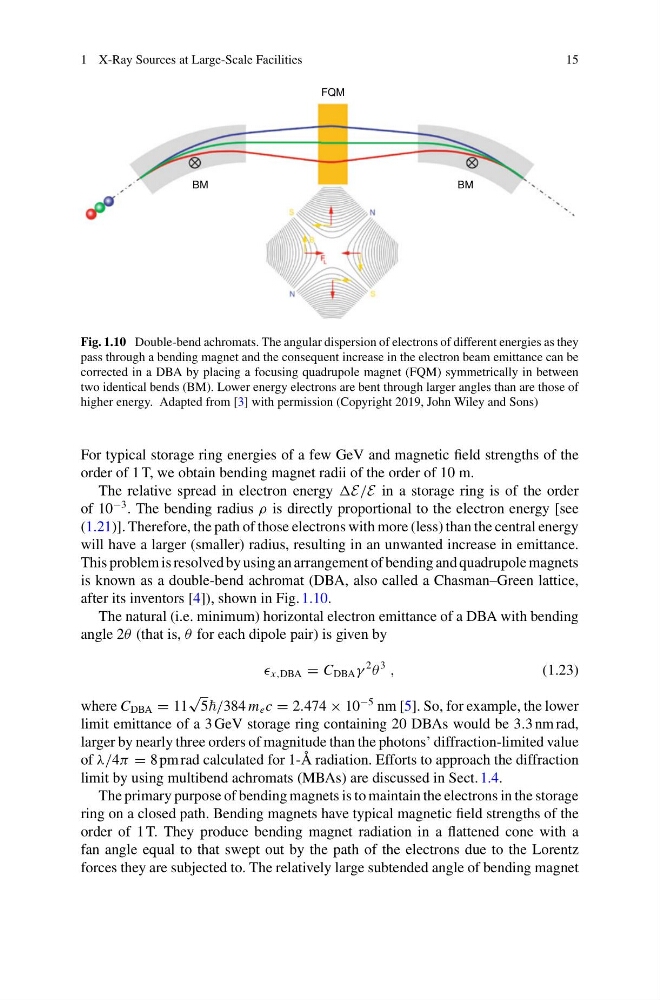
Fig. 1.10 Double-bend achromats. The angular dispersion of electrons of different energies as they
pass through a bending magnet and the consequent increase in the electron beam emittance can be
corrected in a DBA by placing a focusing quadrupole magnet (FQM) symmetrically in between
two identical bends (BM). Lower energy electrons are bent through larger angles than are those of
higher energy. Adapted from [3] with permission (Copyright 2019, John Wiley and Sons)
For typical storage ring energies of a few GeV and magnetic field strengths of the
order of 1 T, we obtain bending magnet radii of the order of 10 m.
The relative spread in electron energy in a storage ring is of the order
of 10
−3 . The bending radius ρ is directly proportional to the electron energy [see
(1.21)]. Therefore, the path of those electrons with more (less) than the central energy
will have a larger (smaller) radius, resulting in an unwanted increase in emittance.
This problem is resolved by using an arrangement of bending and quadrupole magnets
is known as a double-bend achromat (DBA, also called a Chasman–Green lattice,
after its inventors [4]), shown in Fig. 1.10.
The natural (i.e. minimum) horizontal electron emittance of a DBA with bending
angle 2θ (that is, θ for each dipole pair) is given by
x,DBA = C DBA γ
2
θ
3
,
(1.23)
where C DBA = 11
√
5/384 m e c = 2.474 × 10
−5 nm [5]. So, for example, the lower
limit emittance of a 3 GeV storage ring containing 20 DBAs would be 3.3 nm rad,
larger by nearly three orders of magnitude than the photons’ diffraction-limited value
of λ/4π = 8 pm rad calculated for 1-Å radiation. Efforts to approach the diffraction
limit by using multibend achromats (MBAs) are discussed in Sect. 1.4.
The primary purpose of bending magnets is to maintain the electrons in the storage
ring on a closed path. Bending magnets have typical magnetic field strengths of the
order of 1 T. They produce bending magnet radiation in a flattened cone with a
fan angle equal to that swept out by the path of the electrons due to the Lorentz
forces they are subjected to. The relatively large subtended angle of bending magnet
15
BM
FQM
BM
Fig. 1.10 Double-bend achromats. The angular dispersion of electrons of different energies as they
pass through a bending magnet and the consequent increase in the electron beam emittance can be
corrected in a DBA by placing a focusing quadrupole magnet (FQM) symmetrically in between
two identical bends (BM). Lower energy electrons are bent through larger angles than are those of
higher energy. Adapted from [3] with permission (Copyright 2019, John Wiley and Sons)
For typical storage ring energies of a few GeV and magnetic field strengths of the
order of 1 T, we obtain bending magnet radii of the order of 10 m.
The relative spread in electron energy in a storage ring is of the order
of 10
−3 . The bending radius ρ is directly proportional to the electron energy [see
(1.21)]. Therefore, the path of those electrons with more (less) than the central energy
will have a larger (smaller) radius, resulting in an unwanted increase in emittance.
This problem is resolved by using an arrangement of bending and quadrupole magnets
is known as a double-bend achromat (DBA, also called a Chasman–Green lattice,
after its inventors [4]), shown in Fig. 1.10.
The natural (i.e. minimum) horizontal electron emittance of a DBA with bending
angle 2θ (that is, θ for each dipole pair) is given by
x,DBA = C DBA γ
2
θ
3
,
(1.23)
where C DBA = 11
√
5/384 m e c = 2.474 × 10
−5 nm [5]. So, for example, the lower
limit emittance of a 3 GeV storage ring containing 20 DBAs would be 3.3 nm rad,
larger by nearly three orders of magnitude than the photons’ diffraction-limited value
of λ/4π = 8 pm rad calculated for 1-Å radiation. Efforts to approach the diffraction
limit by using multibend achromats (MBAs) are discussed in Sect. 1.4.
The primary purpose of bending magnets is to maintain the electrons in the storage
ring on a closed path. Bending magnets have typical magnetic field strengths of the
order of 1 T. They produce bending magnet radiation in a flattened cone with a
fan angle equal to that swept out by the path of the electrons due to the Lorentz
forces they are subjected to. The relatively large subtended angle of bending magnet