

10
P. R. Willmott
voltage
t
RF
V ref
A
B
Resonant
cavity
(b)
RF
(a)
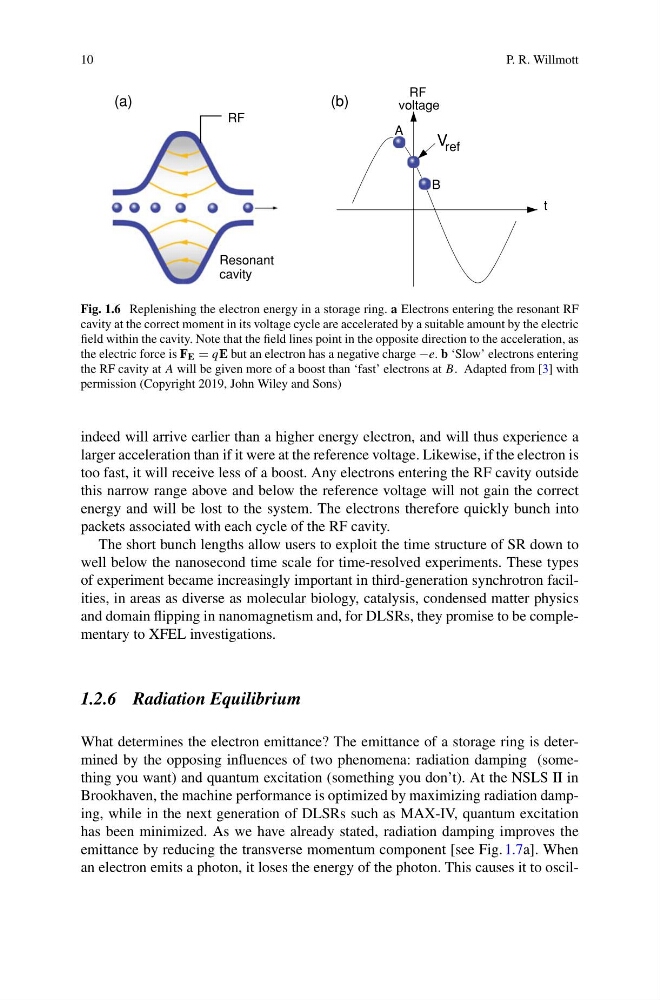
Fig. 1.6 Replenishing the electron energy in a storage ring. a Electrons entering the resonant RF
cavity at the correct moment in its voltage cycle are accelerated by a suitable amount by the electric
field within the cavity. Note that the field lines point in the opposite direction to the acceleration, as
the electric force is F E = qE but an electron has a negative charge −e. b ‘Slow’ electrons entering
the RF cavity at A will be given more of a boost than ‘fast’ electrons at B. Adapted from [3] with
permission (Copyright 2019, John Wiley and Sons)
indeed will arrive earlier than a higher energy electron, and will thus experience a
larger acceleration than if it were at the reference voltage. Likewise, if the electron is
too fast, it will receive less of a boost. Any electrons entering the RF cavity outside
this narrow range above and below the reference voltage will not gain the correct
energy and will be lost to the system. The electrons therefore quickly bunch into
packets associated with each cycle of the RF cavity.
The short bunch lengths allow users to exploit the time structure of SR down to
well below the nanosecond time scale for time-resolved experiments. These types
of experiment became increasingly important in third-generation synchrotron facilities, in areas as diverse as molecular biology, catalysis, condensed matter physics
and domain flipping in nanomagnetism and, for DLSRs, they promise to be complementary to XFEL investigations.
1.2.6 Radiation Equilibrium
What determines the electron emittance? The emittance of a storage ring is determined by the opposing influences of two phenomena: radiation damping (something you want) and quantum excitation (something you don’t). At the NSLS II in
Brookhaven, the machine performance is optimized by maximizing radiation damping, while in the next generation of DLSRs such as MAX-IV, quantum excitation
has been minimized. As we have already stated, radiation damping improves the
emittance by reducing the transverse momentum component [see Fig. 1.7a]. When
an electron emits a photon, it loses the energy of the photon. This causes it to oscil-
P. R. Willmott
voltage
t
RF
V ref
A
B
Resonant
cavity
(b)
RF
(a)
Fig. 1.6 Replenishing the electron energy in a storage ring. a Electrons entering the resonant RF
cavity at the correct moment in its voltage cycle are accelerated by a suitable amount by the electric
field within the cavity. Note that the field lines point in the opposite direction to the acceleration, as
the electric force is F E = qE but an electron has a negative charge −e. b ‘Slow’ electrons entering
the RF cavity at A will be given more of a boost than ‘fast’ electrons at B. Adapted from [3] with
permission (Copyright 2019, John Wiley and Sons)
indeed will arrive earlier than a higher energy electron, and will thus experience a
larger acceleration than if it were at the reference voltage. Likewise, if the electron is
too fast, it will receive less of a boost. Any electrons entering the RF cavity outside
this narrow range above and below the reference voltage will not gain the correct
energy and will be lost to the system. The electrons therefore quickly bunch into
packets associated with each cycle of the RF cavity.
The short bunch lengths allow users to exploit the time structure of SR down to
well below the nanosecond time scale for time-resolved experiments. These types
of experiment became increasingly important in third-generation synchrotron facilities, in areas as diverse as molecular biology, catalysis, condensed matter physics
and domain flipping in nanomagnetism and, for DLSRs, they promise to be complementary to XFEL investigations.
1.2.6 Radiation Equilibrium
What determines the electron emittance? The emittance of a storage ring is determined by the opposing influences of two phenomena: radiation damping (something you want) and quantum excitation (something you don’t). At the NSLS II in
Brookhaven, the machine performance is optimized by maximizing radiation damping, while in the next generation of DLSRs such as MAX-IV, quantum excitation
has been minimized. As we have already stated, radiation damping improves the
emittance by reducing the transverse momentum component [see Fig. 1.7a]. When
an electron emits a photon, it loses the energy of the photon. This causes it to oscil-