

6 p-Wave Superconductivity and d-Vector Representation
187
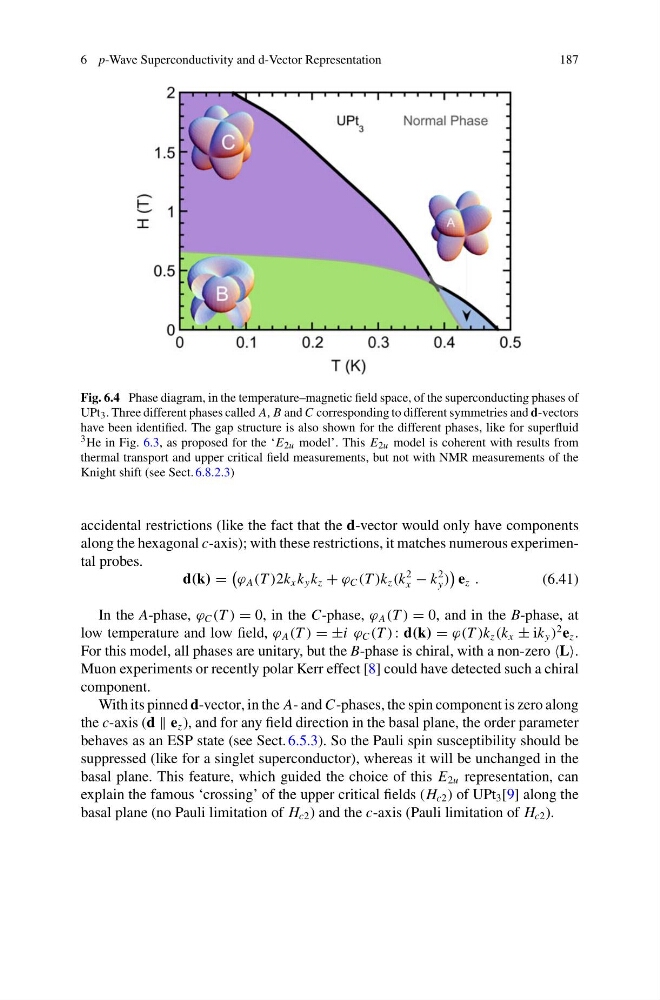
Fig. 6.4 Phase diagram, in the temperature–magnetic field space, of the superconducting phases of
UPt 3 . Three different phases called A, B and C corresponding to different symmetries and d-vectors
have been identified. The gap structure is also shown for the different phases, like for superfluid
3 He in Fig. 6.3, as proposed for the ‘E 2u model’. This E 2u model is coherent with results from
thermal transport and upper critical field measurements, but not with NMR measurements of the
Knight shift (see Sect. 6.8.2.3)
accidental restrictions (like the fact that the d-vector would only have components
along the hexagonal c-axis); with these restrictions, it matches numerous experimental probes.
d(k) =
ϕ A (T )2k x k y k z + ϕ C (T )k z (k
2
x − k
2
y )
e z .
(6.41)
In the A-phase, ϕ C (T ) = 0, in the C-phase, ϕ A (T ) = 0, and in the B-phase, at
low temperature and low field, ϕ A (T ) = ±i ϕ C (T ) : d(k) = ϕ(T )k z (k x ± ik y )
2 e z .
For this model, all phases are unitary, but the B-phase is chiral, with a non-zero L.
Muon experiments or recently polar Kerr effect [8] could have detected such a chiral
component.
With its pinned d-vector, in the A- and C-phases, the spin component is zero along
the c-axis (d e z ), and for any field direction in the basal plane, the order parameter
behaves as an ESP state (see Sect. 6.5.3). So the Pauli spin susceptibility should be
suppressed (like for a singlet superconductor), whereas it will be unchanged in the
basal plane. This feature, which guided the choice of this E 2u representation, can
explain the famous ‘crossing’ of the upper critical fields (H c2 ) of UPt 3 [9] along the
basal plane (no Pauli limitation of H c2 ) and the c-axis (Pauli limitation of H c2 ).
187
Fig. 6.4 Phase diagram, in the temperature–magnetic field space, of the superconducting phases of
UPt 3 . Three different phases called A, B and C corresponding to different symmetries and d-vectors
have been identified. The gap structure is also shown for the different phases, like for superfluid
3 He in Fig. 6.3, as proposed for the ‘E 2u model’. This E 2u model is coherent with results from
thermal transport and upper critical field measurements, but not with NMR measurements of the
Knight shift (see Sect. 6.8.2.3)
accidental restrictions (like the fact that the d-vector would only have components
along the hexagonal c-axis); with these restrictions, it matches numerous experimental probes.
d(k) =
ϕ A (T )2k x k y k z + ϕ C (T )k z (k
2
x − k
2
y )
e z .
(6.41)
In the A-phase, ϕ C (T ) = 0, in the C-phase, ϕ A (T ) = 0, and in the B-phase, at
low temperature and low field, ϕ A (T ) = ±i ϕ C (T ) : d(k) = ϕ(T )k z (k x ± ik y )
2 e z .
For this model, all phases are unitary, but the B-phase is chiral, with a non-zero L.
Muon experiments or recently polar Kerr effect [8] could have detected such a chiral
component.
With its pinned d-vector, in the A- and C-phases, the spin component is zero along
the c-axis (d e z ), and for any field direction in the basal plane, the order parameter
behaves as an ESP state (see Sect. 6.5.3). So the Pauli spin susceptibility should be
suppressed (like for a singlet superconductor), whereas it will be unchanged in the
basal plane. This feature, which guided the choice of this E 2u representation, can
explain the famous ‘crossing’ of the upper critical fields (H c2 ) of UPt 3 [9] along the
basal plane (no Pauli limitation of H c2 ) and the c-axis (Pauli limitation of H c2 ).