

148
R. Mattana et al.
5.2.1 Voltage Control of Magnetism
5.2.1.1 Effect of Charge Accumulation/Depletion and Electromigration
Perpendicular magnetic anisotropy (PMA) has been widely investigated in
NM/FM/oxide heterostructures. For example, by varying the oxidation time of top
Al layer in Pt/Co/AlOx devices, it has been demonstrated that the PMA is induced
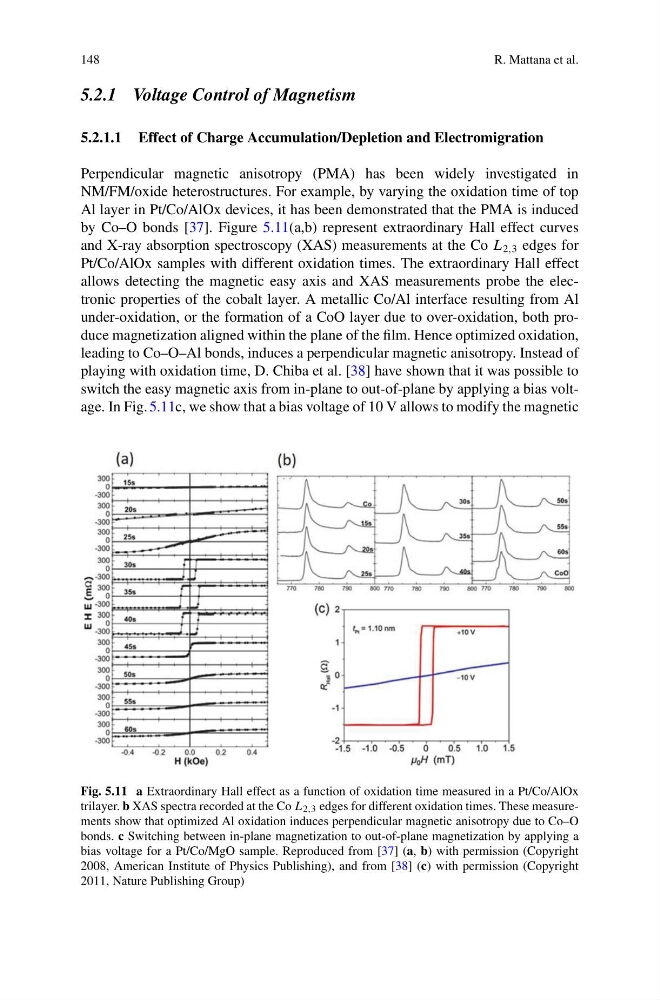
by Co–O bonds [37]. Figure 5.11(a,b) represent extraordinary Hall effect curves
and X-ray absorption spectroscopy (XAS) measurements at the Co L 2,3 edges for
Pt/Co/AlOx samples with different oxidation times. The extraordinary Hall effect
allows detecting the magnetic easy axis and XAS measurements probe the electronic properties of the cobalt layer. A metallic Co/Al interface resulting from Al
under-oxidation, or the formation of a CoO layer due to over-oxidation, both produce magnetization aligned within the plane of the film. Hence optimized oxidation,
leading to Co–O–Al bonds, induces a perpendicular magnetic anisotropy. Instead of
playing with oxidation time, D. Chiba et al. [38] have shown that it was possible to
switch the easy magnetic axis from in-plane to out-of-plane by applying a bias voltage. In Fig. 5.11c, we show that a bias voltage of 10 V allows to modify the magnetic
Fig. 5.11 a Extraordinary Hall effect as a function of oxidation time measured in a Pt/Co/AlOx
trilayer. b XAS spectra recorded at the Co L 2,3 edges for different oxidation times. These measurements show that optimized Al oxidation induces perpendicular magnetic anisotropy due to Co–O
bonds. c Switching between in-plane magnetization to out-of-plane magnetization by applying a
bias voltage for a Pt/Co/MgO sample. Reproduced from [37] (a, b) with permission (Copyright
2008, American Institute of Physics Publishing), and from [38] (c) with permission (Copyright
2011, Nature Publishing Group)
R. Mattana et al.
5.2.1 Voltage Control of Magnetism
5.2.1.1 Effect of Charge Accumulation/Depletion and Electromigration
Perpendicular magnetic anisotropy (PMA) has been widely investigated in
NM/FM/oxide heterostructures. For example, by varying the oxidation time of top
Al layer in Pt/Co/AlOx devices, it has been demonstrated that the PMA is induced
by Co–O bonds [37]. Figure 5.11(a,b) represent extraordinary Hall effect curves
and X-ray absorption spectroscopy (XAS) measurements at the Co L 2,3 edges for
Pt/Co/AlOx samples with different oxidation times. The extraordinary Hall effect
allows detecting the magnetic easy axis and XAS measurements probe the electronic properties of the cobalt layer. A metallic Co/Al interface resulting from Al
under-oxidation, or the formation of a CoO layer due to over-oxidation, both produce magnetization aligned within the plane of the film. Hence optimized oxidation,
leading to Co–O–Al bonds, induces a perpendicular magnetic anisotropy. Instead of
playing with oxidation time, D. Chiba et al. [38] have shown that it was possible to
switch the easy magnetic axis from in-plane to out-of-plane by applying a bias voltage. In Fig. 5.11c, we show that a bias voltage of 10 V allows to modify the magnetic
Fig. 5.11 a Extraordinary Hall effect as a function of oxidation time measured in a Pt/Co/AlOx
trilayer. b XAS spectra recorded at the Co L 2,3 edges for different oxidation times. These measurements show that optimized Al oxidation induces perpendicular magnetic anisotropy due to Co–O
bonds. c Switching between in-plane magnetization to out-of-plane magnetization by applying a
bias voltage for a Pt/Co/MgO sample. Reproduced from [37] (a, b) with permission (Copyright
2008, American Institute of Physics Publishing), and from [38] (c) with permission (Copyright
2011, Nature Publishing Group)