

142
R. Mattana et al.
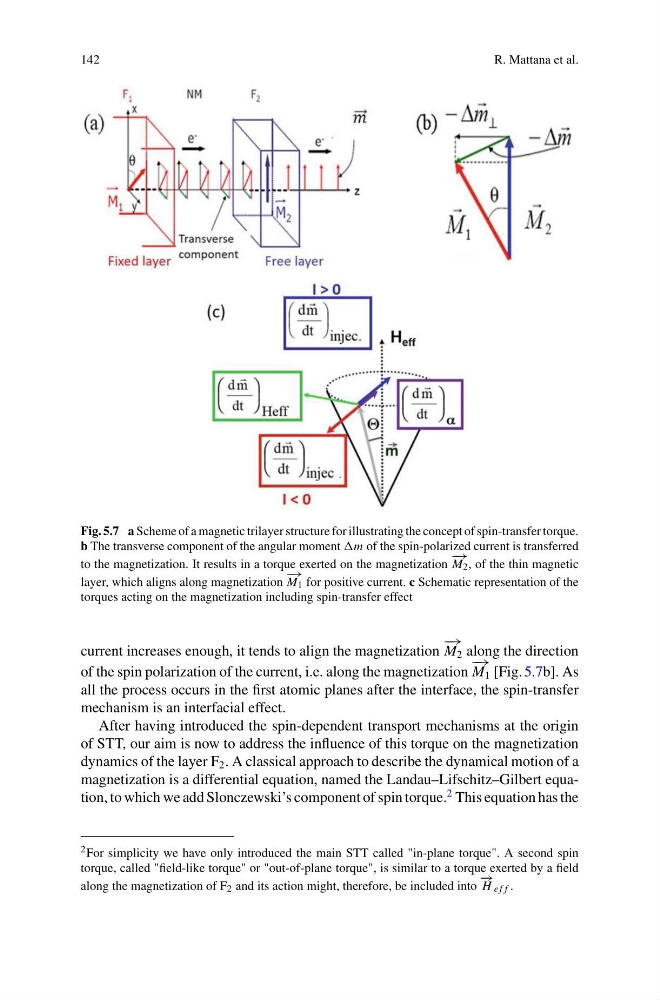
Fig. 5.7 a Scheme of a magnetic trilayer structure for illustrating the concept of spin-transfer torque.
b The transverse component of the angular moment m of the spin-polarized current is transferred
to the magnetization. It results in a torque exerted on the magnetization
− →
M 2 , of the thin magnetic
layer, which aligns along magnetization
− →
M 1 for positive current. c Schematic representation of the
torques acting on the magnetization including spin-transfer effect
current increases enough, it tends to align the magnetization
− →
M 2 along the direction
of the spin polarization of the current, i.e. along the magnetization
− →
M 1 [Fig. 5.7b]. As
all the process occurs in the first atomic planes after the interface, the spin-transfer
mechanism is an interfacial effect.
After having introduced the spin-dependent transport mechanisms at the origin
of STT, our aim is now to address the influence of this torque on the magnetization
dynamics of the layer F 2 . A classical approach to describe the dynamical motion of a
magnetization is a differential equation, named the Landau–Lifschitz–Gilbert equation, to which we add Slonczewski’s component of spin torque.
2 This equation has the
2 For simplicity we have only introduced the main STT called "in-plane torque". A second spin
torque, called "field-like torque" or "out-of-plane torque", is similar to a torque exerted by a field
along the magnetization of F 2 and its action might, therefore, be included into
− →
H ef f .
R. Mattana et al.
Fig. 5.7 a Scheme of a magnetic trilayer structure for illustrating the concept of spin-transfer torque.
b The transverse component of the angular moment m of the spin-polarized current is transferred
to the magnetization. It results in a torque exerted on the magnetization
− →
M 2 , of the thin magnetic
layer, which aligns along magnetization
− →
M 1 for positive current. c Schematic representation of the
torques acting on the magnetization including spin-transfer effect
current increases enough, it tends to align the magnetization
− →
M 2 along the direction
of the spin polarization of the current, i.e. along the magnetization
− →
M 1 [Fig. 5.7b]. As
all the process occurs in the first atomic planes after the interface, the spin-transfer
mechanism is an interfacial effect.
After having introduced the spin-dependent transport mechanisms at the origin
of STT, our aim is now to address the influence of this torque on the magnetization
dynamics of the layer F 2 . A classical approach to describe the dynamical motion of a
magnetization is a differential equation, named the Landau–Lifschitz–Gilbert equation, to which we add Slonczewski’s component of spin torque.
2 This equation has the
2 For simplicity we have only introduced the main STT called "in-plane torque". A second spin
torque, called "field-like torque" or "out-of-plane torque", is similar to a torque exerted by a field
along the magnetization of F 2 and its action might, therefore, be included into
− →
H ef f .