

122
H. Elnaggar et al.
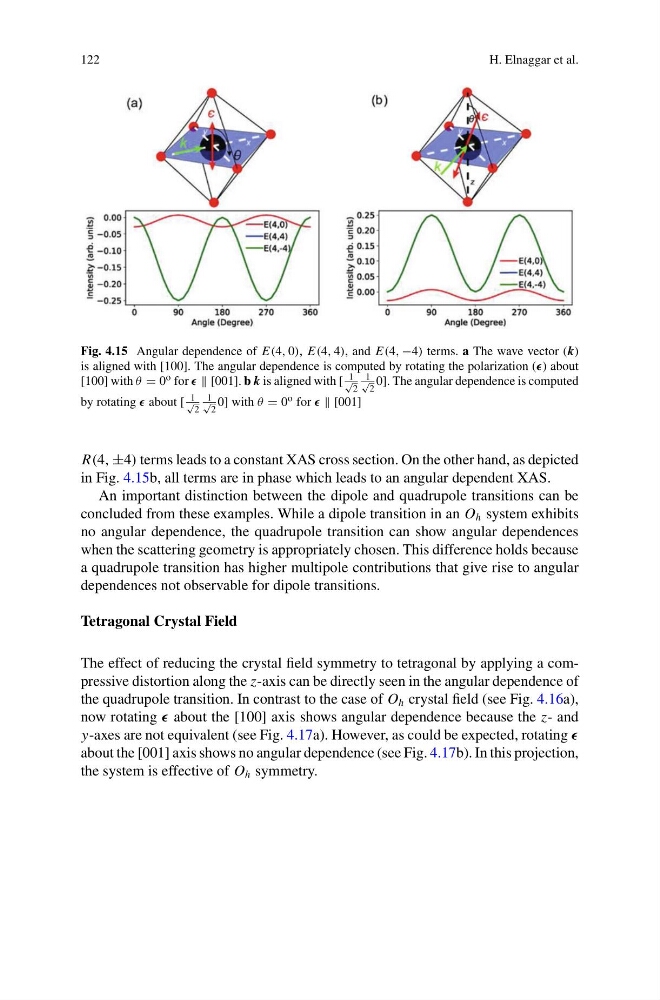
Fig. 4.15 Angular dependence of E(4, 0), E(4, 4), and E(4, −4) terms. a The wave vector (k)
is aligned with [100]. The angular dependence is computed by rotating the polarization () about
[100] with θ = 0 o for [001]. b k is aligned with [
1
√
2
1
√
2
0]. The angular dependence is computed
by rotating about [
1
√
2
1
√
2
0] with θ = 0 o for [001]
R(4, ±4) terms leads to a constant XAS cross section. On the other hand, as depicted
in Fig. 4.15b, all terms are in phase which leads to an angular dependent XAS.
An important distinction between the dipole and quadrupole transitions can be
concluded from these examples. While a dipole transition in an O h system exhibits
no angular dependence, the quadrupole transition can show angular dependences
when the scattering geometry is appropriately chosen. This difference holds because
a quadrupole transition has higher multipole contributions that give rise to angular
dependences not observable for dipole transitions.
Tetragonal Crystal Field
The effect of reducing the crystal field symmetry to tetragonal by applying a compressive distortion along the z-axis can be directly seen in the angular dependence of
the quadrupole transition. In contrast to the case of O h crystal field (see Fig. 4.16a),
now rotating about the [100] axis shows angular dependence because the z- and
y-axes are not equivalent (see Fig. 4.17a). However, as could be expected, rotating
about the [001] axis shows no angular dependence (see Fig. 4.17b). In this projection,
the system is effective of O h symmetry.
H. Elnaggar et al.
Fig. 4.15 Angular dependence of E(4, 0), E(4, 4), and E(4, −4) terms. a The wave vector (k)
is aligned with [100]. The angular dependence is computed by rotating the polarization () about
[100] with θ = 0 o for [001]. b k is aligned with [
1
√
2
1
√
2
0]. The angular dependence is computed
by rotating about [
1
√
2
1
√
2
0] with θ = 0 o for [001]
R(4, ±4) terms leads to a constant XAS cross section. On the other hand, as depicted
in Fig. 4.15b, all terms are in phase which leads to an angular dependent XAS.
An important distinction between the dipole and quadrupole transitions can be
concluded from these examples. While a dipole transition in an O h system exhibits
no angular dependence, the quadrupole transition can show angular dependences
when the scattering geometry is appropriately chosen. This difference holds because
a quadrupole transition has higher multipole contributions that give rise to angular
dependences not observable for dipole transitions.
Tetragonal Crystal Field
The effect of reducing the crystal field symmetry to tetragonal by applying a compressive distortion along the z-axis can be directly seen in the angular dependence of
the quadrupole transition. In contrast to the case of O h crystal field (see Fig. 4.16a),
now rotating about the [100] axis shows angular dependence because the z- and
y-axes are not equivalent (see Fig. 4.17a). However, as could be expected, rotating
about the [001] axis shows no angular dependence (see Fig. 4.17b). In this projection,
the system is effective of O h symmetry.