

94
H. Elnaggar et al.
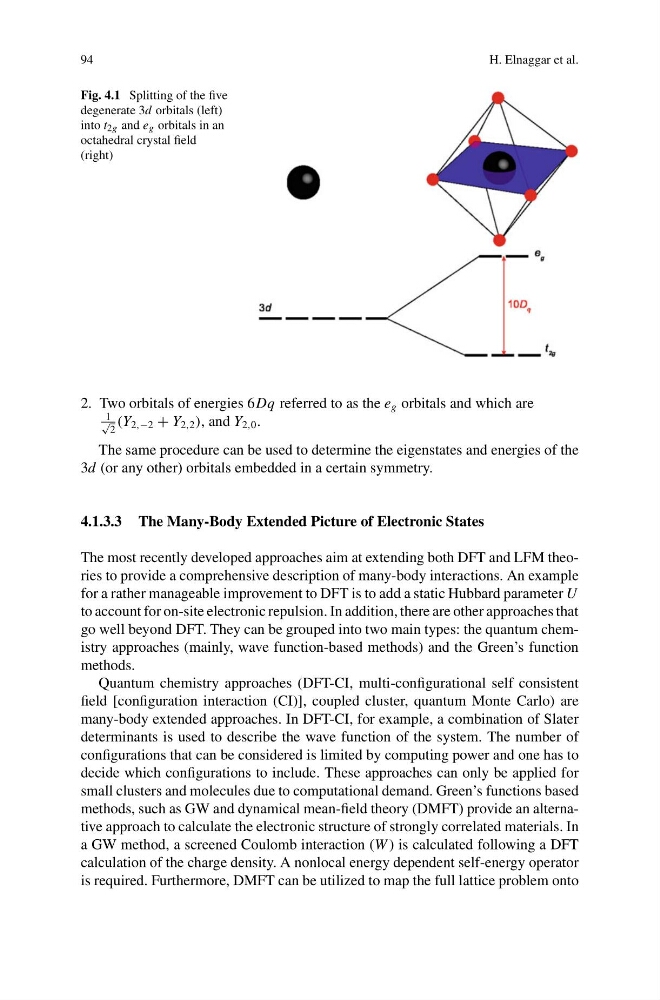
Fig. 4.1 Splitting of the five
degenerate 3d orbitals (left)
into t 2g and e g orbitals in an
octahedral crystal field
(right)
2. Two orbitals of energies 6Dq referred to as the e g orbitals and which are
1
√
2
(Y 2,−2 + Y 2,2 ), and Y 2,0 .
The same procedure can be used to determine the eigenstates and energies of the
3d (or any other) orbitals embedded in a certain symmetry.
4.1.3.3 The Many-Body Extended Picture of Electronic States
The most recently developed approaches aim at extending both DFT and LFM theories to provide a comprehensive description of many-body interactions. An example
for a rather manageable improvement to DFT is to add a static Hubbard parameter U
to account for on-site electronic repulsion. In addition, there are other approaches that
go well beyond DFT. They can be grouped into two main types: the quantum chemistry approaches (mainly, wave function-based methods) and the Green’s function
methods.
Quantum chemistry approaches (DFT-CI, multi-configurational self consistent
field [configuration interaction (CI)], coupled cluster, quantum Monte Carlo) are
many-body extended approaches. In DFT-CI, for example, a combination of Slater
determinants is used to describe the wave function of the system. The number of
configurations that can be considered is limited by computing power and one has to
decide which configurations to include. These approaches can only be applied for
small clusters and molecules due to computational demand. Green’s functions based
methods, such as GW and dynamical mean-field theory (DMFT) provide an alternative approach to calculate the electronic structure of strongly correlated materials. In
a GW method, a screened Coulomb interaction (W ) is calculated following a DFT
calculation of the charge density. A nonlocal energy dependent self-energy operator
is required. Furthermore, DMFT can be utilized to map the full lattice problem onto
H. Elnaggar et al.
Fig. 4.1 Splitting of the five
degenerate 3d orbitals (left)
into t 2g and e g orbitals in an
octahedral crystal field
(right)
2. Two orbitals of energies 6Dq referred to as the e g orbitals and which are
1
√
2
(Y 2,−2 + Y 2,2 ), and Y 2,0 .
The same procedure can be used to determine the eigenstates and energies of the
3d (or any other) orbitals embedded in a certain symmetry.
4.1.3.3 The Many-Body Extended Picture of Electronic States
The most recently developed approaches aim at extending both DFT and LFM theories to provide a comprehensive description of many-body interactions. An example
for a rather manageable improvement to DFT is to add a static Hubbard parameter U
to account for on-site electronic repulsion. In addition, there are other approaches that
go well beyond DFT. They can be grouped into two main types: the quantum chemistry approaches (mainly, wave function-based methods) and the Green’s function
methods.
Quantum chemistry approaches (DFT-CI, multi-configurational self consistent
field [configuration interaction (CI)], coupled cluster, quantum Monte Carlo) are
many-body extended approaches. In DFT-CI, for example, a combination of Slater
determinants is used to describe the wave function of the system. The number of
configurations that can be considered is limited by computing power and one has to
decide which configurations to include. These approaches can only be applied for
small clusters and molecules due to computational demand. Green’s functions based
methods, such as GW and dynamical mean-field theory (DMFT) provide an alternative approach to calculate the electronic structure of strongly correlated materials. In
a GW method, a screened Coulomb interaction (W ) is calculated following a DFT
calculation of the charge density. A nonlocal energy dependent self-energy operator
is required. Furthermore, DMFT can be utilized to map the full lattice problem onto