

4 X-ray Dichroisms in Spherical Tensor and Green’s Function Formalism
89
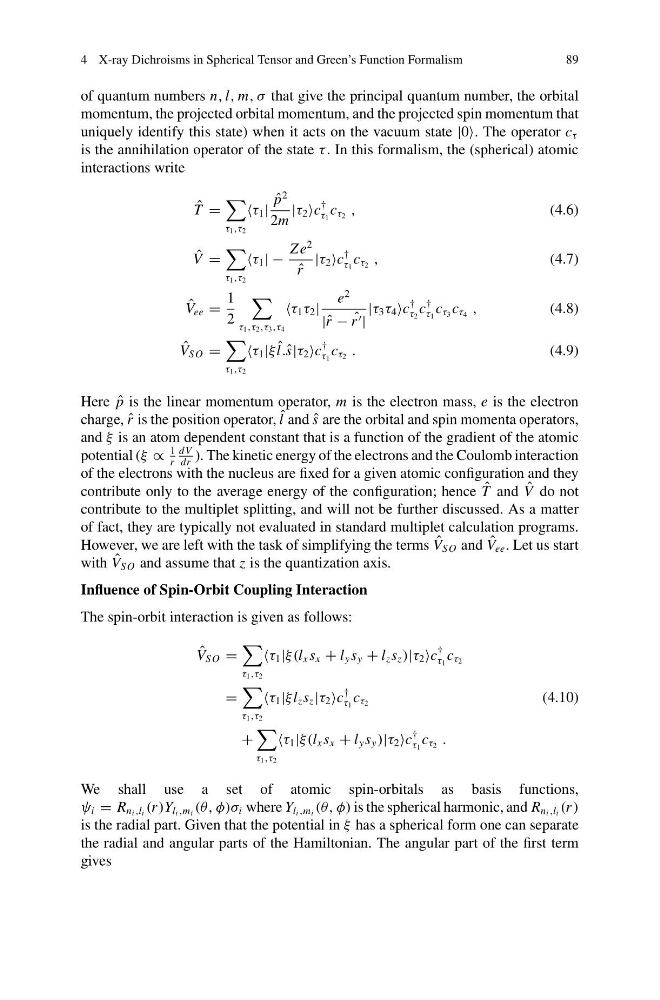
of quantum numbers n, l, m, σ that give the principal quantum number, the orbital
momentum, the projected orbital momentum, and the projected spin momentum that
uniquely identify this state) when it acts on the vacuum state |0. The operator c τ
is the annihilation operator of the state τ . In this formalism, the (spherical) atomic
interactions write
ˆ
T =
τ 1 ,τ 2
τ 1 |
ˆ
p
2
2m
|τ 2 c
†
τ 1
c τ 2 ,
(4.6)
ˆ
V =
τ 1 ,τ 2
τ 1 | −
Ze
2
ˆ
r
|τ 2 c
†
τ 1
c τ 2 ,
(4.7)
ˆ
V ee =
1
2
τ 1 ,τ 2 ,τ 3 ,τ 4
τ 1 τ 2 |
e
2
|ˆ r − ˆ
r |
|τ 3 τ 4 c
†
τ 2
c
†
τ 1
c τ 3 c τ 4 ,
(4.8)
ˆ
V SO =
τ 1 ,τ 2
τ 1 |ξ ˆ
l.ˆ s|τ 2 c
†
τ 1
c τ 2 .
(4.9)
Here ˆ
p is the linear momentum operator, m is the electron mass, e is the electron
charge, ˆ
r is the position operator, ˆ
l and ˆ
s are the orbital and spin momenta operators,
and ξ is an atom dependent constant that is a function of the gradient of the atomic
potential (ξ ∝
1
r
dV
dr
). The kinetic energy of the electrons and the Coulomb interaction
of the electrons with the nucleus are fixed for a given atomic configuration and they
contribute only to the average energy of the configuration; hence ˆ
T and ˆ
V do not
contribute to the multiplet splitting, and will not be further discussed. As a matter
of fact, they are typically not evaluated in standard multiplet calculation programs.
However, we are left with the task of simplifying the terms ˆ
V SO and ˆ
V ee . Let us start
with ˆ
V SO and assume that z is the quantization axis.
Influence of Spin-Orbit Coupling Interaction
The spin-orbit interaction is given as follows:
ˆ
V SO =
τ 1 ,τ 2
τ 1 |ξ(l x s x + l y s y + l z s z )|τ 2 c
†
τ 1
c τ 2
=
τ 1 ,τ 2
τ 1 |ξl z s z |τ 2 c
†
τ 1
c τ 2
(4.10)
+
τ 1 ,τ 2
τ 1 |ξ(l x s x + l y s y )|τ 2 c
†
τ 1
c τ 2 .
We shall use a set of atomic spin-orbitals as basis functions,
ψ i = R n i ,l i (r )Y l i ,m i (θ, φ)σ i where Y l i ,m i (θ, φ) is the spherical harmonic, and R n i ,l i (r )
is the radial part. Given that the potential in ξ has a spherical form one can separate
the radial and angular parts of the Hamiltonian. The angular part of the first term
gives
89
of quantum numbers n, l, m, σ that give the principal quantum number, the orbital
momentum, the projected orbital momentum, and the projected spin momentum that
uniquely identify this state) when it acts on the vacuum state |0. The operator c τ
is the annihilation operator of the state τ . In this formalism, the (spherical) atomic
interactions write
ˆ
T =
τ 1 ,τ 2
τ 1 |
ˆ
p
2
2m
|τ 2 c
†
τ 1
c τ 2 ,
(4.6)
ˆ
V =
τ 1 ,τ 2
τ 1 | −
Ze
2
ˆ
r
|τ 2 c
†
τ 1
c τ 2 ,
(4.7)
ˆ
V ee =
1
2
τ 1 ,τ 2 ,τ 3 ,τ 4
τ 1 τ 2 |
e
2
|ˆ r − ˆ
r |
|τ 3 τ 4 c
†
τ 2
c
†
τ 1
c τ 3 c τ 4 ,
(4.8)
ˆ
V SO =
τ 1 ,τ 2
τ 1 |ξ ˆ
l.ˆ s|τ 2 c
†
τ 1
c τ 2 .
(4.9)
Here ˆ
p is the linear momentum operator, m is the electron mass, e is the electron
charge, ˆ
r is the position operator, ˆ
l and ˆ
s are the orbital and spin momenta operators,
and ξ is an atom dependent constant that is a function of the gradient of the atomic
potential (ξ ∝
1
r
dV
dr
). The kinetic energy of the electrons and the Coulomb interaction
of the electrons with the nucleus are fixed for a given atomic configuration and they
contribute only to the average energy of the configuration; hence ˆ
T and ˆ
V do not
contribute to the multiplet splitting, and will not be further discussed. As a matter
of fact, they are typically not evaluated in standard multiplet calculation programs.
However, we are left with the task of simplifying the terms ˆ
V SO and ˆ
V ee . Let us start
with ˆ
V SO and assume that z is the quantization axis.
Influence of Spin-Orbit Coupling Interaction
The spin-orbit interaction is given as follows:
ˆ
V SO =
τ 1 ,τ 2
τ 1 |ξ(l x s x + l y s y + l z s z )|τ 2 c
†
τ 1
c τ 2
=
τ 1 ,τ 2
τ 1 |ξl z s z |τ 2 c
†
τ 1
c τ 2
(4.10)
+
τ 1 ,τ 2
τ 1 |ξ(l x s x + l y s y )|τ 2 c
†
τ 1
c τ 2 .
We shall use a set of atomic spin-orbitals as basis functions,
ψ i = R n i ,l i (r )Y l i ,m i (θ, φ)σ i where Y l i ,m i (θ, φ) is the spherical harmonic, and R n i ,l i (r )
is the radial part. Given that the potential in ξ has a spherical form one can separate
the radial and angular parts of the Hamiltonian. The angular part of the first term
gives