

71
development through direct medical costs and indirect costs such as loss of productivity and tourism (Narrod et al. 2012).
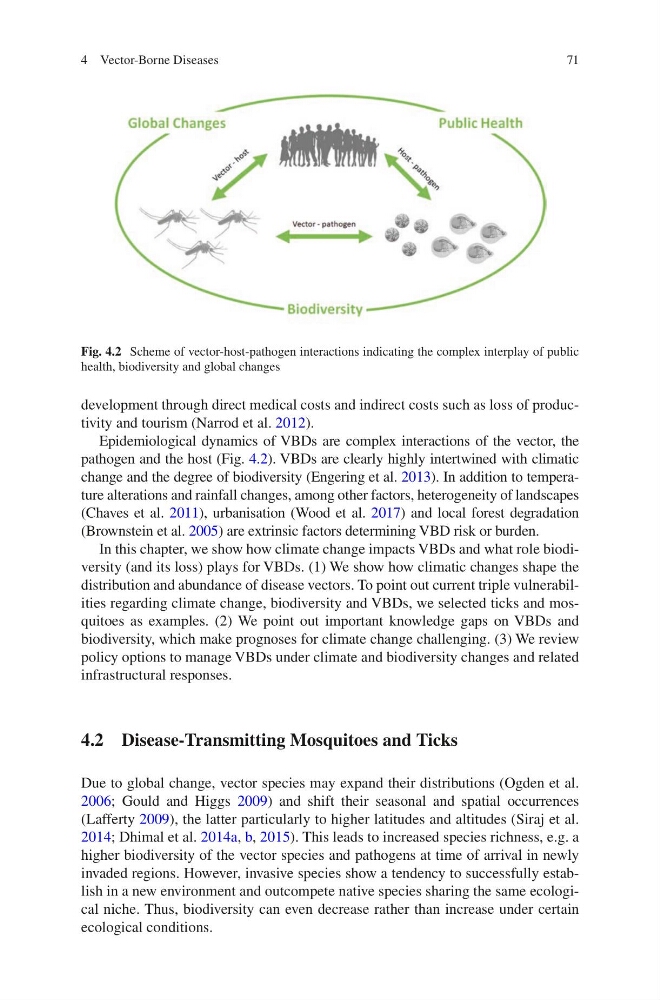
Epidemiological dynamics of VBDs are complex interactions of the vector, the
pathogen and the host (Fig. 4.2). VBDs are clearly highly intertwined with climatic
change and the degree of biodiversity (Engering et al. 2013). In addition to temperature alterations and rainfall changes, among other factors, heterogeneity of landscapes
(Chaves et al. 2011), urbanisation (Wood et al. 2017) and local forest degradation
(Brownstein et al. 2005) are extrinsic factors determining VBD risk or burden.
In this chapter, we show how climate change impacts VBDs and what role biodiversity (and its loss) plays for VBDs. (1) We show how climatic changes shape the
distribution and abundance of disease vectors. To point out current triple vulnerabilities regarding climate change, biodiversity and VBDs, we selected ticks and mosquitoes as examples. (2) We point out important knowledge gaps on VBDs and
biodiversity, which make prognoses for climate change challenging. (3) We review
policy options to manage VBDs under climate and biodiversity changes and related
infrastructural responses.
4.2 Disease-Transmitting Mosquitoes and Ticks
Due to global change, vector species may expand their distributions (Ogden et al.
2006; Gould and Higgs 2009) and shift their seasonal and spatial occurrences
(Lafferty 2009), the latter particularly to higher latitudes and altitudes (Siraj et al.
2014; Dhimal et al. 2014a, b, 2015). This leads to increased species richness, e.g. a
higher biodiversity of the vector species and pathogens at time of arrival in newly
invaded regions. However, invasive species show a tendency to successfully establish in a new environment and outcompete native species sharing the same ecological niche. Thus, biodiversity can even decrease rather than increase under certain
ecological conditions.
Fig. 4.2 Scheme of vector-host-pathogen interactions indicating the complex interplay of public
health, biodiversity and global changes
4 Vector-Borne Diseases
development through direct medical costs and indirect costs such as loss of productivity and tourism (Narrod et al. 2012).
Epidemiological dynamics of VBDs are complex interactions of the vector, the
pathogen and the host (Fig. 4.2). VBDs are clearly highly intertwined with climatic
change and the degree of biodiversity (Engering et al. 2013). In addition to temperature alterations and rainfall changes, among other factors, heterogeneity of landscapes
(Chaves et al. 2011), urbanisation (Wood et al. 2017) and local forest degradation
(Brownstein et al. 2005) are extrinsic factors determining VBD risk or burden.
In this chapter, we show how climate change impacts VBDs and what role biodiversity (and its loss) plays for VBDs. (1) We show how climatic changes shape the
distribution and abundance of disease vectors. To point out current triple vulnerabilities regarding climate change, biodiversity and VBDs, we selected ticks and mosquitoes as examples. (2) We point out important knowledge gaps on VBDs and
biodiversity, which make prognoses for climate change challenging. (3) We review
policy options to manage VBDs under climate and biodiversity changes and related
infrastructural responses.
4.2 Disease-Transmitting Mosquitoes and Ticks
Due to global change, vector species may expand their distributions (Ogden et al.
2006; Gould and Higgs 2009) and shift their seasonal and spatial occurrences
(Lafferty 2009), the latter particularly to higher latitudes and altitudes (Siraj et al.
2014; Dhimal et al. 2014a, b, 2015). This leads to increased species richness, e.g. a
higher biodiversity of the vector species and pathogens at time of arrival in newly
invaded regions. However, invasive species show a tendency to successfully establish in a new environment and outcompete native species sharing the same ecological niche. Thus, biodiversity can even decrease rather than increase under certain
ecological conditions.
Fig. 4.2 Scheme of vector-host-pathogen interactions indicating the complex interplay of public
health, biodiversity and global changes
4 Vector-Borne Diseases