

53
Jugendlichen in Deutschland, (KiGGS initial survey, 2003–2006 of the Robert
Koch Institute)) was shown to be 4.7% (95% CI) for allergic bronchial asthma and
10.7% (95% CI) for allergic rhinitis (Bergmann et al. 2016). Allergic rhinitis was
shown to have a negative impact on quality of life, by using validated questionnaires
like the five-dimension EuroQol QOL survey (EQ-5D, the Sino-Nasal Outcome
Test (SNOT-22) or the Nasal Obstruction Severity Evaluation (NOSE) scale (e.g.
Höhle et al. 2017).
In addition to respiratory symptoms, a number of pollen-allergic patients, especially those with birch allergy, suffer from concomitant pollen-related food allergies, which means that they develop allergy symptoms after ingestion of certain
foods. Symptoms may manifest as oral itching, swelling of the lips, itchy exanthema, shortness of breath, diarrhoea or even circulation problems (Treudler et al.
2017). Overall, the majority of IgE-mediated food allergies in adults are based on
sensitisation to aeroallergens (in particular pollen), followed by (cross-) reactions to
structurally related, often unstable, allergens, especially in (plant) foods such as
fruit, vegetables and spices (Treudler et al. 2017). This type of food allergy has been
referred to as a secondary food allergy, as distinct from the primary form, which is
presumed to involve sensitisation via the gastrointestinal tract. The types of fruit
most commonly involved in pollen-related food allergy belong to the Rosaceae
plant family (e.g. apples) and to the Corylaceae family (e.g. hazel) (Treudler and
Simon 2017). Recently, birch-related soy allergy has gained much attention as soy
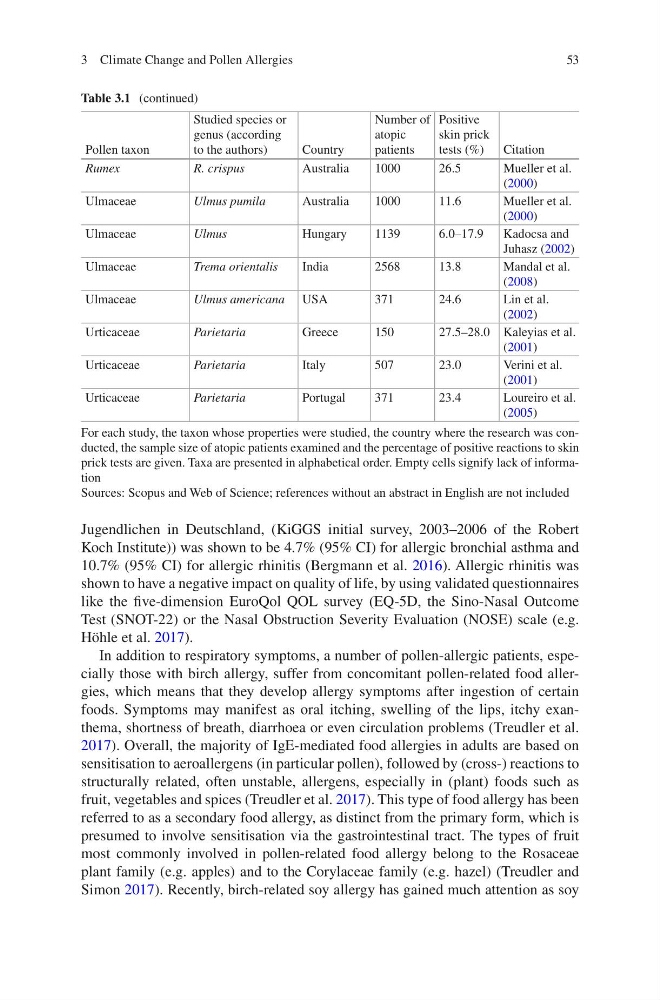
Table 3.1 (continued)
Pollen taxon
Studied species or
genus (according
to the authors)
Country
Number of
atopic
patients
Positive
skin prick
tests (%)
Citation
Rumex
R. crispus
Australia
1000
26.5
Mueller et al.
(2000)
Ulmaceae
Ulmus pumila
Australia
1000
11.6
Mueller et al.
(2000)
Ulmaceae
Ulmus
Hungary
1139
6.0–17.9
Kadocsa and
Juhasz (2002)
Ulmaceae
Trema orientalis
India
2568
13.8
Mandal et al.
(2008)
Ulmaceae
Ulmus americana USA
371
24.6
Lin et al.
(2002)
Urticaceae
Parietaria
Greece
150
27.5–28.0 Kaleyias et al.
(2001)
Urticaceae
Parietaria
Italy
507
23.0
Verini et al.
(2001)
Urticaceae
Parietaria
Portugal
371
23.4
Loureiro et al.
(2005)
For each study, the taxon whose properties were studied, the country where the research was conducted, the sample size of atopic patients examined and the percentage of positive reactions to skin
prick tests are given. Taxa are presented in alphabetical order. Empty cells signify lack of information
Sources: Scopus and Web of Science; references without an abstract in English are not included
3 Climate Change and Pollen Allergies
Jugendlichen in Deutschland, (KiGGS initial survey, 2003–2006 of the Robert
Koch Institute)) was shown to be 4.7% (95% CI) for allergic bronchial asthma and
10.7% (95% CI) for allergic rhinitis (Bergmann et al. 2016). Allergic rhinitis was
shown to have a negative impact on quality of life, by using validated questionnaires
like the five-dimension EuroQol QOL survey (EQ-5D, the Sino-Nasal Outcome
Test (SNOT-22) or the Nasal Obstruction Severity Evaluation (NOSE) scale (e.g.
Höhle et al. 2017).
In addition to respiratory symptoms, a number of pollen-allergic patients, especially those with birch allergy, suffer from concomitant pollen-related food allergies, which means that they develop allergy symptoms after ingestion of certain
foods. Symptoms may manifest as oral itching, swelling of the lips, itchy exanthema, shortness of breath, diarrhoea or even circulation problems (Treudler et al.
2017). Overall, the majority of IgE-mediated food allergies in adults are based on
sensitisation to aeroallergens (in particular pollen), followed by (cross-) reactions to
structurally related, often unstable, allergens, especially in (plant) foods such as
fruit, vegetables and spices (Treudler et al. 2017). This type of food allergy has been
referred to as a secondary food allergy, as distinct from the primary form, which is
presumed to involve sensitisation via the gastrointestinal tract. The types of fruit
most commonly involved in pollen-related food allergy belong to the Rosaceae
plant family (e.g. apples) and to the Corylaceae family (e.g. hazel) (Treudler and
Simon 2017). Recently, birch-related soy allergy has gained much attention as soy
Table 3.1 (continued)
Pollen taxon
Studied species or
genus (according
to the authors)
Country
Number of
atopic
patients
Positive
skin prick
tests (%)
Citation
Rumex
R. crispus
Australia
1000
26.5
Mueller et al.
(2000)
Ulmaceae
Ulmus pumila
Australia
1000
11.6
Mueller et al.
(2000)
Ulmaceae
Ulmus
Hungary
1139
6.0–17.9
Kadocsa and
Juhasz (2002)
Ulmaceae
Trema orientalis
India
2568
13.8
Mandal et al.
(2008)
Ulmaceae
Ulmus americana USA
371
24.6
Lin et al.
(2002)
Urticaceae
Parietaria
Greece
150
27.5–28.0 Kaleyias et al.
(2001)
Urticaceae
Parietaria
Italy
507
23.0
Verini et al.
(2001)
Urticaceae
Parietaria
Portugal
371
23.4
Loureiro et al.
(2005)
For each study, the taxon whose properties were studied, the country where the research was conducted, the sample size of atopic patients examined and the percentage of positive reactions to skin
prick tests are given. Taxa are presented in alphabetical order. Empty cells signify lack of information
Sources: Scopus and Web of Science; references without an abstract in English are not included
3 Climate Change and Pollen Allergies