

40
2.6 Conclusion
In this chapter, we have presented a summary and synthesis of the current evidence
for the links between nature, biodiversity, physical health and climate change with a
particular focus on urban areas. We have mainly drawn on recent review papers from
the peer reviewed academic literature, supplemented by additional materials from a
range of disciplinary fields. Much of the literature is still discipline-based, but
increasingly informed by multi-disciplinary research projects and related endeavours. We feel that this is a necessary and positive development, and the greater availability of papers with large and diverse authorships is a positive sign that research is
increasingly attempting to draw disciplines together to provide insights into the bigger and most critically important questions for human health and well-being.
Nevertheless, we have found little evidence from investigations that explicitly sought
to connect climate change with biodiversity and human physical health.
The evidence that does exist suggests that links between biodiversity, physical
health and climate change are multiple, interconnected, multi-scale and interdependent. Their interdependence puts into sharp focus the importance of a holistic
approach to the major global challenges of health, biodiversity and climate change.
Indeed, a holistic approach in policy and practice is as important as it is in scientific
research (see Korn et al. Chap. 14; Keune et al. Chap. 15, both this volume). Some
of the existing, and newly emerging, challenges for health can be tackled through
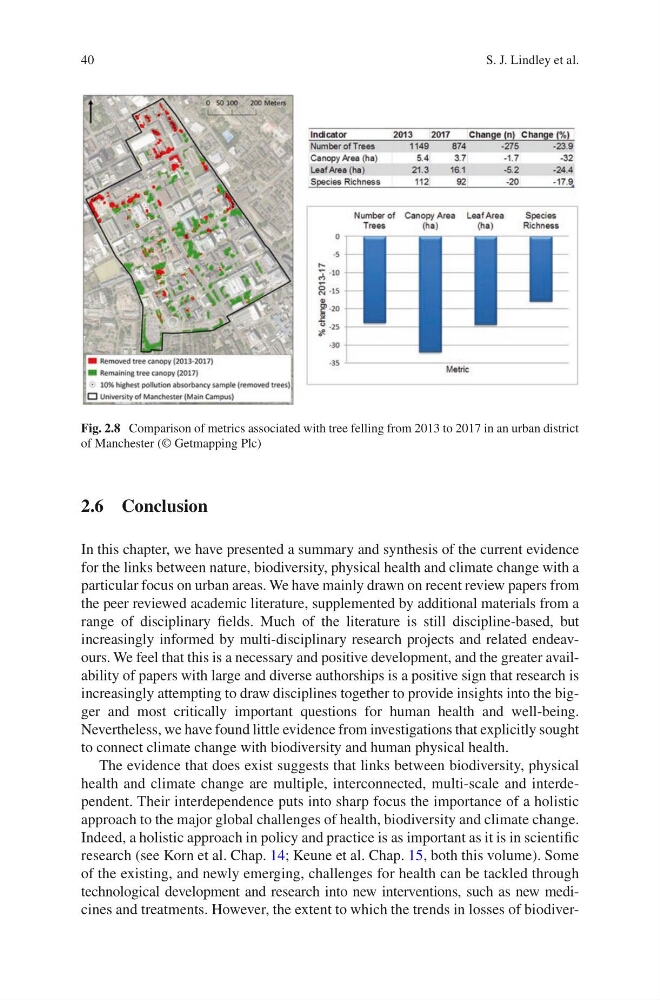
technological development and research into new interventions, such as new medicines and treatments. However, the extent to which the trends in losses of biodiverFig. 2.8 Comparison of metrics associated with tree felling from 2013 to 2017 in an urban district
of Manchester (© Getmapping Plc)
S. J. Lindley et al.
2.6 Conclusion
In this chapter, we have presented a summary and synthesis of the current evidence
for the links between nature, biodiversity, physical health and climate change with a
particular focus on urban areas. We have mainly drawn on recent review papers from
the peer reviewed academic literature, supplemented by additional materials from a
range of disciplinary fields. Much of the literature is still discipline-based, but
increasingly informed by multi-disciplinary research projects and related endeavours. We feel that this is a necessary and positive development, and the greater availability of papers with large and diverse authorships is a positive sign that research is
increasingly attempting to draw disciplines together to provide insights into the bigger and most critically important questions for human health and well-being.
Nevertheless, we have found little evidence from investigations that explicitly sought
to connect climate change with biodiversity and human physical health.
The evidence that does exist suggests that links between biodiversity, physical
health and climate change are multiple, interconnected, multi-scale and interdependent. Their interdependence puts into sharp focus the importance of a holistic
approach to the major global challenges of health, biodiversity and climate change.
Indeed, a holistic approach in policy and practice is as important as it is in scientific
research (see Korn et al. Chap. 14; Keune et al. Chap. 15, both this volume). Some
of the existing, and newly emerging, challenges for health can be tackled through
technological development and research into new interventions, such as new medicines and treatments. However, the extent to which the trends in losses of biodiverFig. 2.8 Comparison of metrics associated with tree felling from 2013 to 2017 in an urban district
of Manchester (© Getmapping Plc)
S. J. Lindley et al.