

403
There was inconclusive evidence to support urban greenways or trails regardless
of whether there were promotion and/or marketing activities to encourage use of the
greenway/trails. There was limited evidence for park-based interventions that only
involved physical change to the urban green space (i.e. they did not include
Case Study: Woods in and Around Towns, Multiple Locations, Scotland,
UK
Led by Forestry Commission Scotland, this greening intervention targets
deprived urban areas within Scotland. The intervention aims to enhance quality of life for local residents by restoring nearby wooded green spaces and
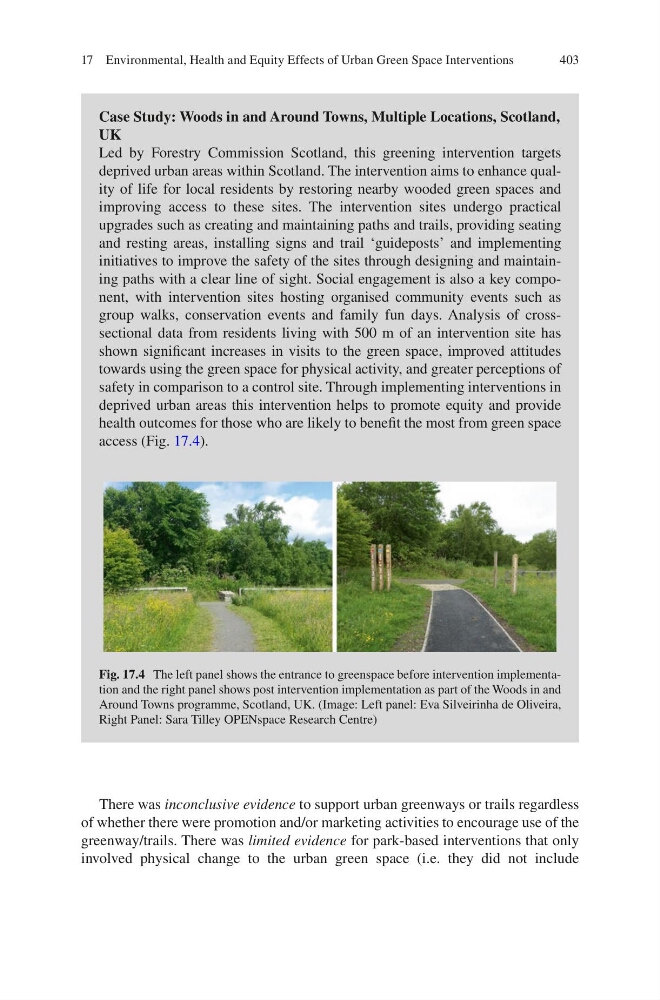
improving access to these sites. The intervention sites undergo practical
upgrades such as creating and maintaining paths and trails, providing seating
and resting areas, installing signs and trail ‘guideposts’ and implementing
initiatives to improve the safety of the sites through designing and maintaining paths with a clear line of sight. Social engagement is also a key component, with intervention sites hosting organised community events such as
group walks, conservation events and family fun days. Analysis of crosssectional data from residents living with 500 m of an intervention site has
shown significant increases in visits to the green space, improved attitudes
towards using the green space for physical activity, and greater perceptions of
safety in comparison to a control site. Through implementing interventions in
deprived urban areas this intervention helps to promote equity and provide
health outcomes for those who are likely to benefit the most from green space
access (Fig. 17.4).
Fig. 17.4 The left panel shows the entrance to greenspace before intervention implementation and the right panel shows post intervention implementation as part of the Woods in and
Around Towns programme, Scotland, UK. (Image: Left panel: Eva Silveirinha de Oliveira,
Right Panel: Sara Tilley OPENspace Research Centre)
17 Environmental, Health and Equity Effects of Urban Green Space Interventions
There was inconclusive evidence to support urban greenways or trails regardless
of whether there were promotion and/or marketing activities to encourage use of the
greenway/trails. There was limited evidence for park-based interventions that only
involved physical change to the urban green space (i.e. they did not include
Case Study: Woods in and Around Towns, Multiple Locations, Scotland,
UK
Led by Forestry Commission Scotland, this greening intervention targets
deprived urban areas within Scotland. The intervention aims to enhance quality of life for local residents by restoring nearby wooded green spaces and
improving access to these sites. The intervention sites undergo practical
upgrades such as creating and maintaining paths and trails, providing seating
and resting areas, installing signs and trail ‘guideposts’ and implementing
initiatives to improve the safety of the sites through designing and maintaining paths with a clear line of sight. Social engagement is also a key component, with intervention sites hosting organised community events such as
group walks, conservation events and family fun days. Analysis of crosssectional data from residents living with 500 m of an intervention site has
shown significant increases in visits to the green space, improved attitudes
towards using the green space for physical activity, and greater perceptions of
safety in comparison to a control site. Through implementing interventions in
deprived urban areas this intervention helps to promote equity and provide
health outcomes for those who are likely to benefit the most from green space
access (Fig. 17.4).
Fig. 17.4 The left panel shows the entrance to greenspace before intervention implementation and the right panel shows post intervention implementation as part of the Woods in and
Around Towns programme, Scotland, UK. (Image: Left panel: Eva Silveirinha de Oliveira,
Right Panel: Sara Tilley OPENspace Research Centre)
17 Environmental, Health and Equity Effects of Urban Green Space Interventions