

392
Significant pre-post increases in trail usage were found for both comparison (31%
increase) and intervention (35% increase) trails (p < 0.01). A large multisite natural experiment in the UK (n = 1796 participants) investigated the impact of new
walking and cycling routes on physical activity (Sahlqvist et al. 2013; Brand et al.
2014; Goodman et al. 2014). Proximity to the intervention was strongly associated with greater use of the new infrastructure (32% of the study population
reported using the new infrastructure at 1-year follow-up; 38% reported at 2-year
Case Study: Parque Ribeiro do Matadouro, Santo Tirso, Portugal
Led by the Santo Tirso municipality, the ‘Parque Ribeiro do Matadouro’ is a
1.54 ha park constructed on derelict land, near the Matadouro stream, close to
the Santo Tirso city centre. Construction of the park was completed in 2013
costing approximately €1,400,000. This park-based intervention applied a
dual approach. Open public forums engaged local community in the design of
the park with feedback and suggestions from the community being included
in the design (e.g. wi-fi access in the park). Guided tours occurred during the
construction phase to keep the community updated on progress of the park’s
construction and the park’s name was chosen via community voting in a naming contest. Signs, interactive art installations and organised community
events within the park invite people to visit and use the park. Further work is
planned to expand green space along the river to create green networks
improving connectivity between Parque Ribeiro do Matadouro and other
green spaces. This phase of works will also closely integrate social engagement, with community gardens and a youth house being established as part of
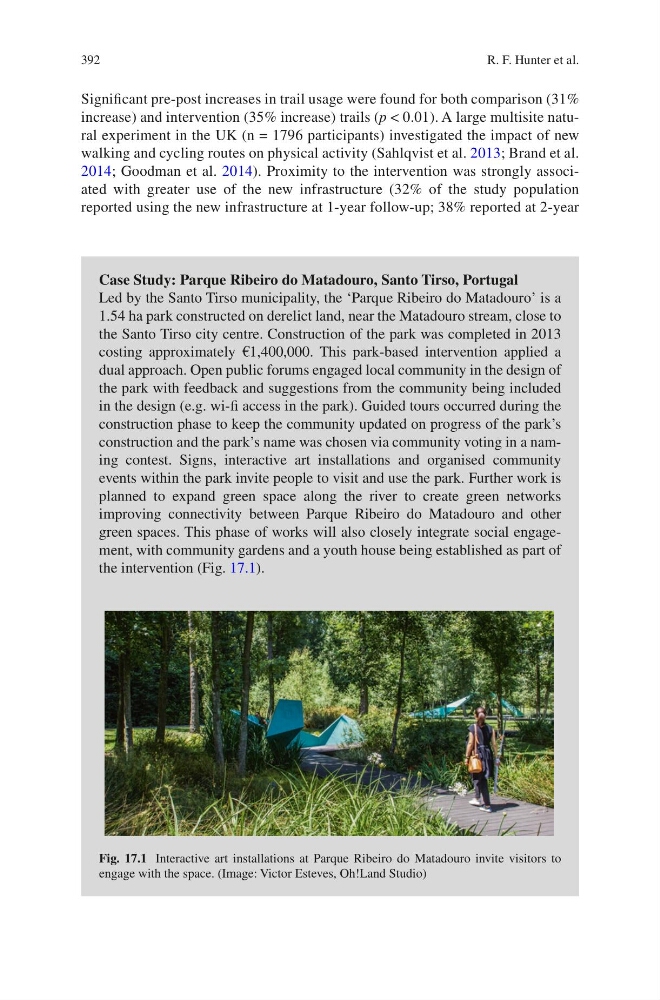
the intervention (Fig. 17.1).
Fig. 17.1 Interactive art installations at Parque Ribeiro do Matadouro invite visitors to
engage with the space. (Image: Victor Esteves, Oh!Land Studio)
R. F. Hunter et al.
Significant pre-post increases in trail usage were found for both comparison (31%
increase) and intervention (35% increase) trails (p < 0.01). A large multisite natural experiment in the UK (n = 1796 participants) investigated the impact of new
walking and cycling routes on physical activity (Sahlqvist et al. 2013; Brand et al.
2014; Goodman et al. 2014). Proximity to the intervention was strongly associated with greater use of the new infrastructure (32% of the study population
reported using the new infrastructure at 1-year follow-up; 38% reported at 2-year
Case Study: Parque Ribeiro do Matadouro, Santo Tirso, Portugal
Led by the Santo Tirso municipality, the ‘Parque Ribeiro do Matadouro’ is a
1.54 ha park constructed on derelict land, near the Matadouro stream, close to
the Santo Tirso city centre. Construction of the park was completed in 2013
costing approximately €1,400,000. This park-based intervention applied a
dual approach. Open public forums engaged local community in the design of
the park with feedback and suggestions from the community being included
in the design (e.g. wi-fi access in the park). Guided tours occurred during the
construction phase to keep the community updated on progress of the park’s
construction and the park’s name was chosen via community voting in a naming contest. Signs, interactive art installations and organised community
events within the park invite people to visit and use the park. Further work is
planned to expand green space along the river to create green networks
improving connectivity between Parque Ribeiro do Matadouro and other
green spaces. This phase of works will also closely integrate social engagement, with community gardens and a youth house being established as part of
the intervention (Fig. 17.1).
Fig. 17.1 Interactive art installations at Parque Ribeiro do Matadouro invite visitors to
engage with the space. (Image: Victor Esteves, Oh!Land Studio)
R. F. Hunter et al.