

253
is an important and emerging area of clinical and public health practice (Axelson
et al. 2018; Andermann 2016).
Reducing unhealthy behaviours requires the construction of supportive environments that facilitate healthier lifestyles. A biodiverse natural environment is a
health-promoting resource (Lovell et al. 2014). More fundamentally, biodiverse
environments are a foundation for human well-being and health, helping to sustain
ecosystems that provide human health benefits, including within nutrition and medicine. A number of suggested conceptual and practical frameworks have been
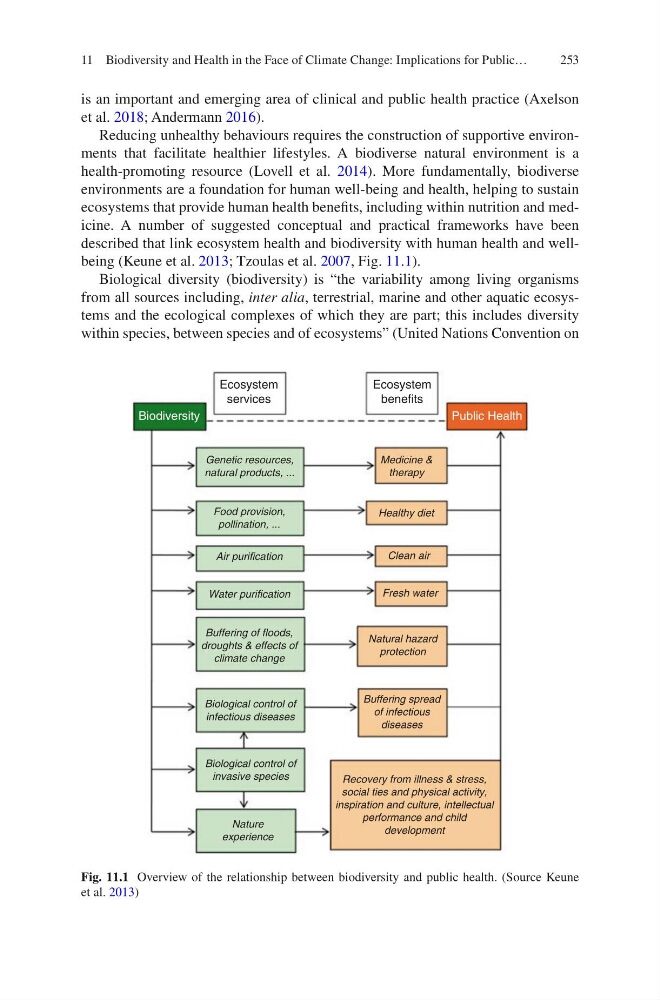
described that link ecosystem health and biodiversity with human health and wellbeing (Keune et al. 2013; Tzoulas et al. 2007, Fig. 11.1).
Biological diversity (biodiversity) is “the variability among living organisms
from all sources including, inter alia, terrestrial, marine and other aquatic ecosystems and the ecological complexes of which they are part; this includes diversity
within species, between species and of ecosystems” (United Nations Convention on
Ecosystem
services
Genetic resources,
natural products, ...
Food provision,
pollination, ...
Air purification
Healthy diet
Clean air
Fresh water
Natural hazard
protection
Buffering spread
of infectious
diseases
Nature
experience
Biological control of
invasive species
Biological control of
infectious diseases
Recovery from illness & stress,
social ties and physical activity,
inspiration and culture, intellectual
performance and child
development
Water purification
Buffering of floods,
droughts & effects of
climate change
Medicine &
therapy
Ecosystem
benefits
Biodiversity
Public Health
Fig. 11.1 Overview of the relationship between biodiversity and public health. (Source Keune
et al. 2013)
11 Biodiversity and Health in the Face of Climate Change: Implications for Public…
is an important and emerging area of clinical and public health practice (Axelson
et al. 2018; Andermann 2016).
Reducing unhealthy behaviours requires the construction of supportive environments that facilitate healthier lifestyles. A biodiverse natural environment is a
health-promoting resource (Lovell et al. 2014). More fundamentally, biodiverse
environments are a foundation for human well-being and health, helping to sustain
ecosystems that provide human health benefits, including within nutrition and medicine. A number of suggested conceptual and practical frameworks have been
described that link ecosystem health and biodiversity with human health and wellbeing (Keune et al. 2013; Tzoulas et al. 2007, Fig. 11.1).
Biological diversity (biodiversity) is “the variability among living organisms
from all sources including, inter alia, terrestrial, marine and other aquatic ecosystems and the ecological complexes of which they are part; this includes diversity
within species, between species and of ecosystems” (United Nations Convention on
Ecosystem
services
Genetic resources,
natural products, ...
Food provision,
pollination, ...
Air purification
Healthy diet
Clean air
Fresh water
Natural hazard
protection
Buffering spread
of infectious
diseases
Nature
experience
Biological control of
invasive species
Biological control of
infectious diseases
Recovery from illness & stress,
social ties and physical activity,
inspiration and culture, intellectual
performance and child
development
Water purification
Buffering of floods,
droughts & effects of
climate change
Medicine &
therapy
Ecosystem
benefits
Biodiversity
Public Health
Fig. 11.1 Overview of the relationship between biodiversity and public health. (Source Keune
et al. 2013)
11 Biodiversity and Health in the Face of Climate Change: Implications for Public…