

218
forward an expanded understanding of spiritual well-being that encompasses one’s
relationships with the self, the community, the environment and a transcendent
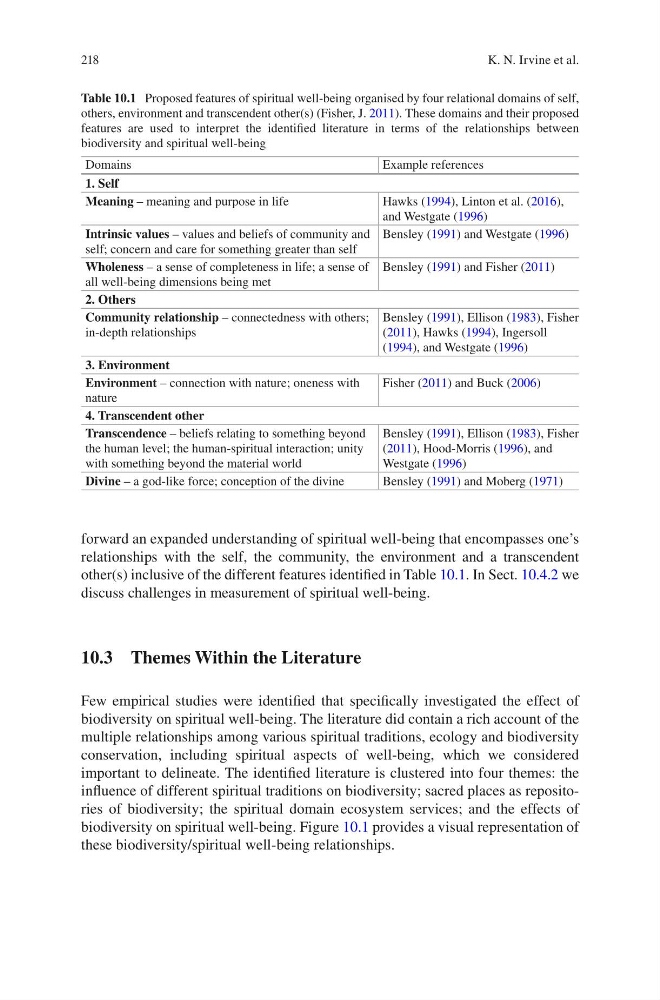
other(s) inclusive of the different features identified in Table 10.1. In Sect. 10.4.2 we
discuss challenges in measurement of spiritual well-being.
10.3 Themes Within the Literature
Few empirical studies were identified that specifically investigated the effect of
biodiversity on spiritual well-being. The literature did contain a rich account of the
multiple relationships among various spiritual traditions, ecology and biodiversity
conservation, including spiritual aspects of well-being, which we considered
important to delineate. The identified literature is clustered into four themes: the
influence of different spiritual traditions on biodiversity; sacred places as repositories of biodiversity; the spiritual domain ecosystem services; and the effects of
biodiversity on spiritual well-being. Figure 10.1 provides a visual representation of
these biodiversity/spiritual well-being relationships.
Table 10.1 Proposed features of spiritual well-being organised by four relational domains of self,
others, environment and transcendent other(s) (Fisher, J. 2011). These domains and their proposed
features are used to interpret the identified literature in terms of the relationships between
biodiversity and spiritual well-being
Domains
Example references
1. Self
Meaning – meaning and purpose in life
Hawks (1994), Linton et al. (2016),
and Westgate (1996)
Intrinsic values – values and beliefs of community and
self; concern and care for something greater than self
Bensley (1991) and Westgate (1996)
Wholeness – a sense of completeness in life; a sense of
all well-being dimensions being met
Bensley (1991) and Fisher (2011)
2. Others
Community relationship – connectedness with others;
in-depth relationships
Bensley (1991), Ellison (1983), Fisher
(2011), Hawks (1994), Ingersoll
(1994), and Westgate (1996)
3. Environment
Environment – connection with nature; oneness with
nature
Fisher (2011) and Buck (2006)
4. Transcendent other
Transcendence – beliefs relating to something beyond
the human level; the human-spiritual interaction; unity
with something beyond the material world
Bensley (1991), Ellison (1983), Fisher
(2011), Hood-Morris (1996), and
Westgate (1996)
Divine – a god-like force; conception of the divine
Bensley (1991) and Moberg (1971)
K. N. Irvine et al.
forward an expanded understanding of spiritual well-being that encompasses one’s
relationships with the self, the community, the environment and a transcendent
other(s) inclusive of the different features identified in Table 10.1. In Sect. 10.4.2 we
discuss challenges in measurement of spiritual well-being.
10.3 Themes Within the Literature
Few empirical studies were identified that specifically investigated the effect of
biodiversity on spiritual well-being. The literature did contain a rich account of the
multiple relationships among various spiritual traditions, ecology and biodiversity
conservation, including spiritual aspects of well-being, which we considered
important to delineate. The identified literature is clustered into four themes: the
influence of different spiritual traditions on biodiversity; sacred places as repositories of biodiversity; the spiritual domain ecosystem services; and the effects of
biodiversity on spiritual well-being. Figure 10.1 provides a visual representation of
these biodiversity/spiritual well-being relationships.
Table 10.1 Proposed features of spiritual well-being organised by four relational domains of self,
others, environment and transcendent other(s) (Fisher, J. 2011). These domains and their proposed
features are used to interpret the identified literature in terms of the relationships between
biodiversity and spiritual well-being
Domains
Example references
1. Self
Meaning – meaning and purpose in life
Hawks (1994), Linton et al. (2016),
and Westgate (1996)
Intrinsic values – values and beliefs of community and
self; concern and care for something greater than self
Bensley (1991) and Westgate (1996)
Wholeness – a sense of completeness in life; a sense of
all well-being dimensions being met
Bensley (1991) and Fisher (2011)
2. Others
Community relationship – connectedness with others;
in-depth relationships
Bensley (1991), Ellison (1983), Fisher
(2011), Hawks (1994), Ingersoll
(1994), and Westgate (1996)
3. Environment
Environment – connection with nature; oneness with
nature
Fisher (2011) and Buck (2006)
4. Transcendent other
Transcendence – beliefs relating to something beyond
the human level; the human-spiritual interaction; unity
with something beyond the material world
Bensley (1991), Ellison (1983), Fisher
(2011), Hood-Morris (1996), and
Westgate (1996)
Divine – a god-like force; conception of the divine
Bensley (1991) and Moberg (1971)
K. N. Irvine et al.