

195
individuals who lived in rural areas, whilst, conversely, bird species richness had the
strongest positive effect on health for those who lived in urban areas. Carrus et al.
(2015) found a high level of biodiversity was more strongly associated with wellbeing in urban green spaces than in peri-urban areas suggesting that higher biodiversity is more important in urban areas for well-being. Other contextual variables,
such as living near to the coast (White et al. 2017), had no moderating effect.
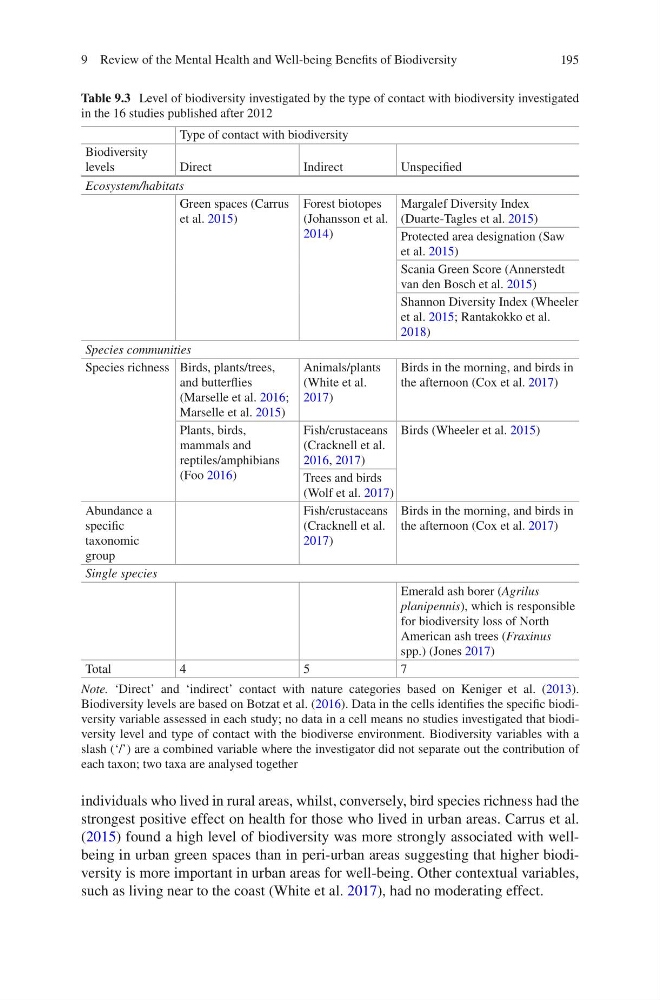
Table 9.3 Level of biodiversity investigated by the type of contact with biodiversity investigated
in the 16 studies published after 2012
Type of contact with biodiversity
Biodiversity
levels
Direct
Indirect
Unspecified
Ecosystem/habitats
Green spaces (Carrus
et al. 2015)
Forest biotopes
(Johansson et al.
2014)
Margalef Diversity Index
(Duarte-Tagles et al. 2015)
Protected area designation (Saw
et al. 2015)
Scania Green Score (Annerstedt
van den Bosch et al. 2015)
Shannon Diversity Index (Wheeler
et al. 2015; Rantakokko et al.
2018)
Species communities
Species richness Birds, plants/trees,
and butterflies
(Marselle et al. 2016;
Marselle et al. 2015)
Animals/plants
(White et al.
2017)
Birds in the morning, and birds in
the afternoon (Cox et al. 2017)
Plants, birds,
mammals and
reptiles/amphibians
(Foo 2016)
Fish/crustaceans
(Cracknell et al.
2016, 2017)
Birds (Wheeler et al. 2015)
Trees and birds
(Wolf et al. 2017)
Abundance a
specific
taxonomic
group
Fish/crustaceans
(Cracknell et al.
2017)
Birds in the morning, and birds in
the afternoon (Cox et al. 2017)
Single species
Emerald ash borer (Agrilus
planipennis), which is responsible
for biodiversity loss of North
American ash trees (Fraxinus
spp.) (Jones 2017)
Total
4
5
7
Note. ‘Direct’ and ‘indirect’ contact with nature categories based on Keniger et al. (2013).
Biodiversity levels are based on Botzat et al. (2016). Data in the cells identifies the specific biodiversity variable assessed in each study; no data in a cell means no studies investigated that biodiversity level and type of contact with the biodiverse environment. Biodiversity variables with a
slash (‘/’) are a combined variable where the investigator did not separate out the contribution of
each taxon; two taxa are analysed together
9 Review of the Mental Health and Well-being Benefits of Biodiversity
individuals who lived in rural areas, whilst, conversely, bird species richness had the
strongest positive effect on health for those who lived in urban areas. Carrus et al.
(2015) found a high level of biodiversity was more strongly associated with wellbeing in urban green spaces than in peri-urban areas suggesting that higher biodiversity is more important in urban areas for well-being. Other contextual variables,
such as living near to the coast (White et al. 2017), had no moderating effect.
Table 9.3 Level of biodiversity investigated by the type of contact with biodiversity investigated
in the 16 studies published after 2012
Type of contact with biodiversity
Biodiversity
levels
Direct
Indirect
Unspecified
Ecosystem/habitats
Green spaces (Carrus
et al. 2015)
Forest biotopes
(Johansson et al.
2014)
Margalef Diversity Index
(Duarte-Tagles et al. 2015)
Protected area designation (Saw
et al. 2015)
Scania Green Score (Annerstedt
van den Bosch et al. 2015)
Shannon Diversity Index (Wheeler
et al. 2015; Rantakokko et al.
2018)
Species communities
Species richness Birds, plants/trees,
and butterflies
(Marselle et al. 2016;
Marselle et al. 2015)
Animals/plants
(White et al.
2017)
Birds in the morning, and birds in
the afternoon (Cox et al. 2017)
Plants, birds,
mammals and
reptiles/amphibians
(Foo 2016)
Fish/crustaceans
(Cracknell et al.
2016, 2017)
Birds (Wheeler et al. 2015)
Trees and birds
(Wolf et al. 2017)
Abundance a
specific
taxonomic
group
Fish/crustaceans
(Cracknell et al.
2017)
Birds in the morning, and birds in
the afternoon (Cox et al. 2017)
Single species
Emerald ash borer (Agrilus
planipennis), which is responsible
for biodiversity loss of North
American ash trees (Fraxinus
spp.) (Jones 2017)
Total
4
5
7
Note. ‘Direct’ and ‘indirect’ contact with nature categories based on Keniger et al. (2013).
Biodiversity levels are based on Botzat et al. (2016). Data in the cells identifies the specific biodiversity variable assessed in each study; no data in a cell means no studies investigated that biodiversity level and type of contact with the biodiverse environment. Biodiversity variables with a
slash (‘/’) are a combined variable where the investigator did not separate out the contribution of
each taxon; two taxa are analysed together
9 Review of the Mental Health and Well-being Benefits of Biodiversity