

151
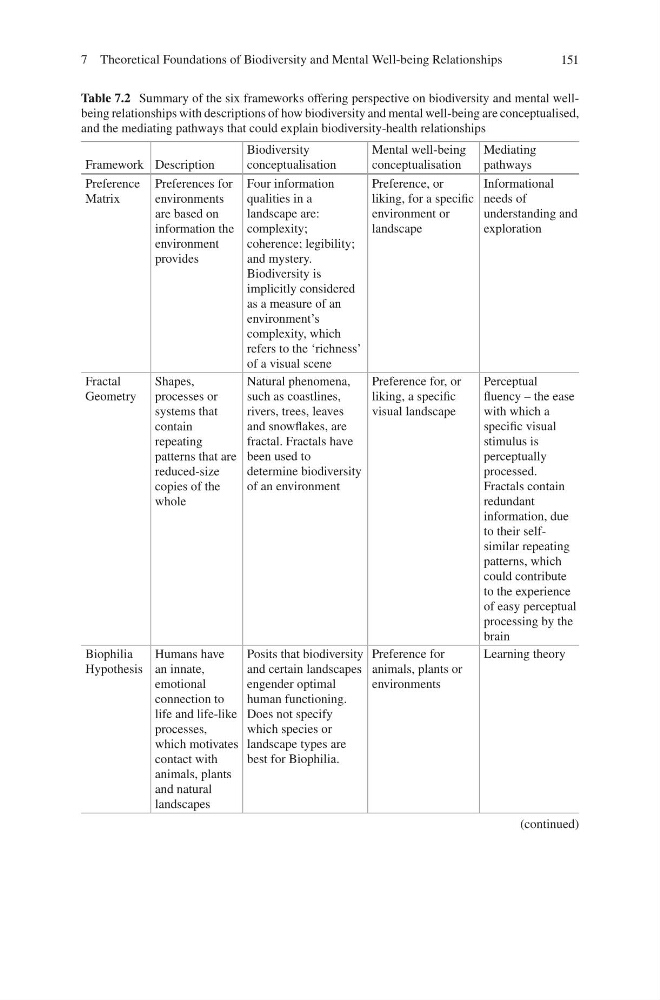
Table 7.2 Summary of the six frameworks offering perspective on biodiversity and mental wellbeing relationships with descriptions of how biodiversity and mental well-being are conceptualised,
and the mediating pathways that could explain biodiversity-health relationships
Framework Description
Biodiversity
conceptualisation
Mental well-being
conceptualisation
Mediating
pathways
Preference
Matrix
Preferences for
environments
are based on
information the
environment
provides
Four information
qualities in a
landscape are:
complexity;
coherence; legibility;
and mystery.
Biodiversity is
implicitly considered
as a measure of an
environment’s
complexity, which
refers to the ‘richness’
of a visual scene
Preference, or
liking, for a specific
environment or
landscape
Informational
needs of
understanding and
exploration
Fractal
Geometry
Shapes,
processes or
systems that
contain
repeating
patterns that are
reduced-size
copies of the
whole
Natural phenomena,
such as coastlines,
rivers, trees, leaves
and snowflakes, are
fractal. Fractals have
been used to
determine biodiversity
of an environment
Preference for, or
liking, a specific
visual landscape
Perceptual
fluency – the ease
with which a
specific visual
stimulus is
perceptually
processed.
Fractals contain
redundant
information, due
to their selfsimilar repeating
patterns, which
could contribute
to the experience
of easy perceptual
processing by the
brain
Biophilia
Hypothesis
Humans have
an innate,
emotional
connection to
life and life-like
processes,
which motivates
contact with
animals, plants
and natural
landscapes
Posits that biodiversity
and certain landscapes
engender optimal
human functioning.
Does not specify
which species or
landscape types are
best for Biophilia.
Preference for
animals, plants or
environments
Learning theory
(continued)
7 Theoretical Foundations of Biodiversity and Mental Well-being Relationships
Table 7.2 Summary of the six frameworks offering perspective on biodiversity and mental wellbeing relationships with descriptions of how biodiversity and mental well-being are conceptualised,
and the mediating pathways that could explain biodiversity-health relationships
Framework Description
Biodiversity
conceptualisation
Mental well-being
conceptualisation
Mediating
pathways
Preference
Matrix
Preferences for
environments
are based on
information the
environment
provides
Four information
qualities in a
landscape are:
complexity;
coherence; legibility;
and mystery.
Biodiversity is
implicitly considered
as a measure of an
environment’s
complexity, which
refers to the ‘richness’
of a visual scene
Preference, or
liking, for a specific
environment or
landscape
Informational
needs of
understanding and
exploration
Fractal
Geometry
Shapes,
processes or
systems that
contain
repeating
patterns that are
reduced-size
copies of the
whole
Natural phenomena,
such as coastlines,
rivers, trees, leaves
and snowflakes, are
fractal. Fractals have
been used to
determine biodiversity
of an environment
Preference for, or
liking, a specific
visual landscape
Perceptual
fluency – the ease
with which a
specific visual
stimulus is
perceptually
processed.
Fractals contain
redundant
information, due
to their selfsimilar repeating
patterns, which
could contribute
to the experience
of easy perceptual
processing by the
brain
Biophilia
Hypothesis
Humans have
an innate,
emotional
connection to
life and life-like
processes,
which motivates
contact with
animals, plants
and natural
landscapes
Posits that biodiversity
and certain landscapes
engender optimal
human functioning.
Does not specify
which species or
landscape types are
best for Biophilia.
Preference for
animals, plants or
environments
Learning theory
(continued)
7 Theoretical Foundations of Biodiversity and Mental Well-being Relationships