

43 The Influence of Rod Waveguide on Acoustic Emission …
489
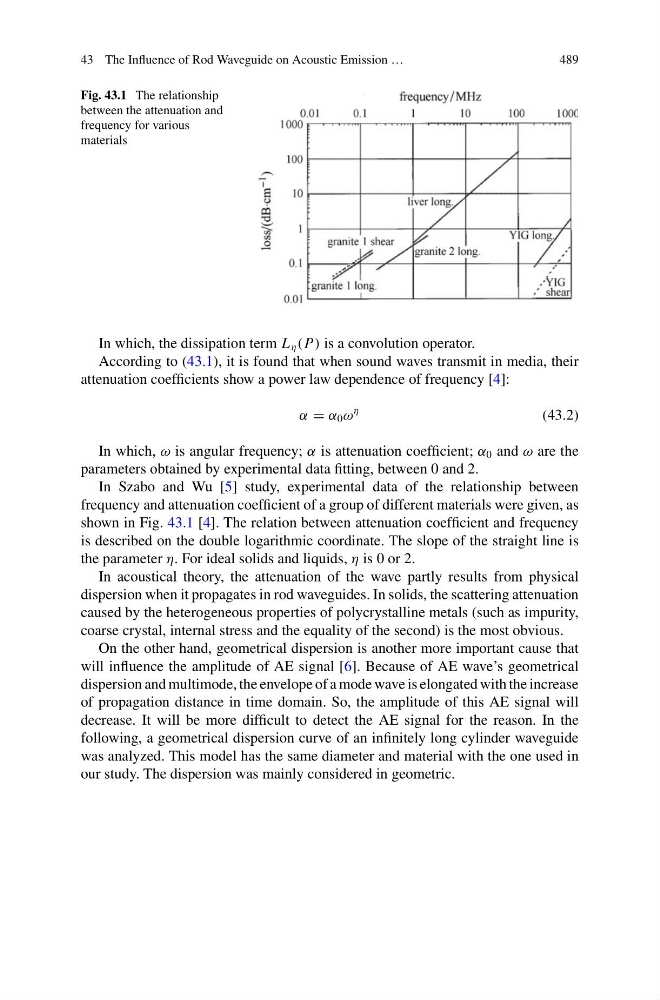
Fig. 43.1 The relationship
between the attenuation and
frequency for various
materials
In which, the dissipation term L η (P) is a convolution operator.
According to (43.1), it is found that when sound waves transmit in media, their
attenuation coefficients show a power law dependence of frequency [4]:
α = α 0 ω
η
(43.2)
In which, ω is angular frequency; α is attenuation coefficient; α 0 and ω are the
parameters obtained by experimental data fitting, between 0 and 2.
In Szabo and Wu [5] study, experimental data of the relationship between
frequency and attenuation coefficient of a group of different materials were given, as
shown in Fig. 43.1 [4]. The relation between attenuation coefficient and frequency
is described on the double logarithmic coordinate. The slope of the straight line is
the parameter η. For ideal solids and liquids, η is 0 or 2.
In acoustical theory, the attenuation of the wave partly results from physical
dispersion when it propagates in rod waveguides. In solids, the scattering attenuation
caused by the heterogeneous properties of polycrystalline metals (such as impurity,
coarse crystal, internal stress and the equality of the second) is the most obvious.
On the other hand, geometrical dispersion is another more important cause that
will influence the amplitude of AE signal [6]. Because of AE wave’s geometrical
dispersion and multimode, the envelope of a mode wave is elongated with the increase
of propagation distance in time domain. So, the amplitude of this AE signal will
decrease. It will be more difficult to detect the AE signal for the reason. In the
following, a geometrical dispersion curve of an infinitely long cylinder waveguide
was analyzed. This model has the same diameter and material with the one used in
our study. The dispersion was mainly considered in geometric.
489
Fig. 43.1 The relationship
between the attenuation and
frequency for various
materials
In which, the dissipation term L η (P) is a convolution operator.
According to (43.1), it is found that when sound waves transmit in media, their
attenuation coefficients show a power law dependence of frequency [4]:
α = α 0 ω
η
(43.2)
In which, ω is angular frequency; α is attenuation coefficient; α 0 and ω are the
parameters obtained by experimental data fitting, between 0 and 2.
In Szabo and Wu [5] study, experimental data of the relationship between
frequency and attenuation coefficient of a group of different materials were given, as
shown in Fig. 43.1 [4]. The relation between attenuation coefficient and frequency
is described on the double logarithmic coordinate. The slope of the straight line is
the parameter η. For ideal solids and liquids, η is 0 or 2.
In acoustical theory, the attenuation of the wave partly results from physical
dispersion when it propagates in rod waveguides. In solids, the scattering attenuation
caused by the heterogeneous properties of polycrystalline metals (such as impurity,
coarse crystal, internal stress and the equality of the second) is the most obvious.
On the other hand, geometrical dispersion is another more important cause that
will influence the amplitude of AE signal [6]. Because of AE wave’s geometrical
dispersion and multimode, the envelope of a mode wave is elongated with the increase
of propagation distance in time domain. So, the amplitude of this AE signal will
decrease. It will be more difficult to detect the AE signal for the reason. In the
following, a geometrical dispersion curve of an infinitely long cylinder waveguide
was analyzed. This model has the same diameter and material with the one used in
our study. The dispersion was mainly considered in geometric.