

480
K. Zhang et al.
(a) V=2.50 km/s
(b) V=5.05 km/s
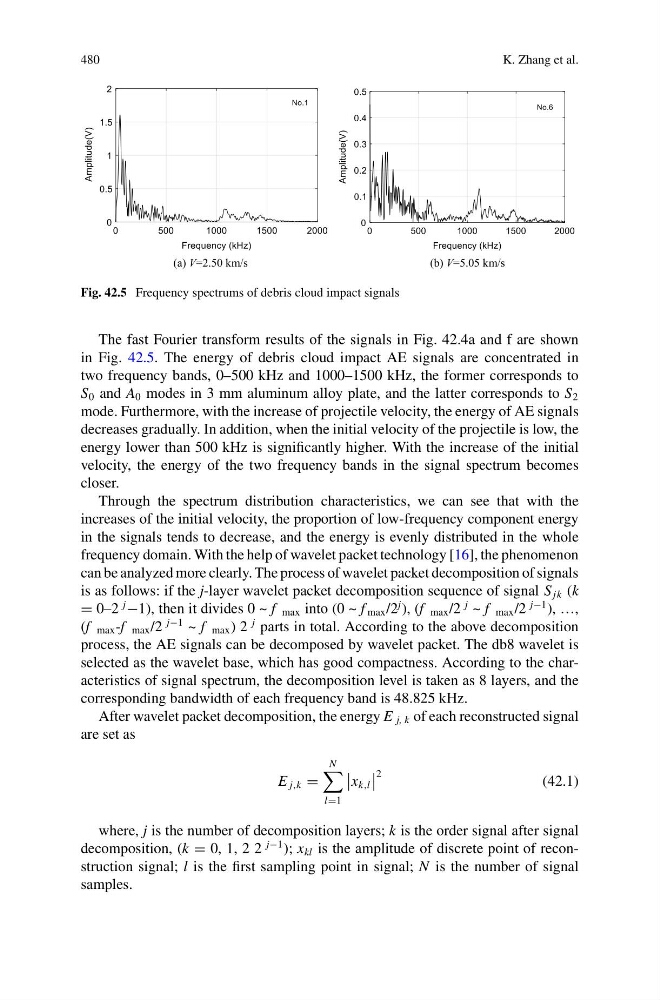
Fig. 42.5 Frequency spectrums of debris cloud impact signals
The fast Fourier transform results of the signals in Fig. 42.4a and f are shown
in Fig. 42.5. The energy of debris cloud impact AE signals are concentrated in
two frequency bands, 0–500 kHz and 1000–1500 kHz, the former corresponds to
S 0 and A 0 modes in 3 mm aluminum alloy plate, and the latter corresponds to S 2
mode. Furthermore, with the increase of projectile velocity, the energy of AE signals
decreases gradually. In addition, when the initial velocity of the projectile is low, the
energy lower than 500 kHz is significantly higher. With the increase of the initial
velocity, the energy of the two frequency bands in the signal spectrum becomes
closer.
Through the spectrum distribution characteristics, we can see that with the
increases of the initial velocity, the proportion of low-frequency component energy
in the signals tends to decrease, and the energy is evenly distributed in the whole
frequency domain. With the help of wavelet packet technology [16], the phenomenon
can be analyzed more clearly. The process of wavelet packet decomposition of signals
is as follows: if the j-layer wavelet packet decomposition sequence of signal S jk (k
= 0–2
j
−1), then it divides 0 ~ f max into (0 ~ f max /2
j ), (f max /2
j ~ f max /2
j−1 ), …,
(f max -f max /2
j−1 ~ f max ) 2
j parts in total. According to the above decomposition
process, the AE signals can be decomposed by wavelet packet. The db8 wavelet is
selected as the wavelet base, which has good compactness. According to the characteristics of signal spectrum, the decomposition level is taken as 8 layers, and the
corresponding bandwidth of each frequency band is 48.825 kHz.
After wavelet packet decomposition, the energy E j, k of each reconstructed signal
are set as
E j,k =
N
l=1
x k,l
2
(42.1)
where, j is the number of decomposition layers; k is the order signal after signal
decomposition, (k = 0, 1, 2 2
j−1 ); x kl is the amplitude of discrete point of reconstruction signal; l is the first sampling point in signal; N is the number of signal
samples.
K. Zhang et al.
(a) V=2.50 km/s
(b) V=5.05 km/s
Fig. 42.5 Frequency spectrums of debris cloud impact signals
The fast Fourier transform results of the signals in Fig. 42.4a and f are shown
in Fig. 42.5. The energy of debris cloud impact AE signals are concentrated in
two frequency bands, 0–500 kHz and 1000–1500 kHz, the former corresponds to
S 0 and A 0 modes in 3 mm aluminum alloy plate, and the latter corresponds to S 2
mode. Furthermore, with the increase of projectile velocity, the energy of AE signals
decreases gradually. In addition, when the initial velocity of the projectile is low, the
energy lower than 500 kHz is significantly higher. With the increase of the initial
velocity, the energy of the two frequency bands in the signal spectrum becomes
closer.
Through the spectrum distribution characteristics, we can see that with the
increases of the initial velocity, the proportion of low-frequency component energy
in the signals tends to decrease, and the energy is evenly distributed in the whole
frequency domain. With the help of wavelet packet technology [16], the phenomenon
can be analyzed more clearly. The process of wavelet packet decomposition of signals
is as follows: if the j-layer wavelet packet decomposition sequence of signal S jk (k
= 0–2
j
−1), then it divides 0 ~ f max into (0 ~ f max /2
j ), (f max /2
j ~ f max /2
j−1 ), …,
(f max -f max /2
j−1 ~ f max ) 2
j parts in total. According to the above decomposition
process, the AE signals can be decomposed by wavelet packet. The db8 wavelet is
selected as the wavelet base, which has good compactness. According to the characteristics of signal spectrum, the decomposition level is taken as 8 layers, and the
corresponding bandwidth of each frequency band is 48.825 kHz.
After wavelet packet decomposition, the energy E j, k of each reconstructed signal
are set as
E j,k =
N
l=1
x k,l
2
(42.1)
where, j is the number of decomposition layers; k is the order signal after signal
decomposition, (k = 0, 1, 2 2
j−1 ); x kl is the amplitude of discrete point of reconstruction signal; l is the first sampling point in signal; N is the number of signal
samples.