

37 A Method of Vacuum Leak Detecting Based on Acoustic Emission …
421
produce a dipole sound source, and the superposition of the two forms the generation
of gas leak ultrasound [10, 11].
In this paper, the acoustic emission sensors are installed on the spacecraft bulkhead structure to collect the leak acoustic emission signal and perform characteristic
analysis, which can realize leak location and leak rate evaluation. However, because
the spacecraft leak is from the atmosphere to the vacuum, the pressure difference
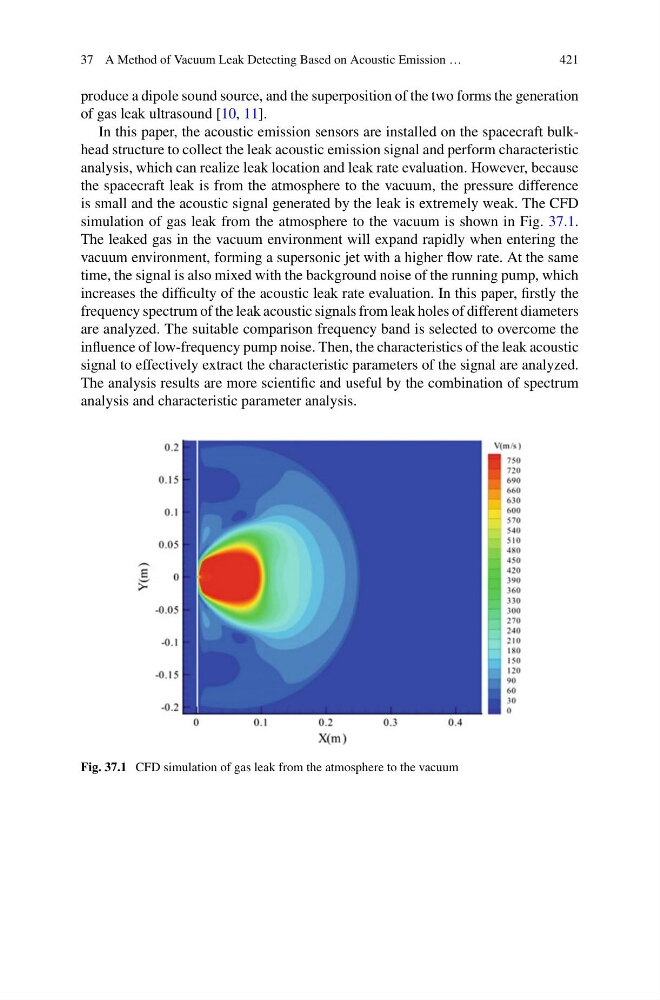
is small and the acoustic signal generated by the leak is extremely weak. The CFD
simulation of gas leak from the atmosphere to the vacuum is shown in Fig. 37.1.
The leaked gas in the vacuum environment will expand rapidly when entering the
vacuum environment, forming a supersonic jet with a higher flow rate. At the same
time, the signal is also mixed with the background noise of the running pump, which
increases the difficulty of the acoustic leak rate evaluation. In this paper, firstly the
frequency spectrum of the leak acoustic signals from leak holes of different diameters
are analyzed. The suitable comparison frequency band is selected to overcome the
influence of low-frequency pump noise. Then, the characteristics of the leak acoustic
signal to effectively extract the characteristic parameters of the signal are analyzed.
The analysis results are more scientific and useful by the combination of spectrum
analysis and characteristic parameter analysis.
Fig. 37.1 CFD simulation of gas leak from the atmosphere to the vacuum
421
produce a dipole sound source, and the superposition of the two forms the generation
of gas leak ultrasound [10, 11].
In this paper, the acoustic emission sensors are installed on the spacecraft bulkhead structure to collect the leak acoustic emission signal and perform characteristic
analysis, which can realize leak location and leak rate evaluation. However, because
the spacecraft leak is from the atmosphere to the vacuum, the pressure difference
is small and the acoustic signal generated by the leak is extremely weak. The CFD
simulation of gas leak from the atmosphere to the vacuum is shown in Fig. 37.1.
The leaked gas in the vacuum environment will expand rapidly when entering the
vacuum environment, forming a supersonic jet with a higher flow rate. At the same
time, the signal is also mixed with the background noise of the running pump, which
increases the difficulty of the acoustic leak rate evaluation. In this paper, firstly the
frequency spectrum of the leak acoustic signals from leak holes of different diameters
are analyzed. The suitable comparison frequency band is selected to overcome the
influence of low-frequency pump noise. Then, the characteristics of the leak acoustic
signal to effectively extract the characteristic parameters of the signal are analyzed.
The analysis results are more scientific and useful by the combination of spectrum
analysis and characteristic parameter analysis.
Fig. 37.1 CFD simulation of gas leak from the atmosphere to the vacuum