

414
Y. Xu et al.
The EO reactor introduced in this paper is a bi-conical shell structure with internal
metal supporting structures to strengthen its rigidity. There are indications that the
container has been leaking for several years. The leakage position is suspected to
be on the vessel wall under the welded heating pipe (half pipe). It is impossible to
enter the container for internal inspection during shutdown inspection, because all
four manholes have been welded after the installation and acceptance of the vessel.
The outside of the conical shell is welded with dense heating pipes, so most of the
inspection methods cannot be implemented because of the small space. Technicians
from foreign manufacturers have come to China several times and have not found
out the location of the leakage. This technical problem has been puzzling the owners
for several years.
Finally, AE technology becomes the only possible way to solve this problem.
The external shell does not bear the internal pressure, only bears the local external
pressure from the heating pipe, and the shell thickness is up to 100 mm, so it is very
likely that the defect (leaking) cannot be excited to send detectable signals or cannot
be further accurately located. Therefore, it brings a great challenge to the application
of AE detection technology. By making a detailed inspection plan and taking some
targeted technical measures, we finally succeeded in finding out the leakage and
positioning it accurately. At the same time, we have also found another very serious
crack with a depth 80 mm.
36.2 AE Testing Process of the EO Reactor
36.2.1 The Structure of the EO Reactor
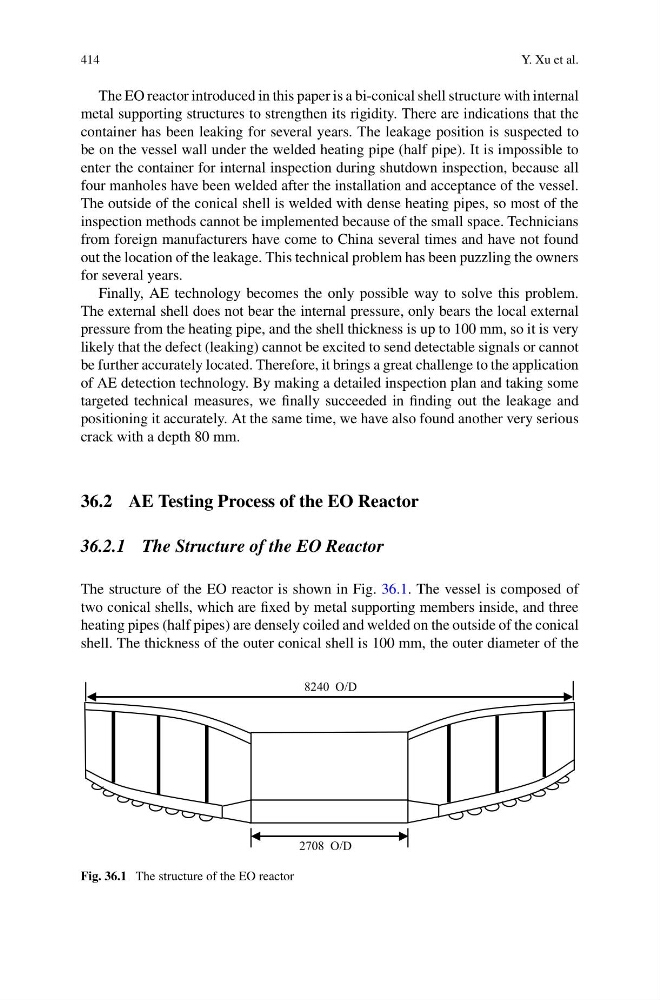
The structure of the EO reactor is shown in Fig. 36.1. The vessel is composed of
two conical shells, which are fixed by metal supporting members inside, and three
heating pipes (half pipes) are densely coiled and welded on the outside of the conical
shell. The thickness of the outer conical shell is 100 mm, the outer diameter of the
8240 O/D
2708 O/D
Fig. 36.1 The structure of the EO reactor
Y. Xu et al.
The EO reactor introduced in this paper is a bi-conical shell structure with internal
metal supporting structures to strengthen its rigidity. There are indications that the
container has been leaking for several years. The leakage position is suspected to
be on the vessel wall under the welded heating pipe (half pipe). It is impossible to
enter the container for internal inspection during shutdown inspection, because all
four manholes have been welded after the installation and acceptance of the vessel.
The outside of the conical shell is welded with dense heating pipes, so most of the
inspection methods cannot be implemented because of the small space. Technicians
from foreign manufacturers have come to China several times and have not found
out the location of the leakage. This technical problem has been puzzling the owners
for several years.
Finally, AE technology becomes the only possible way to solve this problem.
The external shell does not bear the internal pressure, only bears the local external
pressure from the heating pipe, and the shell thickness is up to 100 mm, so it is very
likely that the defect (leaking) cannot be excited to send detectable signals or cannot
be further accurately located. Therefore, it brings a great challenge to the application
of AE detection technology. By making a detailed inspection plan and taking some
targeted technical measures, we finally succeeded in finding out the leakage and
positioning it accurately. At the same time, we have also found another very serious
crack with a depth 80 mm.
36.2 AE Testing Process of the EO Reactor
36.2.1 The Structure of the EO Reactor
The structure of the EO reactor is shown in Fig. 36.1. The vessel is composed of
two conical shells, which are fixed by metal supporting members inside, and three
heating pipes (half pipes) are densely coiled and welded on the outside of the conical
shell. The thickness of the outer conical shell is 100 mm, the outer diameter of the
8240 O/D
2708 O/D
Fig. 36.1 The structure of the EO reactor