

406
V. V. Bardakov et al.
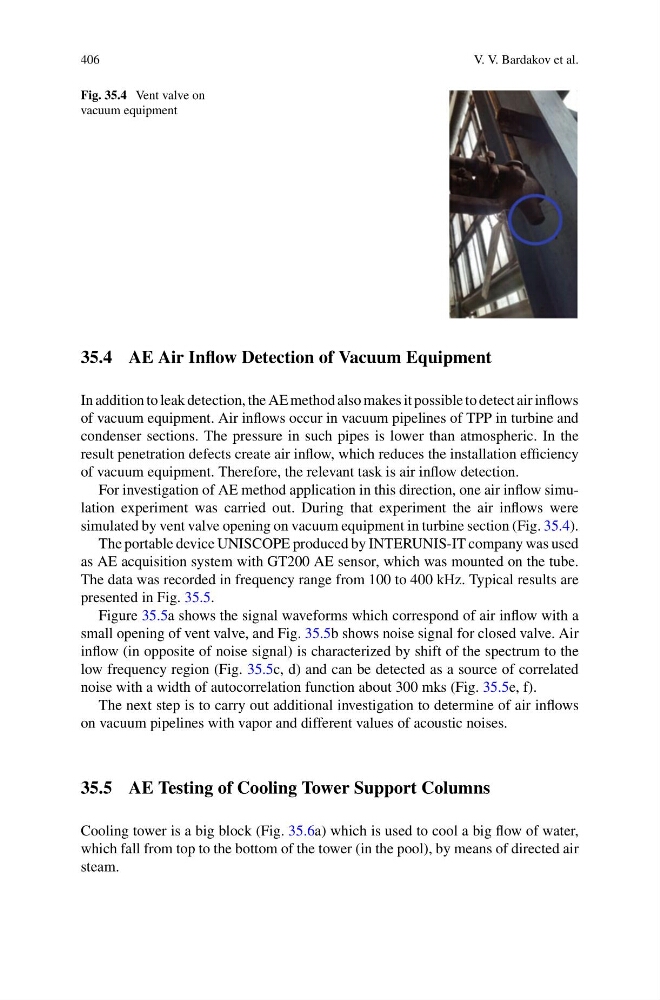
Fig. 35.4 Vent valve on
vacuum equipment
35.4 AE Air Inflow Detection of Vacuum Equipment
In addition to leak detection, the AE method also makes it possible to detect air inflows
of vacuum equipment. Air inflows occur in vacuum pipelines of TPP in turbine and
condenser sections. The pressure in such pipes is lower than atmospheric. In the
result penetration defects create air inflow, which reduces the installation efficiency
of vacuum equipment. Therefore, the relevant task is air inflow detection.
For investigation of AE method application in this direction, one air inflow simulation experiment was carried out. During that experiment the air inflows were
simulated by vent valve opening on vacuum equipment in turbine section (Fig. 35.4).
The portable device UNISCOPE produced by INTERUNIS-IT company was used
as AE acquisition system with GT200 AE sensor, which was mounted on the tube.
The data was recorded in frequency range from 100 to 400 kHz. Typical results are
presented in Fig. 35.5.
Figure 35.5a shows the signal waveforms which correspond of air inflow with a
small opening of vent valve, and Fig. 35.5b shows noise signal for closed valve. Air
inflow (in opposite of noise signal) is characterized by shift of the spectrum to the
low frequency region (Fig. 35.5c, d) and can be detected as a source of correlated
noise with a width of autocorrelation function about 300 mks (Fig. 35.5e, f).
The next step is to carry out additional investigation to determine of air inflows
on vacuum pipelines with vapor and different values of acoustic noises.
35.5 AE Testing of Cooling Tower Support Columns
Cooling tower is a big block (Fig. 35.6a) which is used to cool a big flow of water,
which fall from top to the bottom of the tower (in the pool), by means of directed air
steam.
V. V. Bardakov et al.
Fig. 35.4 Vent valve on
vacuum equipment
35.4 AE Air Inflow Detection of Vacuum Equipment
In addition to leak detection, the AE method also makes it possible to detect air inflows
of vacuum equipment. Air inflows occur in vacuum pipelines of TPP in turbine and
condenser sections. The pressure in such pipes is lower than atmospheric. In the
result penetration defects create air inflow, which reduces the installation efficiency
of vacuum equipment. Therefore, the relevant task is air inflow detection.
For investigation of AE method application in this direction, one air inflow simulation experiment was carried out. During that experiment the air inflows were
simulated by vent valve opening on vacuum equipment in turbine section (Fig. 35.4).
The portable device UNISCOPE produced by INTERUNIS-IT company was used
as AE acquisition system with GT200 AE sensor, which was mounted on the tube.
The data was recorded in frequency range from 100 to 400 kHz. Typical results are
presented in Fig. 35.5.
Figure 35.5a shows the signal waveforms which correspond of air inflow with a
small opening of vent valve, and Fig. 35.5b shows noise signal for closed valve. Air
inflow (in opposite of noise signal) is characterized by shift of the spectrum to the
low frequency region (Fig. 35.5c, d) and can be detected as a source of correlated
noise with a width of autocorrelation function about 300 mks (Fig. 35.5e, f).
The next step is to carry out additional investigation to determine of air inflows
on vacuum pipelines with vapor and different values of acoustic noises.
35.5 AE Testing of Cooling Tower Support Columns
Cooling tower is a big block (Fig. 35.6a) which is used to cool a big flow of water,
which fall from top to the bottom of the tower (in the pool), by means of directed air
steam.