

10
L. Dong
1.3.2 Source Mechanism Inversion [22]
The discrimination of seismic source mechanisms is a crucial and fundamental issue
to analyze and control seismic hazard in mining environments. Different types of
mechanisms have been observed and modelled in the past, including cavity collapses,
rock falls, pillar bursts, explosions, tensional ruptures, and fault-slips [23–25]. By
fitting the amplitude spectrum in the frequency domain and the displacement waveform in the time domain, the point source moment tensor is obtained. A probabilistic
method is used to calculate the likelihood of a given candidate event to a certain
source, so as to identify the type of the induced seismicity in a more quantitative
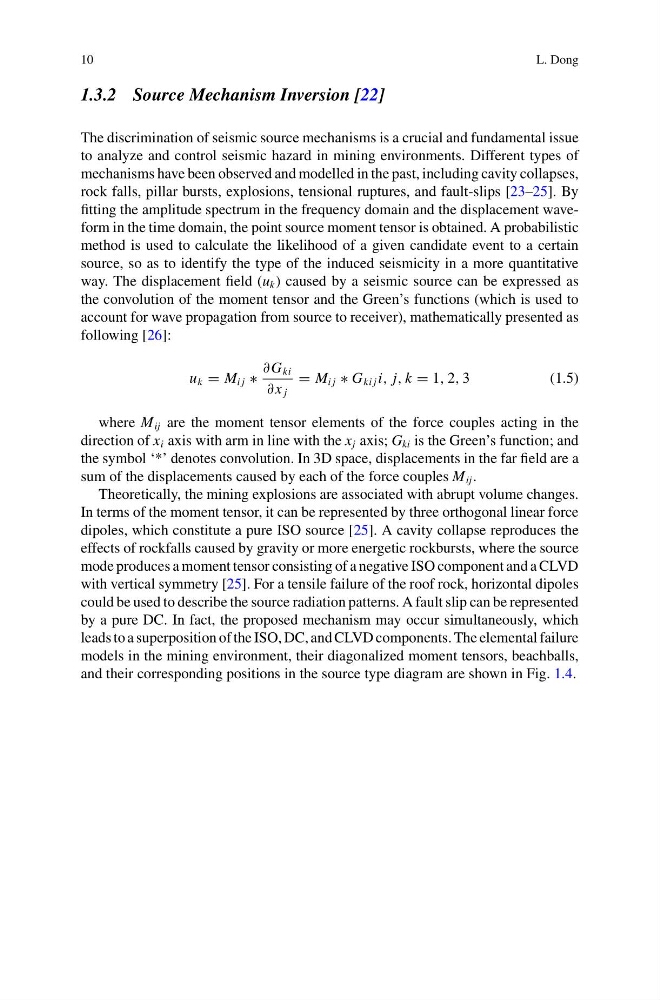
way. The displacement field (u k ) caused by a seismic source can be expressed as
the convolution of the moment tensor and the Green’s functions (which is used to
account for wave propagation from source to receiver), mathematically presented as
following [26]:
u k = M i j ∗
∂G ki
∂ x j
= M i j ∗ G ki j i, j, k = 1, 2, 3
(1.5)
where M ij are the moment tensor elements of the force couples acting in the
direction of x i axis with arm in line with the x j axis; G ki is the Green’s function; and
the symbol ‘*’ denotes convolution. In 3D space, displacements in the far field are a
sum of the displacements caused by each of the force couples M ij .
Theoretically, the mining explosions are associated with abrupt volume changes.
In terms of the moment tensor, it can be represented by three orthogonal linear force
dipoles, which constitute a pure ISO source [25]. A cavity collapse reproduces the
effects of rockfalls caused by gravity or more energetic rockbursts, where the source
mode produces a moment tensor consisting of a negative ISO component and a CLVD
with vertical symmetry [25]. For a tensile failure of the roof rock, horizontal dipoles
could be used to describe the source radiation patterns. A fault slip can be represented
by a pure DC. In fact, the proposed mechanism may occur simultaneously, which
leads to a superposition of the ISO, DC, and CLVD components. The elemental failure
models in the mining environment, their diagonalized moment tensors, beachballs,
and their corresponding positions in the source type diagram are shown in Fig. 1.4.
L. Dong
1.3.2 Source Mechanism Inversion [22]
The discrimination of seismic source mechanisms is a crucial and fundamental issue
to analyze and control seismic hazard in mining environments. Different types of
mechanisms have been observed and modelled in the past, including cavity collapses,
rock falls, pillar bursts, explosions, tensional ruptures, and fault-slips [23–25]. By
fitting the amplitude spectrum in the frequency domain and the displacement waveform in the time domain, the point source moment tensor is obtained. A probabilistic
method is used to calculate the likelihood of a given candidate event to a certain
source, so as to identify the type of the induced seismicity in a more quantitative
way. The displacement field (u k ) caused by a seismic source can be expressed as
the convolution of the moment tensor and the Green’s functions (which is used to
account for wave propagation from source to receiver), mathematically presented as
following [26]:
u k = M i j ∗
∂G ki
∂ x j
= M i j ∗ G ki j i, j, k = 1, 2, 3
(1.5)
where M ij are the moment tensor elements of the force couples acting in the
direction of x i axis with arm in line with the x j axis; G ki is the Green’s function; and
the symbol ‘*’ denotes convolution. In 3D space, displacements in the far field are a
sum of the displacements caused by each of the force couples M ij .
Theoretically, the mining explosions are associated with abrupt volume changes.
In terms of the moment tensor, it can be represented by three orthogonal linear force
dipoles, which constitute a pure ISO source [25]. A cavity collapse reproduces the
effects of rockfalls caused by gravity or more energetic rockbursts, where the source
mode produces a moment tensor consisting of a negative ISO component and a CLVD
with vertical symmetry [25]. For a tensile failure of the roof rock, horizontal dipoles
could be used to describe the source radiation patterns. A fault slip can be represented
by a pure DC. In fact, the proposed mechanism may occur simultaneously, which
leads to a superposition of the ISO, DC, and CLVD components. The elemental failure
models in the mining environment, their diagonalized moment tensors, beachballs,
and their corresponding positions in the source type diagram are shown in Fig. 1.4.