

272
Y. Zhang et al.
Gong et al. [16] evaluated the mechanical properties of alumina coatings by tensile
test. By analyzing the amplitude, energy, counts, the impact rate and the frequency
domain waveform, the process of crack initiation and propagation in the coating
during was pointed out. Meanwhile, the calculation method of mechanical parameters
such as the strength in the coating layer and the bonding strength of the coating was
given.
Watanabi et al. [17] studied the failure process of plasma sprayed alumina coatings under thermal cycling. The temperature range of the thermal cycle was from
room temperature to 1000 °C, which was well beyond the use of AE probes. The
introduction of laser technology solved this problem. Correspondingly, the surface
velocity became the parameter to determine the fracture mode and the location of
each AE events.
In summary, in the study of ceramic coatings, AE played a similar role in the
study of metal coatings, including the determination of mechanical properties and
the analysis of failure processes. In addition, because of that ceramic coatings are
more likely used in high temperature, the use of laser technology is necessary to
widened the temperature range of AE.
Because of the great difference in thermal expansion coefficient between metal
and ceramic, ceramic coatings are easy to peel off under high temperature working
environment. In high temperature applications, a metal transition layer is added
between the ceramic and the metal. This special ceramic coatings are called thermal
barrier coatings.
23.4 Thermal Barrier Coatings
Thermal barrier coatings (TBCs) are widely used in aerospace turbine engines
for their outstanding performance in thermal, abrasion and corrosion resistance.
However, the actual service environment of the thermal barrier coatings is awfully
harsh, and its own structure is complicated, which causes the thermal barrier coating
system to be prone to surface cracking and interface separation, and eventually lead
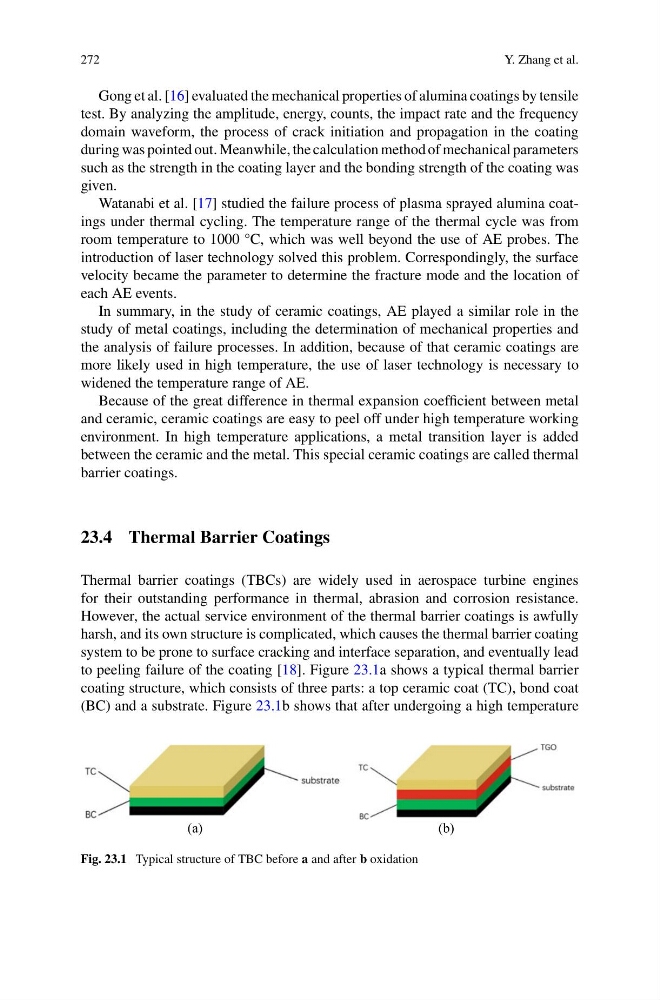
to peeling failure of the coating [18]. Figure 23.1a shows a typical thermal barrier
coating structure, which consists of three parts: a top ceramic coat (TC), bond coat
(BC) and a substrate. Figure 23.1b shows that after undergoing a high temperature
(a)
(b)
Fig. 23.1 Typical structure of TBC before a and after b oxidation
Y. Zhang et al.
Gong et al. [16] evaluated the mechanical properties of alumina coatings by tensile
test. By analyzing the amplitude, energy, counts, the impact rate and the frequency
domain waveform, the process of crack initiation and propagation in the coating
during was pointed out. Meanwhile, the calculation method of mechanical parameters
such as the strength in the coating layer and the bonding strength of the coating was
given.
Watanabi et al. [17] studied the failure process of plasma sprayed alumina coatings under thermal cycling. The temperature range of the thermal cycle was from
room temperature to 1000 °C, which was well beyond the use of AE probes. The
introduction of laser technology solved this problem. Correspondingly, the surface
velocity became the parameter to determine the fracture mode and the location of
each AE events.
In summary, in the study of ceramic coatings, AE played a similar role in the
study of metal coatings, including the determination of mechanical properties and
the analysis of failure processes. In addition, because of that ceramic coatings are
more likely used in high temperature, the use of laser technology is necessary to
widened the temperature range of AE.
Because of the great difference in thermal expansion coefficient between metal
and ceramic, ceramic coatings are easy to peel off under high temperature working
environment. In high temperature applications, a metal transition layer is added
between the ceramic and the metal. This special ceramic coatings are called thermal
barrier coatings.
23.4 Thermal Barrier Coatings
Thermal barrier coatings (TBCs) are widely used in aerospace turbine engines
for their outstanding performance in thermal, abrasion and corrosion resistance.
However, the actual service environment of the thermal barrier coatings is awfully
harsh, and its own structure is complicated, which causes the thermal barrier coating
system to be prone to surface cracking and interface separation, and eventually lead
to peeling failure of the coating [18]. Figure 23.1a shows a typical thermal barrier
coating structure, which consists of three parts: a top ceramic coat (TC), bond coat
(BC) and a substrate. Figure 23.1b shows that after undergoing a high temperature
(a)
(b)
Fig. 23.1 Typical structure of TBC before a and after b oxidation