

246
G. Bai et al.
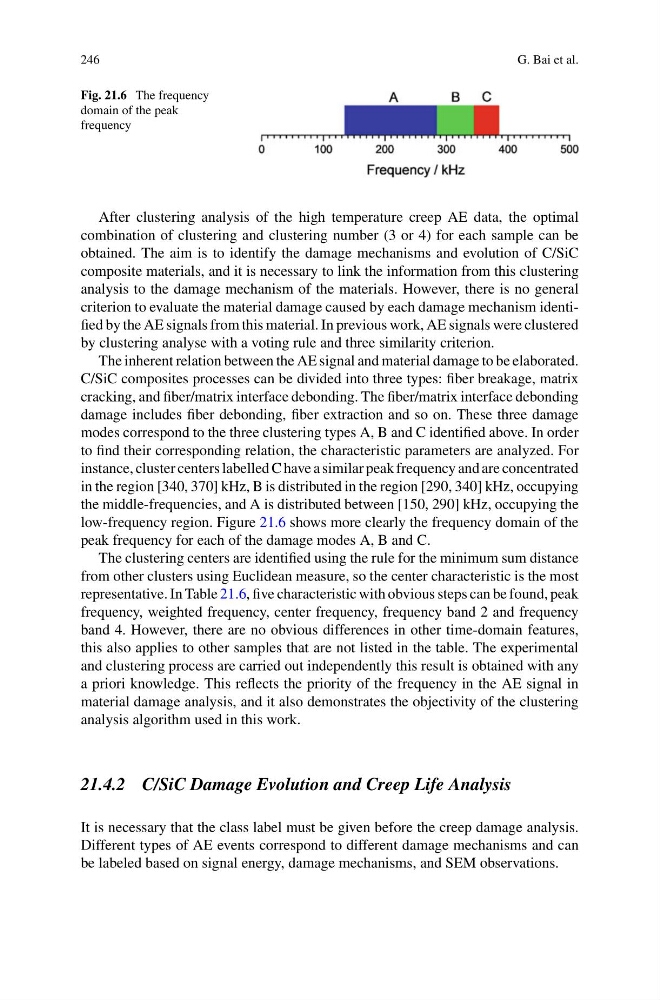
Fig. 21.6 The frequency
domain of the peak
frequency
After clustering analysis of the high temperature creep AE data, the optimal
combination of clustering and clustering number (3 or 4) for each sample can be
obtained. The aim is to identify the damage mechanisms and evolution of C/SiC
composite materials, and it is necessary to link the information from this clustering
analysis to the damage mechanism of the materials. However, there is no general
criterion to evaluate the material damage caused by each damage mechanism identified by the AE signals from this material. In previous work, AE signals were clustered
by clustering analyse with a voting rule and three similarity criterion.
The inherent relation between the AE signal and material damage to be elaborated.
C/SiC composites processes can be divided into three types: fiber breakage, matrix
cracking, and fiber/matrix interface debonding. The fiber/matrix interface debonding
damage includes fiber debonding, fiber extraction and so on. These three damage
modes correspond to the three clustering types A, B and C identified above. In order
to find their corresponding relation, the characteristic parameters are analyzed. For
instance, cluster centers labelled C have a similar peak frequency and are concentrated
in the region [340, 370] kHz, B is distributed in the region [290, 340] kHz, occupying
the middle-frequencies, and A is distributed between [150, 290] kHz, occupying the
low-frequency region. Figure 21.6 shows more clearly the frequency domain of the
peak frequency for each of the damage modes A, B and C.
The clustering centers are identified using the rule for the minimum sum distance
from other clusters using Euclidean measure, so the center characteristic is the most
representative. In Table 21.6, five characteristic with obvious steps can be found, peak
frequency, weighted frequency, center frequency, frequency band 2 and frequency
band 4. However, there are no obvious differences in other time-domain features,
this also applies to other samples that are not listed in the table. The experimental
and clustering process are carried out independently this result is obtained with any
a priori knowledge. This reflects the priority of the frequency in the AE signal in
material damage analysis, and it also demonstrates the objectivity of the clustering
analysis algorithm used in this work.
21.4.2 C/SiC Damage Evolution and Creep Life Analysis
It is necessary that the class label must be given before the creep damage analysis.
Different types of AE events correspond to different damage mechanisms and can
be labeled based on signal energy, damage mechanisms, and SEM observations.
G. Bai et al.
Fig. 21.6 The frequency
domain of the peak
frequency
After clustering analysis of the high temperature creep AE data, the optimal
combination of clustering and clustering number (3 or 4) for each sample can be
obtained. The aim is to identify the damage mechanisms and evolution of C/SiC
composite materials, and it is necessary to link the information from this clustering
analysis to the damage mechanism of the materials. However, there is no general
criterion to evaluate the material damage caused by each damage mechanism identified by the AE signals from this material. In previous work, AE signals were clustered
by clustering analyse with a voting rule and three similarity criterion.
The inherent relation between the AE signal and material damage to be elaborated.
C/SiC composites processes can be divided into three types: fiber breakage, matrix
cracking, and fiber/matrix interface debonding. The fiber/matrix interface debonding
damage includes fiber debonding, fiber extraction and so on. These three damage
modes correspond to the three clustering types A, B and C identified above. In order
to find their corresponding relation, the characteristic parameters are analyzed. For
instance, cluster centers labelled C have a similar peak frequency and are concentrated
in the region [340, 370] kHz, B is distributed in the region [290, 340] kHz, occupying
the middle-frequencies, and A is distributed between [150, 290] kHz, occupying the
low-frequency region. Figure 21.6 shows more clearly the frequency domain of the
peak frequency for each of the damage modes A, B and C.
The clustering centers are identified using the rule for the minimum sum distance
from other clusters using Euclidean measure, so the center characteristic is the most
representative. In Table 21.6, five characteristic with obvious steps can be found, peak
frequency, weighted frequency, center frequency, frequency band 2 and frequency
band 4. However, there are no obvious differences in other time-domain features,
this also applies to other samples that are not listed in the table. The experimental
and clustering process are carried out independently this result is obtained with any
a priori knowledge. This reflects the priority of the frequency in the AE signal in
material damage analysis, and it also demonstrates the objectivity of the clustering
analysis algorithm used in this work.
21.4.2 C/SiC Damage Evolution and Creep Life Analysis
It is necessary that the class label must be given before the creep damage analysis.
Different types of AE events correspond to different damage mechanisms and can
be labeled based on signal energy, damage mechanisms, and SEM observations.