

16 Research on Extraction Method of Fatigue …
175
system, the signal generator is the Agilent 33220A signal generator, which produces
a stable low distortion sinusoidal output signal [14]. The power amplifier is Newton
N4L LPA05B amplifier, which has the advantages of high frequency, large current
and low impedance, and has a fixed gain of 10 times [15]. The oscilloscope modle
is DSO9064A [16] manufactured by Agilent Technologies. The acoustic emission
detector is the SAEU2S acoustic emission detector manufactured by Shenghua Technologies [17]. Based on the experimental requirements of this paper, the sensor
is SR150 sensor manufactured by Shenghua Technologies, and the preamplifier is
broadband universal PAI preamplifier.
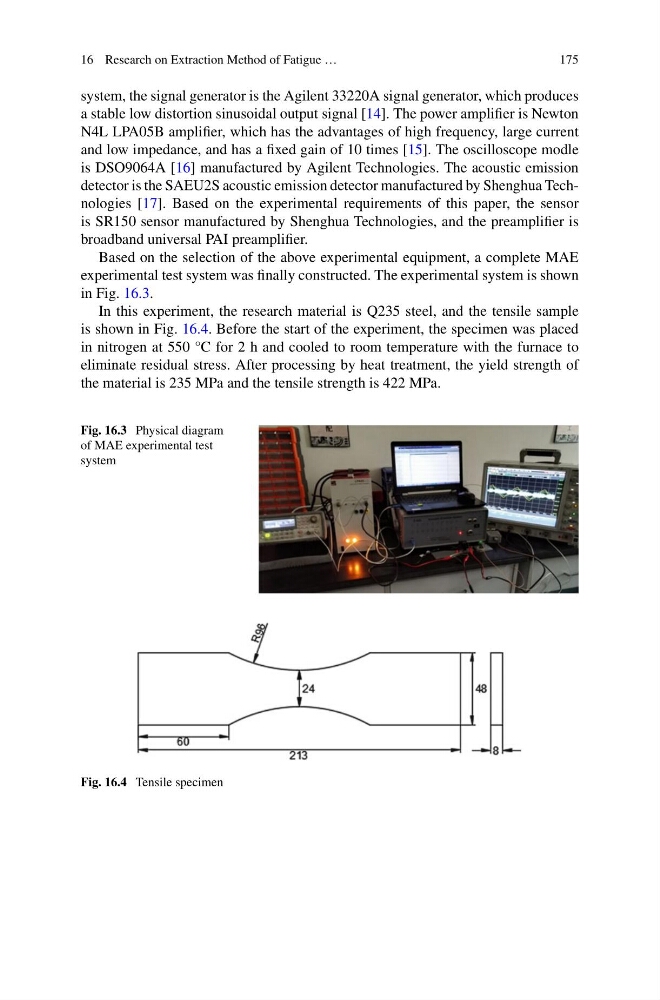
Based on the selection of the above experimental equipment, a complete MAE
experimental test system was finally constructed. The experimental system is shown
in Fig. 16.3.
In this experiment, the research material is Q235 steel, and the tensile sample
is shown in Fig. 16.4. Before the start of the experiment, the specimen was placed
in nitrogen at 550 °C for 2 h and cooled to room temperature with the furnace to
eliminate residual stress. After processing by heat treatment, the yield strength of
the material is 235 MPa and the tensile strength is 422 MPa.
Fig. 16.3 Physical diagram
of MAE experimental test
system
Fig. 16.4 Tensile specimen
175
system, the signal generator is the Agilent 33220A signal generator, which produces
a stable low distortion sinusoidal output signal [14]. The power amplifier is Newton
N4L LPA05B amplifier, which has the advantages of high frequency, large current
and low impedance, and has a fixed gain of 10 times [15]. The oscilloscope modle
is DSO9064A [16] manufactured by Agilent Technologies. The acoustic emission
detector is the SAEU2S acoustic emission detector manufactured by Shenghua Technologies [17]. Based on the experimental requirements of this paper, the sensor
is SR150 sensor manufactured by Shenghua Technologies, and the preamplifier is
broadband universal PAI preamplifier.
Based on the selection of the above experimental equipment, a complete MAE
experimental test system was finally constructed. The experimental system is shown
in Fig. 16.3.
In this experiment, the research material is Q235 steel, and the tensile sample
is shown in Fig. 16.4. Before the start of the experiment, the specimen was placed
in nitrogen at 550 °C for 2 h and cooled to room temperature with the furnace to
eliminate residual stress. After processing by heat treatment, the yield strength of
the material is 235 MPa and the tensile strength is 422 MPa.
Fig. 16.3 Physical diagram
of MAE experimental test
system
Fig. 16.4 Tensile specimen