

16 Research on Extraction Method of Fatigue …
173
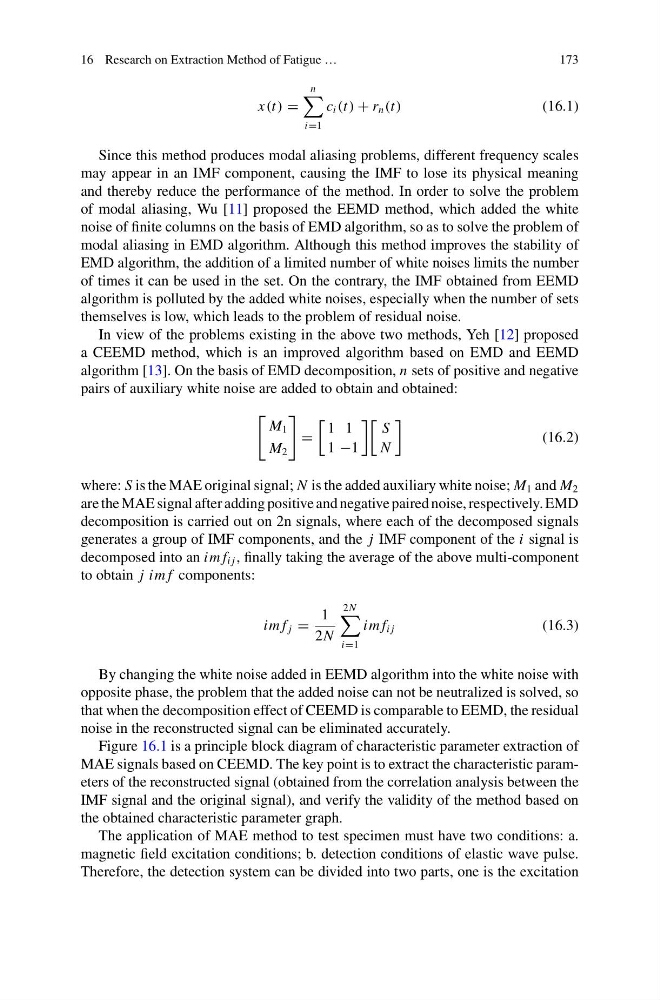
x(t) =
n
i=1
c i (t) + r n (t)
(16.1)
Since this method produces modal aliasing problems, different frequency scales
may appear in an IMF component, causing the IMF to lose its physical meaning
and thereby reduce the performance of the method. In order to solve the problem
of modal aliasing, Wu [11] proposed the EEMD method, which added the white
noise of finite columns on the basis of EMD algorithm, so as to solve the problem of
modal aliasing in EMD algorithm. Although this method improves the stability of
EMD algorithm, the addition of a limited number of white noises limits the number
of times it can be used in the set. On the contrary, the IMF obtained from EEMD
algorithm is polluted by the added white noises, especially when the number of sets
themselves is low, which leads to the problem of residual noise.
In view of the problems existing in the above two methods, Yeh [12] proposed
a CEEMD method, which is an improved algorithm based on EMD and EEMD
algorithm [13]. On the basis of EMD decomposition, n sets of positive and negative
pairs of auxiliary white noise are added to obtain and obtained:
M 1
M 2
=
1 1
1 −1
S
N
(16.2)
where: S is the MAE original signal; N is the added auxiliary white noise; M 1 and M 2
are the MAE signal after adding positive and negative paired noise, respectively. EMD
decomposition is carried out on 2n signals, where each of the decomposed signals
generates a group of IMF components, and the j IMF component of the i signal is
decomposed into an im f i j , finally taking the average of the above multi-component
to obtain j im f components:
im f j =
1
2N
2N
i=1
im f i j
(16.3)
By changing the white noise added in EEMD algorithm into the white noise with
opposite phase, the problem that the added noise can not be neutralized is solved, so
that when the decomposition effect of CEEMD is comparable to EEMD, the residual
noise in the reconstructed signal can be eliminated accurately.
Figure 16.1 is a principle block diagram of characteristic parameter extraction of
MAE signals based on CEEMD. The key point is to extract the characteristic parameters of the reconstructed signal (obtained from the correlation analysis between the
IMF signal and the original signal), and verify the validity of the method based on
the obtained characteristic parameter graph.
The application of MAE method to test specimen must have two conditions: a.
magnetic field excitation conditions; b. detection conditions of elastic wave pulse.
Therefore, the detection system can be divided into two parts, one is the excitation
173
x(t) =
n
i=1
c i (t) + r n (t)
(16.1)
Since this method produces modal aliasing problems, different frequency scales
may appear in an IMF component, causing the IMF to lose its physical meaning
and thereby reduce the performance of the method. In order to solve the problem
of modal aliasing, Wu [11] proposed the EEMD method, which added the white
noise of finite columns on the basis of EMD algorithm, so as to solve the problem of
modal aliasing in EMD algorithm. Although this method improves the stability of
EMD algorithm, the addition of a limited number of white noises limits the number
of times it can be used in the set. On the contrary, the IMF obtained from EEMD
algorithm is polluted by the added white noises, especially when the number of sets
themselves is low, which leads to the problem of residual noise.
In view of the problems existing in the above two methods, Yeh [12] proposed
a CEEMD method, which is an improved algorithm based on EMD and EEMD
algorithm [13]. On the basis of EMD decomposition, n sets of positive and negative
pairs of auxiliary white noise are added to obtain and obtained:
M 1
M 2
=
1 1
1 −1
S
N
(16.2)
where: S is the MAE original signal; N is the added auxiliary white noise; M 1 and M 2
are the MAE signal after adding positive and negative paired noise, respectively. EMD
decomposition is carried out on 2n signals, where each of the decomposed signals
generates a group of IMF components, and the j IMF component of the i signal is
decomposed into an im f i j , finally taking the average of the above multi-component
to obtain j im f components:
im f j =
1
2N
2N
i=1
im f i j
(16.3)
By changing the white noise added in EEMD algorithm into the white noise with
opposite phase, the problem that the added noise can not be neutralized is solved, so
that when the decomposition effect of CEEMD is comparable to EEMD, the residual
noise in the reconstructed signal can be eliminated accurately.
Figure 16.1 is a principle block diagram of characteristic parameter extraction of
MAE signals based on CEEMD. The key point is to extract the characteristic parameters of the reconstructed signal (obtained from the correlation analysis between the
IMF signal and the original signal), and verify the validity of the method based on
the obtained characteristic parameter graph.
The application of MAE method to test specimen must have two conditions: a.
magnetic field excitation conditions; b. detection conditions of elastic wave pulse.
Therefore, the detection system can be divided into two parts, one is the excitation