

14 Study on the Propagation Law of Lamb …
155
14.4.2 Frequency Domain
According to the obtained y-axis displacement waveform, the A0 mode Lamb wave
reaches the receiving point around 160 μs. In this paper, the S0 mode Lamb wave
before 160 μs is selected as the research object.
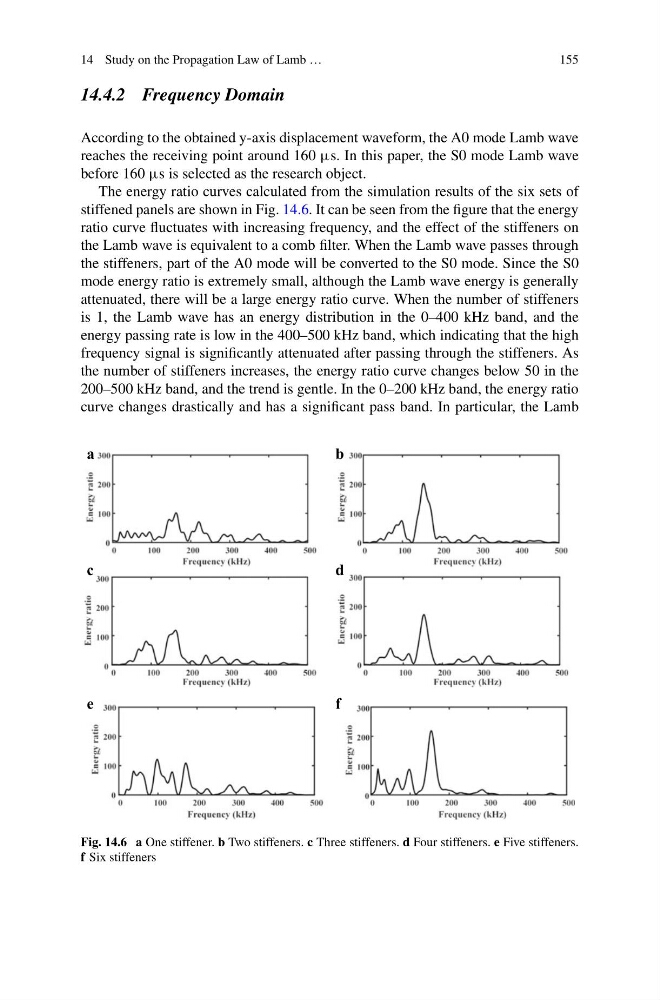
The energy ratio curves calculated from the simulation results of the six sets of
stiffened panels are shown in Fig. 14.6. It can be seen from the figure that the energy
ratio curve fluctuates with increasing frequency, and the effect of the stiffeners on
the Lamb wave is equivalent to a comb filter. When the Lamb wave passes through
the stiffeners, part of the A0 mode will be converted to the S0 mode. Since the S0
mode energy ratio is extremely small, although the Lamb wave energy is generally
attenuated, there will be a large energy ratio curve. When the number of stiffeners
is 1, the Lamb wave has an energy distribution in the 0–400 kHz band, and the
energy passing rate is low in the 400–500 kHz band, which indicating that the high
frequency signal is significantly attenuated after passing through the stiffeners. As
the number of stiffeners increases, the energy ratio curve changes below 50 in the
200–500 kHz band, and the trend is gentle. In the 0–200 kHz band, the energy ratio
curve changes drastically and has a significant pass band. In particular, the Lamb
a
b
c
d
e
f
Fig. 14.6 a One stiffener. b Two stiffeners. c Three stiffeners. d Four stiffeners. e Five stiffeners.
f Six stiffeners
155
14.4.2 Frequency Domain
According to the obtained y-axis displacement waveform, the A0 mode Lamb wave
reaches the receiving point around 160 μs. In this paper, the S0 mode Lamb wave
before 160 μs is selected as the research object.
The energy ratio curves calculated from the simulation results of the six sets of
stiffened panels are shown in Fig. 14.6. It can be seen from the figure that the energy
ratio curve fluctuates with increasing frequency, and the effect of the stiffeners on
the Lamb wave is equivalent to a comb filter. When the Lamb wave passes through
the stiffeners, part of the A0 mode will be converted to the S0 mode. Since the S0
mode energy ratio is extremely small, although the Lamb wave energy is generally
attenuated, there will be a large energy ratio curve. When the number of stiffeners
is 1, the Lamb wave has an energy distribution in the 0–400 kHz band, and the
energy passing rate is low in the 400–500 kHz band, which indicating that the high
frequency signal is significantly attenuated after passing through the stiffeners. As
the number of stiffeners increases, the energy ratio curve changes below 50 in the
200–500 kHz band, and the trend is gentle. In the 0–200 kHz band, the energy ratio
curve changes drastically and has a significant pass band. In particular, the Lamb
a
b
c
d
e
f
Fig. 14.6 a One stiffener. b Two stiffeners. c Three stiffeners. d Four stiffeners. e Five stiffeners.
f Six stiffeners