

13 Fatigue Evolution of Ball Bearing with Improved Acoustic …
145
0
200
400
600
800
1000
t / min
-1
0
1
2
3
4
Amplitude A / V
Kurtosis
Peak Index
Pulse Index
Waveform Index
Margin Index
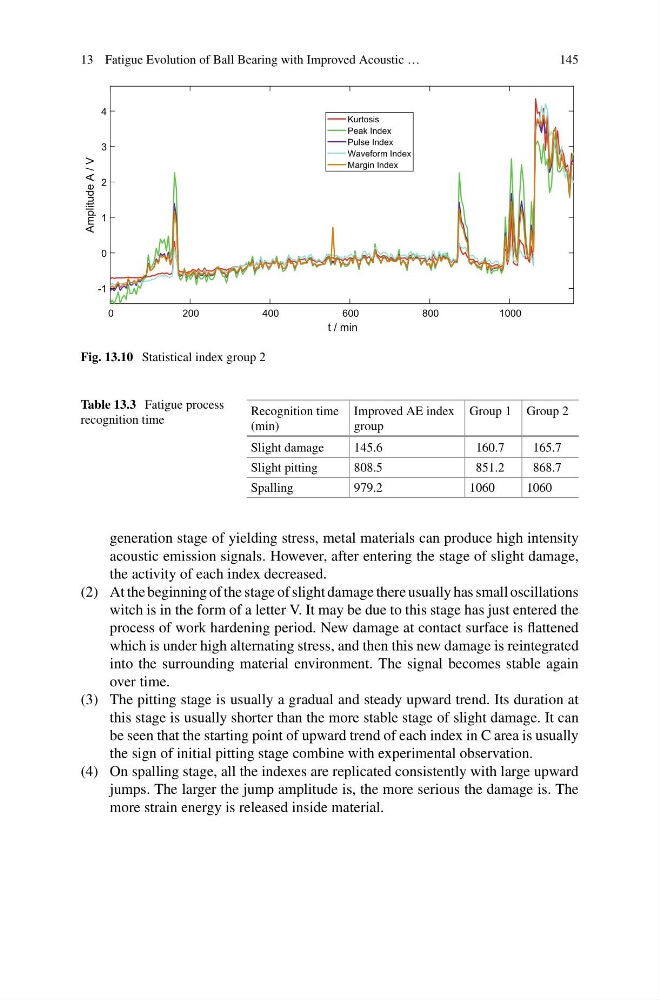
Fig. 13.10 Statistical index group 2
Table 13.3 Fatigue process
recognition time
Recognition time
(min)
Improved AE index
group
Group 1 Group 2
Slight damage
145.6
160.7
165.7
Slight pitting
808.5
851.2
868.7
Spalling
979.2
1060
1060
generation stage of yielding stress, metal materials can produce high intensity
acoustic emission signals. However, after entering the stage of slight damage,
the activity of each index decreased.
(2) At the beginning of the stage of slight damage there usually has small oscillations
witch is in the form of a letter V. It may be due to this stage has just entered the
process of work hardening period. New damage at contact surface is flattened
which is under high alternating stress, and then this new damage is reintegrated
into the surrounding material environment. The signal becomes stable again
over time.
(3) The pitting stage is usually a gradual and steady upward trend. Its duration at
this stage is usually shorter than the more stable stage of slight damage. It can
be seen that the starting point of upward trend of each index in C area is usually
the sign of initial pitting stage combine with experimental observation.
(4) On spalling stage, all the indexes are replicated consistently with large upward
jumps. The larger the jump amplitude is, the more serious the damage is. The
more strain energy is released inside material.
145
0
200
400
600
800
1000
t / min
-1
0
1
2
3
4
Amplitude A / V
Kurtosis
Peak Index
Pulse Index
Waveform Index
Margin Index
Fig. 13.10 Statistical index group 2
Table 13.3 Fatigue process
recognition time
Recognition time
(min)
Improved AE index
group
Group 1 Group 2
Slight damage
145.6
160.7
165.7
Slight pitting
808.5
851.2
868.7
Spalling
979.2
1060
1060
generation stage of yielding stress, metal materials can produce high intensity
acoustic emission signals. However, after entering the stage of slight damage,
the activity of each index decreased.
(2) At the beginning of the stage of slight damage there usually has small oscillations
witch is in the form of a letter V. It may be due to this stage has just entered the
process of work hardening period. New damage at contact surface is flattened
which is under high alternating stress, and then this new damage is reintegrated
into the surrounding material environment. The signal becomes stable again
over time.
(3) The pitting stage is usually a gradual and steady upward trend. Its duration at
this stage is usually shorter than the more stable stage of slight damage. It can
be seen that the starting point of upward trend of each index in C area is usually
the sign of initial pitting stage combine with experimental observation.
(4) On spalling stage, all the indexes are replicated consistently with large upward
jumps. The larger the jump amplitude is, the more serious the damage is. The
more strain energy is released inside material.