

13 Fatigue Evolution of Ball Bearing with Improved Acoustic …
137
crystal lattice
elastic distortion
Dislocation
Dislocation
Accumulation
Slip
Deformation
Slip
Band
Micro Plastic
Deformation
Crack
Nucleation
Crack
Initiation
Crack
Propagation
Crack
Convergence
Pitting
Spalling
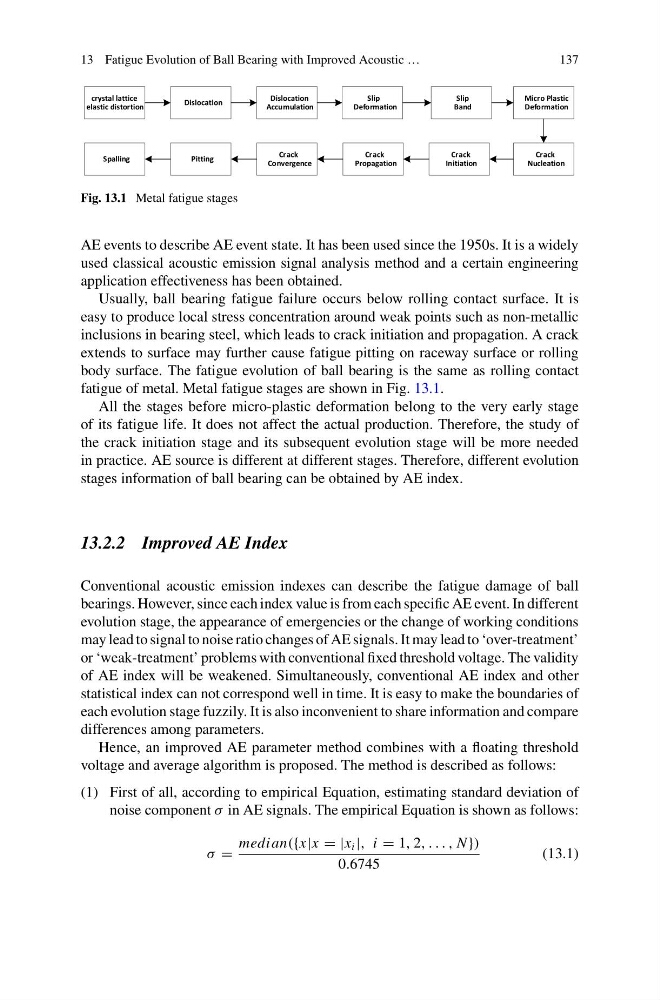
Fig. 13.1 Metal fatigue stages
AE events to describe AE event state. It has been used since the 1950s. It is a widely
used classical acoustic emission signal analysis method and a certain engineering
application effectiveness has been obtained.
Usually, ball bearing fatigue failure occurs below rolling contact surface. It is
easy to produce local stress concentration around weak points such as non-metallic
inclusions in bearing steel, which leads to crack initiation and propagation. A crack
extends to surface may further cause fatigue pitting on raceway surface or rolling
body surface. The fatigue evolution of ball bearing is the same as rolling contact
fatigue of metal. Metal fatigue stages are shown in Fig. 13.1.
All the stages before micro-plastic deformation belong to the very early stage
of its fatigue life. It does not affect the actual production. Therefore, the study of
the crack initiation stage and its subsequent evolution stage will be more needed
in practice. AE source is different at different stages. Therefore, different evolution
stages information of ball bearing can be obtained by AE index.
13.2.2 Improved AE Index
Conventional acoustic emission indexes can describe the fatigue damage of ball
bearings. However, since each index value is from each specific AE event. In different
evolution stage, the appearance of emergencies or the change of working conditions
may lead to signal to noise ratio changes of AE signals. It may lead to ‘over-treatment’
or ‘weak-treatment’ problems with conventional fixed threshold voltage. The validity
of AE index will be weakened. Simultaneously, conventional AE index and other
statistical index can not correspond well in time. It is easy to make the boundaries of
each evolution stage fuzzily. It is also inconvenient to share information and compare
differences among parameters.
Hence, an improved AE parameter method combines with a floating threshold
voltage and average algorithm is proposed. The method is described as follows:
(1) First of all, according to empirical Equation, estimating standard deviation of
noise component σ in AE signals. The empirical Equation is shown as follows:
σ =
median({x|x = |x i |, i = 1, 2, . . . , N })
0.6745
(13.1)
137
crystal lattice
elastic distortion
Dislocation
Dislocation
Accumulation
Slip
Deformation
Slip
Band
Micro Plastic
Deformation
Crack
Nucleation
Crack
Initiation
Crack
Propagation
Crack
Convergence
Pitting
Spalling
Fig. 13.1 Metal fatigue stages
AE events to describe AE event state. It has been used since the 1950s. It is a widely
used classical acoustic emission signal analysis method and a certain engineering
application effectiveness has been obtained.
Usually, ball bearing fatigue failure occurs below rolling contact surface. It is
easy to produce local stress concentration around weak points such as non-metallic
inclusions in bearing steel, which leads to crack initiation and propagation. A crack
extends to surface may further cause fatigue pitting on raceway surface or rolling
body surface. The fatigue evolution of ball bearing is the same as rolling contact
fatigue of metal. Metal fatigue stages are shown in Fig. 13.1.
All the stages before micro-plastic deformation belong to the very early stage
of its fatigue life. It does not affect the actual production. Therefore, the study of
the crack initiation stage and its subsequent evolution stage will be more needed
in practice. AE source is different at different stages. Therefore, different evolution
stages information of ball bearing can be obtained by AE index.
13.2.2 Improved AE Index
Conventional acoustic emission indexes can describe the fatigue damage of ball
bearings. However, since each index value is from each specific AE event. In different
evolution stage, the appearance of emergencies or the change of working conditions
may lead to signal to noise ratio changes of AE signals. It may lead to ‘over-treatment’
or ‘weak-treatment’ problems with conventional fixed threshold voltage. The validity
of AE index will be weakened. Simultaneously, conventional AE index and other
statistical index can not correspond well in time. It is easy to make the boundaries of
each evolution stage fuzzily. It is also inconvenient to share information and compare
differences among parameters.
Hence, an improved AE parameter method combines with a floating threshold
voltage and average algorithm is proposed. The method is described as follows:
(1) First of all, according to empirical Equation, estimating standard deviation of
noise component σ in AE signals. The empirical Equation is shown as follows:
σ =
median({x|x = |x i |, i = 1, 2, . . . , N })
0.6745
(13.1)