

11 Improving Bearing Diagnostic Performance …
117
11.2 The Proposed Diagnostic Methodology for Bearings
in Induction Motors
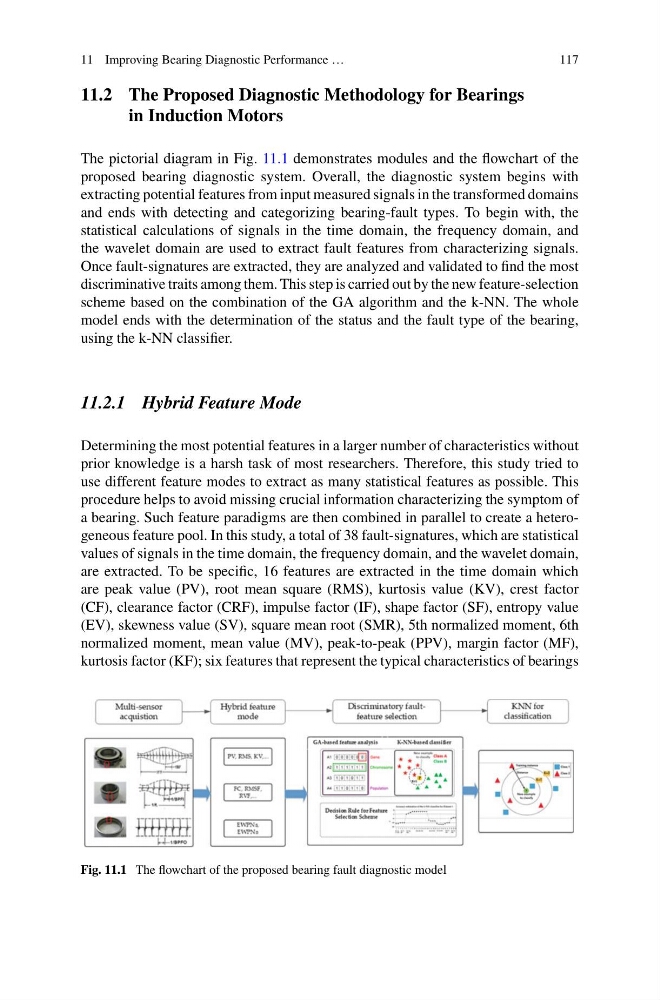
The pictorial diagram in Fig. 11.1 demonstrates modules and the flowchart of the
proposed bearing diagnostic system. Overall, the diagnostic system begins with
extracting potential features from input measured signals in the transformed domains
and ends with detecting and categorizing bearing-fault types. To begin with, the
statistical calculations of signals in the time domain, the frequency domain, and
the wavelet domain are used to extract fault features from characterizing signals.
Once fault-signatures are extracted, they are analyzed and validated to find the most
discriminative traits among them. This step is carried out by the new feature-selection
scheme based on the combination of the GA algorithm and the k-NN. The whole
model ends with the determination of the status and the fault type of the bearing,
using the k-NN classifier.
11.2.1 Hybrid Feature Mode
Determining the most potential features in a larger number of characteristics without
prior knowledge is a harsh task of most researchers. Therefore, this study tried to
use different feature modes to extract as many statistical features as possible. This
procedure helps to avoid missing crucial information characterizing the symptom of
a bearing. Such feature paradigms are then combined in parallel to create a heterogeneous feature pool. In this study, a total of 38 fault-signatures, which are statistical
values of signals in the time domain, the frequency domain, and the wavelet domain,
are extracted. To be specific, 16 features are extracted in the time domain which
are peak value (PV), root mean square (RMS), kurtosis value (KV), crest factor
(CF), clearance factor (CRF), impulse factor (IF), shape factor (SF), entropy value
(EV), skewness value (SV), square mean root (SMR), 5th normalized moment, 6th
normalized moment, mean value (MV), peak-to-peak (PPV), margin factor (MF),
kurtosis factor (KF); six features that represent the typical characteristics of bearings
Fig. 11.1 The flowchart of the proposed bearing fault diagnostic model
117
11.2 The Proposed Diagnostic Methodology for Bearings
in Induction Motors
The pictorial diagram in Fig. 11.1 demonstrates modules and the flowchart of the
proposed bearing diagnostic system. Overall, the diagnostic system begins with
extracting potential features from input measured signals in the transformed domains
and ends with detecting and categorizing bearing-fault types. To begin with, the
statistical calculations of signals in the time domain, the frequency domain, and
the wavelet domain are used to extract fault features from characterizing signals.
Once fault-signatures are extracted, they are analyzed and validated to find the most
discriminative traits among them. This step is carried out by the new feature-selection
scheme based on the combination of the GA algorithm and the k-NN. The whole
model ends with the determination of the status and the fault type of the bearing,
using the k-NN classifier.
11.2.1 Hybrid Feature Mode
Determining the most potential features in a larger number of characteristics without
prior knowledge is a harsh task of most researchers. Therefore, this study tried to
use different feature modes to extract as many statistical features as possible. This
procedure helps to avoid missing crucial information characterizing the symptom of
a bearing. Such feature paradigms are then combined in parallel to create a heterogeneous feature pool. In this study, a total of 38 fault-signatures, which are statistical
values of signals in the time domain, the frequency domain, and the wavelet domain,
are extracted. To be specific, 16 features are extracted in the time domain which
are peak value (PV), root mean square (RMS), kurtosis value (KV), crest factor
(CF), clearance factor (CRF), impulse factor (IF), shape factor (SF), entropy value
(EV), skewness value (SV), square mean root (SMR), 5th normalized moment, 6th
normalized moment, mean value (MV), peak-to-peak (PPV), margin factor (MF),
kurtosis factor (KF); six features that represent the typical characteristics of bearings
Fig. 11.1 The flowchart of the proposed bearing fault diagnostic model