

44
K. Illath et al.
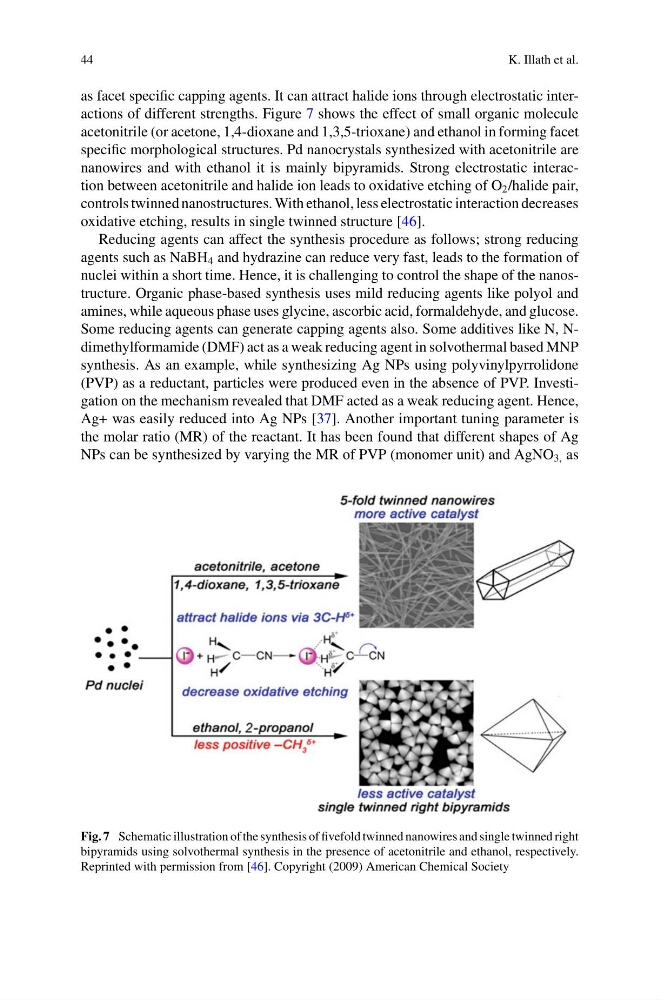
as facet specific capping agents. It can attract halide ions through electrostatic interactions of different strengths. Figure 7 shows the effect of small organic molecule
acetonitrile (or acetone, 1,4-dioxane and 1,3,5-trioxane) and ethanol in forming facet
specific morphological structures. Pd nanocrystals synthesized with acetonitrile are
nanowires and with ethanol it is mainly bipyramids. Strong electrostatic interaction between acetonitrile and halide ion leads to oxidative etching of O 2 /halide pair,
controls twinned nanostructures. With ethanol, less electrostatic interaction decreases
oxidative etching, results in single twinned structure [46].
Reducing agents can affect the synthesis procedure as follows; strong reducing
agents such as NaBH 4 and hydrazine can reduce very fast, leads to the formation of
nuclei within a short time. Hence, it is challenging to control the shape of the nanostructure. Organic phase-based synthesis uses mild reducing agents like polyol and
amines, while aqueous phase uses glycine, ascorbic acid, formaldehyde, and glucose.
Some reducing agents can generate capping agents also. Some additives like N, Ndimethylformamide (DMF) act as a weak reducing agent in solvothermal based MNP
synthesis. As an example, while synthesizing Ag NPs using polyvinylpyrrolidone
(PVP) as a reductant, particles were produced even in the absence of PVP. Investigation on the mechanism revealed that DMF acted as a weak reducing agent. Hence,
Ag+ was easily reduced into Ag NPs [37]. Another important tuning parameter is
the molar ratio (MR) of the reactant. It has been found that different shapes of Ag
NPs can be synthesized by varying the MR of PVP (monomer unit) and AgNO 3, as
Fig. 7 Schematic illustration of the synthesis of fivefold twinned nanowires and single twinned right
bipyramids using solvothermal synthesis in the presence of acetonitrile and ethanol, respectively.
Reprinted with permission from [46]. Copyright (2009) American Chemical Society
K. Illath et al.
as facet specific capping agents. It can attract halide ions through electrostatic interactions of different strengths. Figure 7 shows the effect of small organic molecule
acetonitrile (or acetone, 1,4-dioxane and 1,3,5-trioxane) and ethanol in forming facet
specific morphological structures. Pd nanocrystals synthesized with acetonitrile are
nanowires and with ethanol it is mainly bipyramids. Strong electrostatic interaction between acetonitrile and halide ion leads to oxidative etching of O 2 /halide pair,
controls twinned nanostructures. With ethanol, less electrostatic interaction decreases
oxidative etching, results in single twinned structure [46].
Reducing agents can affect the synthesis procedure as follows; strong reducing
agents such as NaBH 4 and hydrazine can reduce very fast, leads to the formation of
nuclei within a short time. Hence, it is challenging to control the shape of the nanostructure. Organic phase-based synthesis uses mild reducing agents like polyol and
amines, while aqueous phase uses glycine, ascorbic acid, formaldehyde, and glucose.
Some reducing agents can generate capping agents also. Some additives like N, Ndimethylformamide (DMF) act as a weak reducing agent in solvothermal based MNP
synthesis. As an example, while synthesizing Ag NPs using polyvinylpyrrolidone
(PVP) as a reductant, particles were produced even in the absence of PVP. Investigation on the mechanism revealed that DMF acted as a weak reducing agent. Hence,
Ag+ was easily reduced into Ag NPs [37]. Another important tuning parameter is
the molar ratio (MR) of the reactant. It has been found that different shapes of Ag
NPs can be synthesized by varying the MR of PVP (monomer unit) and AgNO 3, as
Fig. 7 Schematic illustration of the synthesis of fivefold twinned nanowires and single twinned right
bipyramids using solvothermal synthesis in the presence of acetonitrile and ethanol, respectively.
Reprinted with permission from [46]. Copyright (2009) American Chemical Society