

Surface Nanostructuring of Metallic Materials …
495
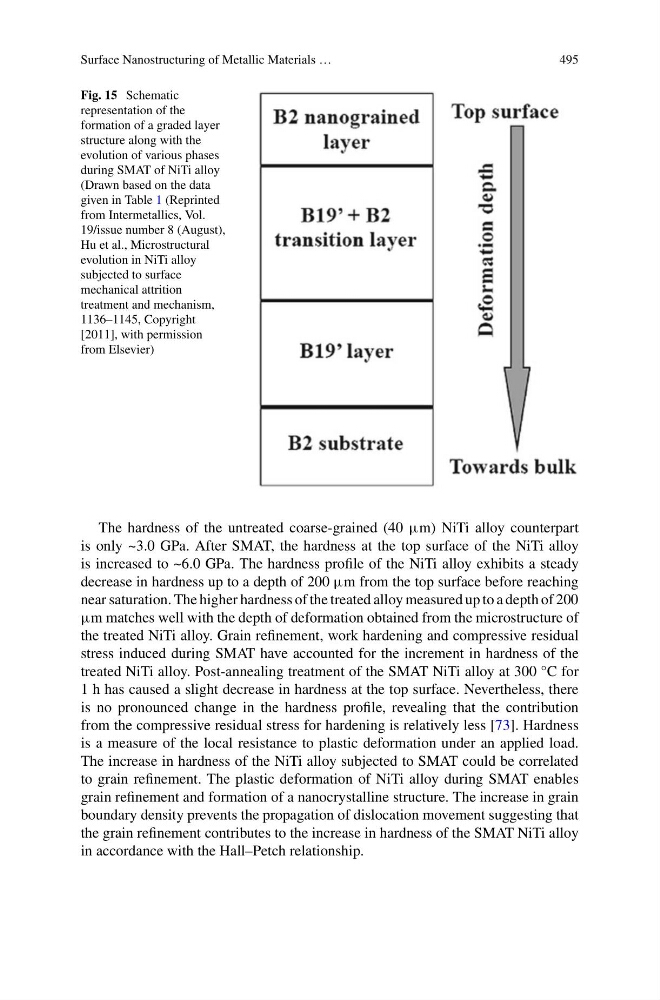
Fig. 15 Schematic
representation of the
formation of a graded layer
structure along with the
evolution of various phases
during SMAT of NiTi alloy
(Drawn based on the data
given in Table 1 (Reprinted
from Intermetallics, Vol.
19/issue number 8 (August),
Hu et al., Microstructural
evolution in NiTi alloy
subjected to surface
mechanical attrition
treatment and mechanism,
1136–1145, Copyright
[2011], with permission
from Elsevier)
The hardness of the untreated coarse-grained (40 μm) NiTi alloy counterpart
is only ~3.0 GPa. After SMAT, the hardness at the top surface of the NiTi alloy
is increased to ~6.0 GPa. The hardness profile of the NiTi alloy exhibits a steady
decrease in hardness up to a depth of 200 μm from the top surface before reaching
near saturation. The higher hardness of the treated alloy measured up to a depth of 200
μm matches well with the depth of deformation obtained from the microstructure of
the treated NiTi alloy. Grain refinement, work hardening and compressive residual
stress induced during SMAT have accounted for the increment in hardness of the
treated NiTi alloy. Post-annealing treatment of the SMAT NiTi alloy at 300 °C for
1 h has caused a slight decrease in hardness at the top surface. Nevertheless, there
is no pronounced change in the hardness profile, revealing that the contribution
from the compressive residual stress for hardening is relatively less [73]. Hardness
is a measure of the local resistance to plastic deformation under an applied load.
The increase in hardness of the NiTi alloy subjected to SMAT could be correlated
to grain refinement. The plastic deformation of NiTi alloy during SMAT enables
grain refinement and formation of a nanocrystalline structure. The increase in grain
boundary density prevents the propagation of dislocation movement suggesting that
the grain refinement contributes to the increase in hardness of the SMAT NiTi alloy
in accordance with the Hall–Petch relationship.
495
Fig. 15 Schematic
representation of the
formation of a graded layer
structure along with the
evolution of various phases
during SMAT of NiTi alloy
(Drawn based on the data
given in Table 1 (Reprinted
from Intermetallics, Vol.
19/issue number 8 (August),
Hu et al., Microstructural
evolution in NiTi alloy
subjected to surface
mechanical attrition
treatment and mechanism,
1136–1145, Copyright
[2011], with permission
from Elsevier)
The hardness of the untreated coarse-grained (40 μm) NiTi alloy counterpart
is only ~3.0 GPa. After SMAT, the hardness at the top surface of the NiTi alloy
is increased to ~6.0 GPa. The hardness profile of the NiTi alloy exhibits a steady
decrease in hardness up to a depth of 200 μm from the top surface before reaching
near saturation. The higher hardness of the treated alloy measured up to a depth of 200
μm matches well with the depth of deformation obtained from the microstructure of
the treated NiTi alloy. Grain refinement, work hardening and compressive residual
stress induced during SMAT have accounted for the increment in hardness of the
treated NiTi alloy. Post-annealing treatment of the SMAT NiTi alloy at 300 °C for
1 h has caused a slight decrease in hardness at the top surface. Nevertheless, there
is no pronounced change in the hardness profile, revealing that the contribution
from the compressive residual stress for hardening is relatively less [73]. Hardness
is a measure of the local resistance to plastic deformation under an applied load.
The increase in hardness of the NiTi alloy subjected to SMAT could be correlated
to grain refinement. The plastic deformation of NiTi alloy during SMAT enables
grain refinement and formation of a nanocrystalline structure. The increase in grain
boundary density prevents the propagation of dislocation movement suggesting that
the grain refinement contributes to the increase in hardness of the SMAT NiTi alloy
in accordance with the Hall–Petch relationship.