

492
T. Balusamy et al.
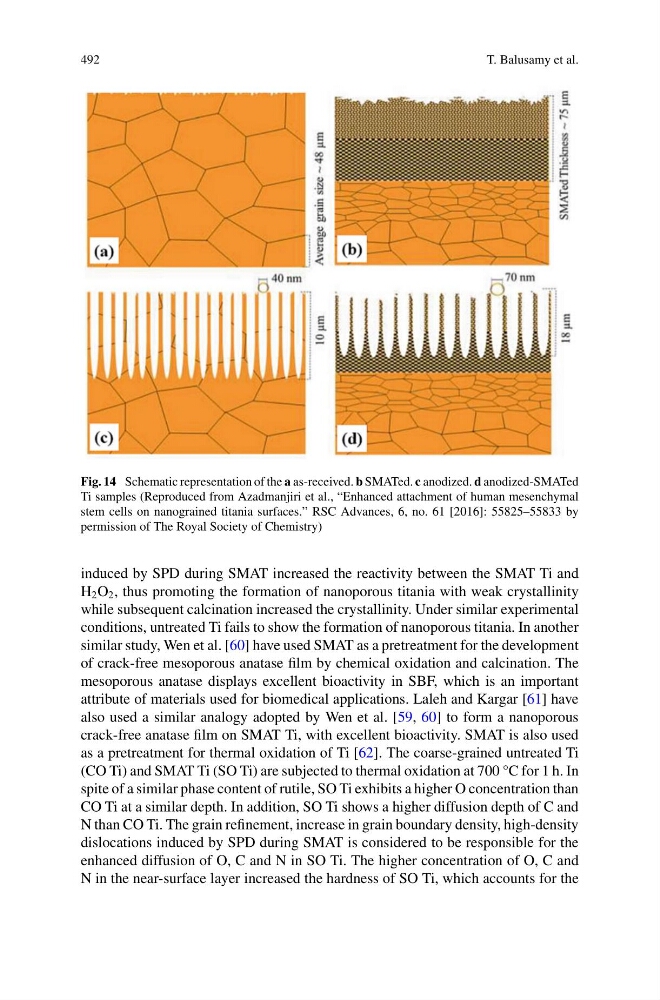
Fig. 14 Schematic representation of the a as-received. b SMATed. c anodized. d anodized-SMATed
Ti samples (Reproduced from Azadmanjiri et al., “Enhanced attachment of human mesenchymal
stem cells on nanograined titania surfaces.” RSC Advances, 6, no. 61 [2016]: 55825–55833 by
permission of The Royal Society of Chemistry)
induced by SPD during SMAT increased the reactivity between the SMAT Ti and
H 2 O 2 , thus promoting the formation of nanoporous titania with weak crystallinity
while subsequent calcination increased the crystallinity. Under similar experimental
conditions, untreated Ti fails to show the formation of nanoporous titania. In another
similar study, Wen et al. [60] have used SMAT as a pretreatment for the development
of crack-free mesoporous anatase film by chemical oxidation and calcination. The
mesoporous anatase displays excellent bioactivity in SBF, which is an important
attribute of materials used for biomedical applications. Laleh and Kargar [61] have
also used a similar analogy adopted by Wen et al. [59, 60] to form a nanoporous
crack-free anatase film on SMAT Ti, with excellent bioactivity. SMAT is also used
as a pretreatment for thermal oxidation of Ti [62]. The coarse-grained untreated Ti
(CO Ti) and SMAT Ti (SO Ti) are subjected to thermal oxidation at 700 °C for 1 h. In
spite of a similar phase content of rutile, SO Ti exhibits a higher O concentration than
CO Ti at a similar depth. In addition, SO Ti shows a higher diffusion depth of C and
N than CO Ti. The grain refinement, increase in grain boundary density, high-density
dislocations induced by SPD during SMAT is considered to be responsible for the
enhanced diffusion of O, C and N in SO Ti. The higher concentration of O, C and
N in the near-surface layer increased the hardness of SO Ti, which accounts for the
T. Balusamy et al.
Fig. 14 Schematic representation of the a as-received. b SMATed. c anodized. d anodized-SMATed
Ti samples (Reproduced from Azadmanjiri et al., “Enhanced attachment of human mesenchymal
stem cells on nanograined titania surfaces.” RSC Advances, 6, no. 61 [2016]: 55825–55833 by
permission of The Royal Society of Chemistry)
induced by SPD during SMAT increased the reactivity between the SMAT Ti and
H 2 O 2 , thus promoting the formation of nanoporous titania with weak crystallinity
while subsequent calcination increased the crystallinity. Under similar experimental
conditions, untreated Ti fails to show the formation of nanoporous titania. In another
similar study, Wen et al. [60] have used SMAT as a pretreatment for the development
of crack-free mesoporous anatase film by chemical oxidation and calcination. The
mesoporous anatase displays excellent bioactivity in SBF, which is an important
attribute of materials used for biomedical applications. Laleh and Kargar [61] have
also used a similar analogy adopted by Wen et al. [59, 60] to form a nanoporous
crack-free anatase film on SMAT Ti, with excellent bioactivity. SMAT is also used
as a pretreatment for thermal oxidation of Ti [62]. The coarse-grained untreated Ti
(CO Ti) and SMAT Ti (SO Ti) are subjected to thermal oxidation at 700 °C for 1 h. In
spite of a similar phase content of rutile, SO Ti exhibits a higher O concentration than
CO Ti at a similar depth. In addition, SO Ti shows a higher diffusion depth of C and
N than CO Ti. The grain refinement, increase in grain boundary density, high-density
dislocations induced by SPD during SMAT is considered to be responsible for the
enhanced diffusion of O, C and N in SO Ti. The higher concentration of O, C and
N in the near-surface layer increased the hardness of SO Ti, which accounts for the