

490
T. Balusamy et al.
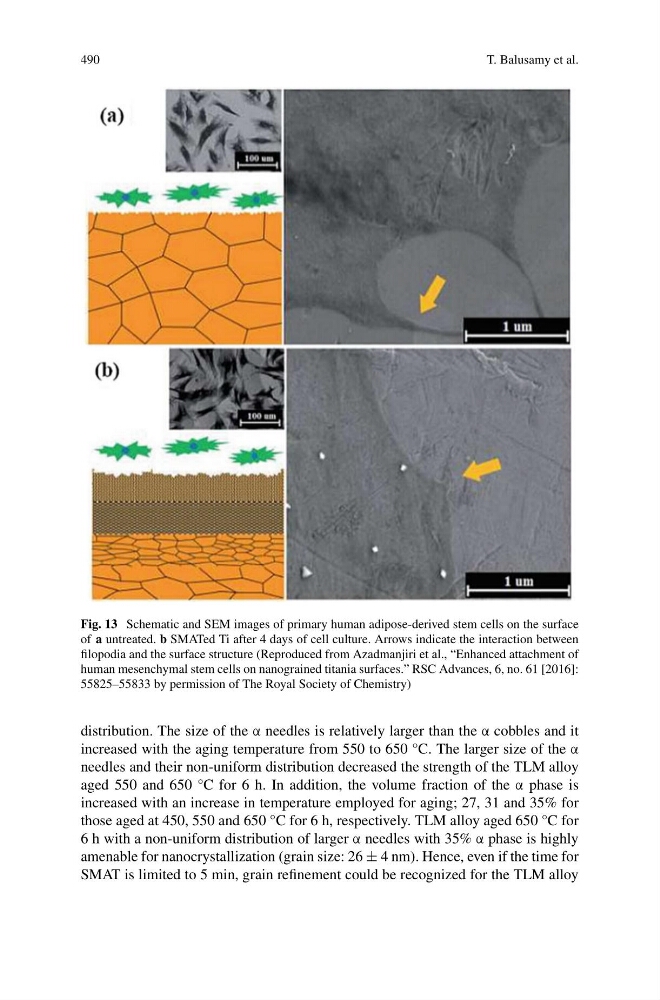
Fig. 13 Schematic and SEM images of primary human adipose-derived stem cells on the surface
of a untreated. b SMATed Ti after 4 days of cell culture. Arrows indicate the interaction between
filopodia and the surface structure (Reproduced from Azadmanjiri et al., “Enhanced attachment of
human mesenchymal stem cells on nanograined titania surfaces.” RSC Advances, 6, no. 61 [2016]:
55825–55833 by permission of The Royal Society of Chemistry)
distribution. The size of the α needles is relatively larger than the α cobbles and it
increased with the aging temperature from 550 to 650 °C. The larger size of the α
needles and their non-uniform distribution decreased the strength of the TLM alloy
aged 550 and 650 °C for 6 h. In addition, the volume fraction of the α phase is
increased with an increase in temperature employed for aging; 27, 31 and 35% for
those aged at 450, 550 and 650 °C for 6 h, respectively. TLM alloy aged 650 °C for
6 h with a non-uniform distribution of larger α needles with 35% α phase is highly
amenable for nanocrystallization (grain size: 26 ± 4 nm). Hence, even if the time for
SMAT is limited to 5 min, grain refinement could be recognized for the TLM alloy
T. Balusamy et al.
Fig. 13 Schematic and SEM images of primary human adipose-derived stem cells on the surface
of a untreated. b SMATed Ti after 4 days of cell culture. Arrows indicate the interaction between
filopodia and the surface structure (Reproduced from Azadmanjiri et al., “Enhanced attachment of
human mesenchymal stem cells on nanograined titania surfaces.” RSC Advances, 6, no. 61 [2016]:
55825–55833 by permission of The Royal Society of Chemistry)
distribution. The size of the α needles is relatively larger than the α cobbles and it
increased with the aging temperature from 550 to 650 °C. The larger size of the α
needles and their non-uniform distribution decreased the strength of the TLM alloy
aged 550 and 650 °C for 6 h. In addition, the volume fraction of the α phase is
increased with an increase in temperature employed for aging; 27, 31 and 35% for
those aged at 450, 550 and 650 °C for 6 h, respectively. TLM alloy aged 650 °C for
6 h with a non-uniform distribution of larger α needles with 35% α phase is highly
amenable for nanocrystallization (grain size: 26 ± 4 nm). Hence, even if the time for
SMAT is limited to 5 min, grain refinement could be recognized for the TLM alloy