

Surface Nanostructuring of Metallic Materials …
487
The in vitro bioactivity of untreated and SMAT Ti6Al4V alloy is studied by
immersing them in SBF with its ionic concentration equal to human blood plasma
(pH: 7.40) at 37 °C for 7, 14 and 21 days [20]. After 14 and 21 days of immersion,
both untreated and SMAT Ti6Al4V alloy exhibit the formation of many particles
with similar morphological features distributed over their entire surface. Based on
the Ca and P contents estimated by EDS analysis and the observed steady increase in
the molar ratio of Ca/P from 7 to 21 days of immersion, the newly formed particles
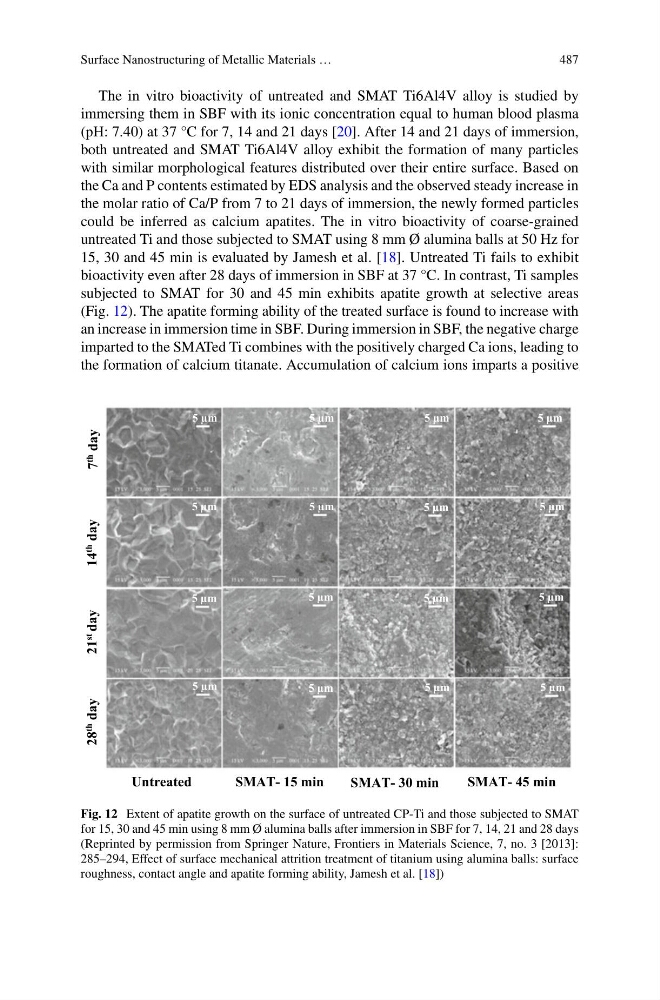
could be inferred as calcium apatites. The in vitro bioactivity of coarse-grained
untreated Ti and those subjected to SMAT using 8 mm Ø alumina balls at 50 Hz for
15, 30 and 45 min is evaluated by Jamesh et al. [18]. Untreated Ti fails to exhibit
bioactivity even after 28 days of immersion in SBF at 37 °C. In contrast, Ti samples
subjected to SMAT for 30 and 45 min exhibits apatite growth at selective areas
(Fig. 12). The apatite forming ability of the treated surface is found to increase with
an increase in immersion time in SBF. During immersion in SBF, the negative charge
imparted to the SMATed Ti combines with the positively charged Ca ions, leading to
the formation of calcium titanate. Accumulation of calcium ions imparts a positive
Untreated
SMAT- 15 min
SMAT- 30 min
SMAT- 45 min
28
th
day
21
st
day
14
th
day
7
th
day
5 μm
5 μm
5 μm
5 μm
5 μm
5 μm
5 μm
5 μm
5 μm
5 μm
5 μm
5 μm
5 μm
5 μm
5 μm
5 μm
Fig. 12 Extent of apatite growth on the surface of untreated CP-Ti and those subjected to SMAT
for 15, 30 and 45 min using 8 mm Ø alumina balls after immersion in SBF for 7, 14, 21 and 28 days
(Reprinted by permission from Springer Nature, Frontiers in Materials Science, 7, no. 3 [2013]:
285–294, Effect of surface mechanical attrition treatment of titanium using alumina balls: surface
roughness, contact angle and apatite forming ability, Jamesh et al. [18])
487
The in vitro bioactivity of untreated and SMAT Ti6Al4V alloy is studied by
immersing them in SBF with its ionic concentration equal to human blood plasma
(pH: 7.40) at 37 °C for 7, 14 and 21 days [20]. After 14 and 21 days of immersion,
both untreated and SMAT Ti6Al4V alloy exhibit the formation of many particles
with similar morphological features distributed over their entire surface. Based on
the Ca and P contents estimated by EDS analysis and the observed steady increase in
the molar ratio of Ca/P from 7 to 21 days of immersion, the newly formed particles
could be inferred as calcium apatites. The in vitro bioactivity of coarse-grained
untreated Ti and those subjected to SMAT using 8 mm Ø alumina balls at 50 Hz for
15, 30 and 45 min is evaluated by Jamesh et al. [18]. Untreated Ti fails to exhibit
bioactivity even after 28 days of immersion in SBF at 37 °C. In contrast, Ti samples
subjected to SMAT for 30 and 45 min exhibits apatite growth at selective areas
(Fig. 12). The apatite forming ability of the treated surface is found to increase with
an increase in immersion time in SBF. During immersion in SBF, the negative charge
imparted to the SMATed Ti combines with the positively charged Ca ions, leading to
the formation of calcium titanate. Accumulation of calcium ions imparts a positive
Untreated
SMAT- 15 min
SMAT- 30 min
SMAT- 45 min
28
th
day
21
st
day
14
th
day
7
th
day
5 μm
5 μm
5 μm
5 μm
5 μm
5 μm
5 μm
5 μm
5 μm
5 μm
5 μm
5 μm
5 μm
5 μm
5 μm
5 μm
Fig. 12 Extent of apatite growth on the surface of untreated CP-Ti and those subjected to SMAT
for 15, 30 and 45 min using 8 mm Ø alumina balls after immersion in SBF for 7, 14, 21 and 28 days
(Reprinted by permission from Springer Nature, Frontiers in Materials Science, 7, no. 3 [2013]:
285–294, Effect of surface mechanical attrition treatment of titanium using alumina balls: surface
roughness, contact angle and apatite forming ability, Jamesh et al. [18])