

40
K. Illath et al.
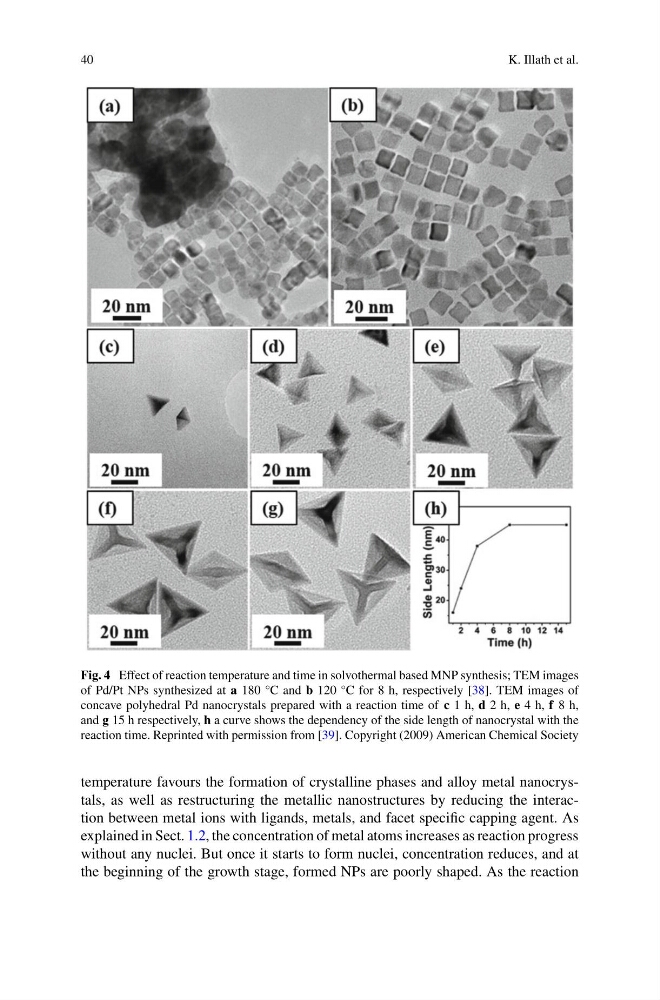
Fig. 4 Effect of reaction temperature and time in solvothermal based MNP synthesis; TEM images
of Pd/Pt NPs synthesized at a 180 °C and b 120 °C for 8 h, respectively [38]. TEM images of
concave polyhedral Pd nanocrystals prepared with a reaction time of c 1 h, d 2 h, e 4 h, f 8 h,
and g 15 h respectively, h a curve shows the dependency of the side length of nanocrystal with the
reaction time. Reprinted with permission from [39]. Copyright (2009) American Chemical Society
temperature favours the formation of crystalline phases and alloy metal nanocrystals, as well as restructuring the metallic nanostructures by reducing the interaction between metal ions with ligands, metals, and facet specific capping agent. As
explained in Sect. 1.2, the concentration of metal atoms increases as reaction progress
without any nuclei. But once it starts to form nuclei, concentration reduces, and at
the beginning of the growth stage, formed NPs are poorly shaped. As the reaction
K. Illath et al.
Fig. 4 Effect of reaction temperature and time in solvothermal based MNP synthesis; TEM images
of Pd/Pt NPs synthesized at a 180 °C and b 120 °C for 8 h, respectively [38]. TEM images of
concave polyhedral Pd nanocrystals prepared with a reaction time of c 1 h, d 2 h, e 4 h, f 8 h,
and g 15 h respectively, h a curve shows the dependency of the side length of nanocrystal with the
reaction time. Reprinted with permission from [39]. Copyright (2009) American Chemical Society
temperature favours the formation of crystalline phases and alloy metal nanocrystals, as well as restructuring the metallic nanostructures by reducing the interaction between metal ions with ligands, metals, and facet specific capping agent. As
explained in Sect. 1.2, the concentration of metal atoms increases as reaction progress
without any nuclei. But once it starts to form nuclei, concentration reduces, and at
the beginning of the growth stage, formed NPs are poorly shaped. As the reaction