

336
N. Ashwin Kumar et al.
part, we discuss the science behind individual nanomaterials with different imaging
systems and its improvements in pre-clinical imaging. Also, the advantages and drawbacks associated with nanomaterials are presented. Finally, we discuss the application
of different nano-based contrast agents and their application in biomedical imaging.
Keywords Contrast agents · Imaging · Nanomaterials · Anatomical imaging ·
Molecular imaging · Biomedical applications · Pre-clinical imaging
1 Introduction
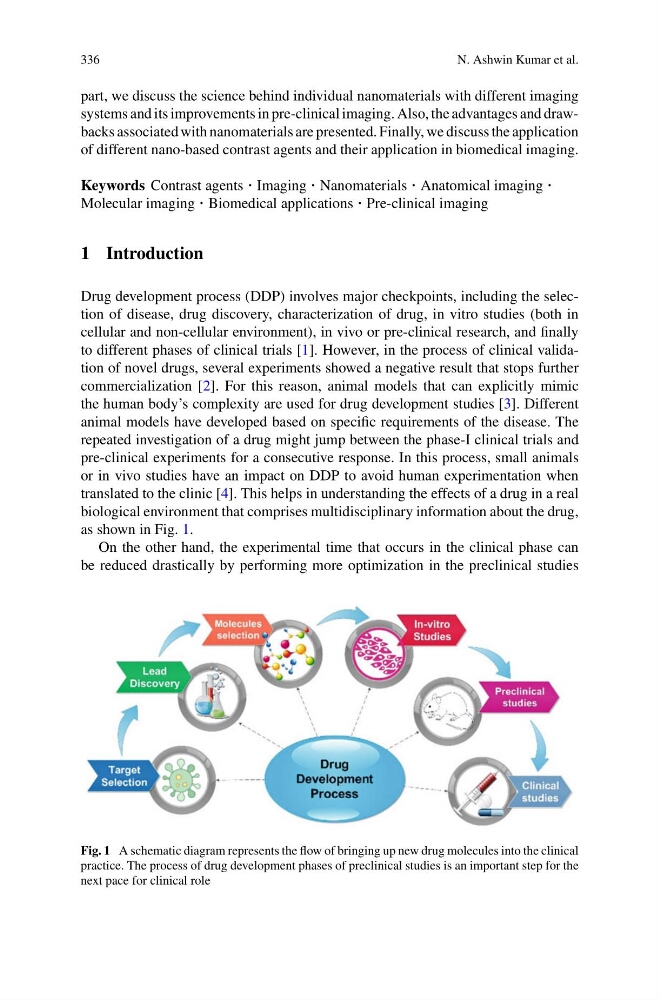
Drug development process (DDP) involves major checkpoints, including the selection of disease, drug discovery, characterization of drug, in vitro studies (both in
cellular and non-cellular environment), in vivo or pre-clinical research, and finally
to different phases of clinical trials [1]. However, in the process of clinical validation of novel drugs, several experiments showed a negative result that stops further
commercialization [2]. For this reason, animal models that can explicitly mimic
the human body’s complexity are used for drug development studies [3]. Different
animal models have developed based on specific requirements of the disease. The
repeated investigation of a drug might jump between the phase-I clinical trials and
pre-clinical experiments for a consecutive response. In this process, small animals
or in vivo studies have an impact on DDP to avoid human experimentation when
translated to the clinic [4]. This helps in understanding the effects of a drug in a real
biological environment that comprises multidisciplinary information about the drug,
as shown in Fig. 1.
On the other hand, the experimental time that occurs in the clinical phase can
be reduced drastically by performing more optimization in the preclinical studies
Fig. 1 A schematic diagram represents the flow of bringing up new drug molecules into the clinical
practice. The process of drug development phases of preclinical studies is an important step for the
next pace for clinical role
N. Ashwin Kumar et al.
part, we discuss the science behind individual nanomaterials with different imaging
systems and its improvements in pre-clinical imaging. Also, the advantages and drawbacks associated with nanomaterials are presented. Finally, we discuss the application
of different nano-based contrast agents and their application in biomedical imaging.
Keywords Contrast agents · Imaging · Nanomaterials · Anatomical imaging ·
Molecular imaging · Biomedical applications · Pre-clinical imaging
1 Introduction
Drug development process (DDP) involves major checkpoints, including the selection of disease, drug discovery, characterization of drug, in vitro studies (both in
cellular and non-cellular environment), in vivo or pre-clinical research, and finally
to different phases of clinical trials [1]. However, in the process of clinical validation of novel drugs, several experiments showed a negative result that stops further
commercialization [2]. For this reason, animal models that can explicitly mimic
the human body’s complexity are used for drug development studies [3]. Different
animal models have developed based on specific requirements of the disease. The
repeated investigation of a drug might jump between the phase-I clinical trials and
pre-clinical experiments for a consecutive response. In this process, small animals
or in vivo studies have an impact on DDP to avoid human experimentation when
translated to the clinic [4]. This helps in understanding the effects of a drug in a real
biological environment that comprises multidisciplinary information about the drug,
as shown in Fig. 1.
On the other hand, the experimental time that occurs in the clinical phase can
be reduced drastically by performing more optimization in the preclinical studies
Fig. 1 A schematic diagram represents the flow of bringing up new drug molecules into the clinical
practice. The process of drug development phases of preclinical studies is an important step for the
next pace for clinical role