

Nanomaterials: Versatile Drug Carriers for Nanomedicine
265
nanoparticles, dendrimers, and liposomes as smart carriers for the release of pharmaceutical drugs in a controlled manner in the aqueous environment upon the structural
degradation of the nano-carriers activated by different chemical factors, such as pH
[32]. Though soft and structurally unstable materials are favorable for drug delivery,
it is strenuous to attain the premature release of drugs with zero percent. In many
scenarios, the drug molecules entrapped in the matrix would start to release from
the biodegradable nano-carrier immediately after the system was injected in vivo.
The premature release problem limits the usage of these DDS for effective disease
treatment along with the significant challenge faced in oral administration for the
site-selective delivery of protein and nucleotide-based drugs. These pharmaceutical
or nutraceutical cargoes of enzymes, DNAs, and RNAs would be decomposed in the
highly acidic environment of the stomach unless the nano-carriers could offer the
essential protection [33].
Recent research has to concentrate on the development of structurally stable DDS
that can help to deliver a large number of drug molecules with minimum premature release difficulty to the targeted tissues, cells, or even intracellular organelles.
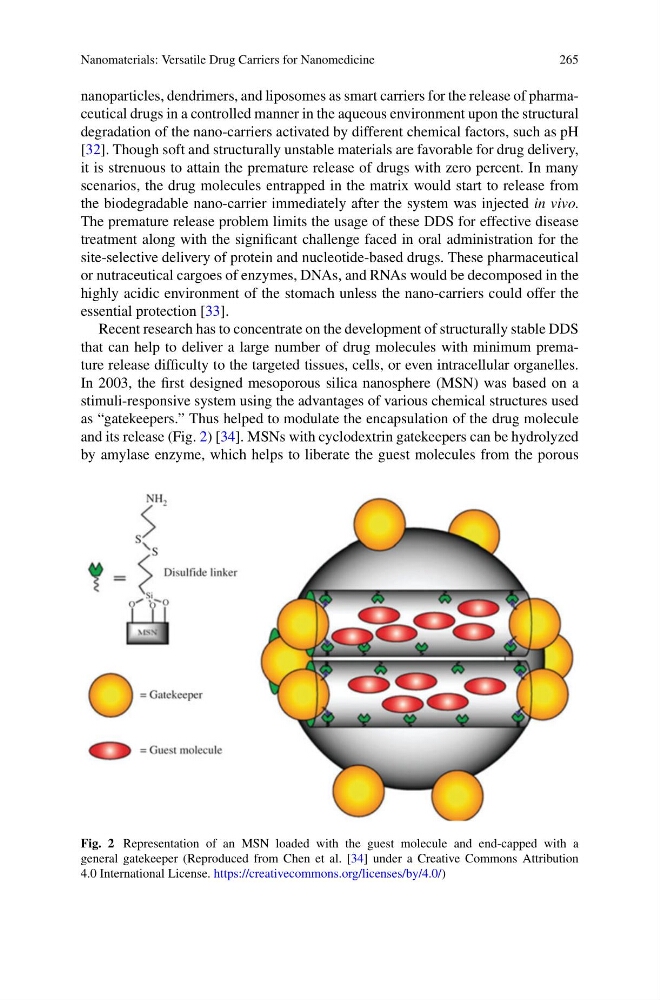
In 2003, the first designed mesoporous silica nanosphere (MSN) was based on a
stimuli-responsive system using the advantages of various chemical structures used
as “gatekeepers.” Thus helped to modulate the encapsulation of the drug molecule
and its release (Fig. 2) [34]. MSNs with cyclodextrin gatekeepers can be hydrolyzed
by amylase enzyme, which helps to liberate the guest molecules from the porous
Fig. 2 Representation of an MSN loaded with the guest molecule and end-capped with a
general gatekeeper (Reproduced from Chen et al. [34] under a Creative Commons Attribution
4.0 International License. https://creativecommons.org/licenses/by/4.0/)
265
nanoparticles, dendrimers, and liposomes as smart carriers for the release of pharmaceutical drugs in a controlled manner in the aqueous environment upon the structural
degradation of the nano-carriers activated by different chemical factors, such as pH
[32]. Though soft and structurally unstable materials are favorable for drug delivery,
it is strenuous to attain the premature release of drugs with zero percent. In many
scenarios, the drug molecules entrapped in the matrix would start to release from
the biodegradable nano-carrier immediately after the system was injected in vivo.
The premature release problem limits the usage of these DDS for effective disease
treatment along with the significant challenge faced in oral administration for the
site-selective delivery of protein and nucleotide-based drugs. These pharmaceutical
or nutraceutical cargoes of enzymes, DNAs, and RNAs would be decomposed in the
highly acidic environment of the stomach unless the nano-carriers could offer the
essential protection [33].
Recent research has to concentrate on the development of structurally stable DDS
that can help to deliver a large number of drug molecules with minimum premature release difficulty to the targeted tissues, cells, or even intracellular organelles.
In 2003, the first designed mesoporous silica nanosphere (MSN) was based on a
stimuli-responsive system using the advantages of various chemical structures used
as “gatekeepers.” Thus helped to modulate the encapsulation of the drug molecule
and its release (Fig. 2) [34]. MSNs with cyclodextrin gatekeepers can be hydrolyzed
by amylase enzyme, which helps to liberate the guest molecules from the porous
Fig. 2 Representation of an MSN loaded with the guest molecule and end-capped with a
general gatekeeper (Reproduced from Chen et al. [34] under a Creative Commons Attribution
4.0 International License. https://creativecommons.org/licenses/by/4.0/)